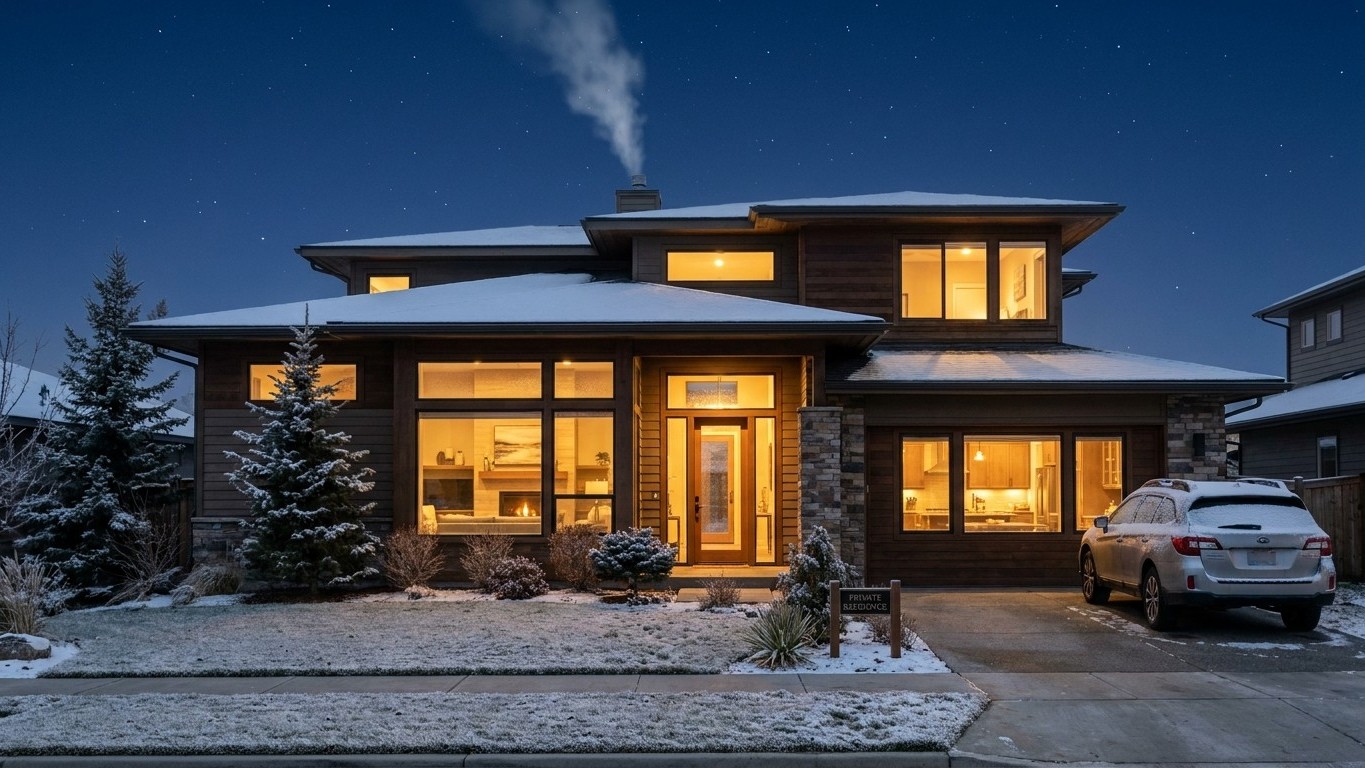

Boise’s coldest-month minimum sits at 25.4°F, a full seven degrees above freezing. That single number shapes everything about heating an Idaho home: how long the furnace runs, how much wood a stove burns through, and how forgiving the season is compared to states where winter means sub-zero weeks. Here’s what it actually adds up to.
How cold it gets, and for how long

That 25.4°F figure is the average daily low for January, the coldest month, measured at Boise over the 1991-2020 period tracked by NOAA. It’s not the record low, and it’s not some abstract yearly average. It’s what a typical night actually feels like at the coldest point in the season, and it tells you the freezer runs, but it doesn’t run flat out.
Compare that to a place where the coldest-month minimum drops into the single digits or below zero, and the difference isn’t just a matter of degree. A furnace or wood stove in a climate like that cycles on almost continuously for weeks. In Boise’s range, the equipment gets real breaks. Nights near freezing still demand steady heat, but the system isn’t fighting the kind of cold that cracks pipes or turns a chimney into a 24-hour job.
What this means for equipment sizing
A house built or heated for Idaho’s winter doesn’t need the oversized furnace or the wood stove rated for arctic conditions. It needs a system sized for a long stretch of near-freezing nights, not a short brutal one. That’s the practical takeaway: the season here is more marathon than sprint. When Does the Heating Season Start in Idaho? Heating runs from roughly October through April in most of the state, which is a wide window, but the intensity within that window rarely spikes the way it does in the northern Rockies or the upper Midwest. The flip side of that long, mild window is knowing when to stop: When Can You Turn the Heat Off in Idaho? Homeowners who oversize equipment for imagined extreme cold end up with a furnace that short-cycles all winter, which wastes fuel and wears out parts faster than a properly matched system would.
Elevation changes this picture fast, though. Boise sits in a valley; head up into the mountains and the number drops considerably. That’s the caveat worth carrying into every decision below.
What a cord of wood is worth here
A cord of well-seasoned hardwood delivers about 20 million BTU, according to Michigan State University Extension. That’s not a small number, but it’s also not something you can eyeball from a stack of logs. A cord is a volume, not a weight, and that distinction is where most firewood buyers get burned, so to speak.
| Measurement | Value |
|---|---|
| Standard dimensions | 4 ft x 4 ft x 8 ft |
| Total volume | 128 cubic feet |
| Heat output (seasoned hardwood) | about 20 million BTU |
Those dimensions matter because a “cord” advertised loosely, thrown in a pickup bed, or stacked haphazardly can shortchange a buyer by a third or more without anyone noticing. The only way to know you’re getting a real cord is to measure the stack: 4 feet tall, 4 feet deep, 8 feet long, tightly racked with minimal gaps.
MSU puts that 20 million BTU in terms a homeowner can actually use: one cord of seasoned hardwood is roughly equivalent to the heat in 145 gallons of #2 fuel oil, or 215 gallons of LP gas. Given Boise’s four-plus month heating season sitting mostly around freezing rather than deep cold, a cord goes further here than it would in a harsher climate, stretching supplemental heat across more weeks before a household needs to restock.
That 20 million BTU figure is an average, and it only holds if the wood is genuinely seasoned. Species density and moisture content swing it substantially, which is exactly why the drying question below isn’t optional.
How long wood takes to dry in Idaho
Firewood needs to reach 20 percent moisture or less before it burns efficiently. Green wood, fresh off the tree, can carry more than 60 percent moisture, according to Michigan State University Extension. That difference is the whole story of why seasoning matters: every bit of water in the wood has to boil off before the fire produces usable heat, and that process eats energy that should be warming the house.
Split and stacked properly, so air moves freely through the pile, green wood typically reaches that 20 percent threshold after one full summer of drying. The key word is stacked. Rounds left whole, or wood piled in a heap without airflow, dry far slower and unevenly, no matter how much time passes. Idaho’s dry summer heat actually works in a homeowner’s favor here; low humidity accelerates evaporation compared to muggier climates, so wood split in spring and stacked in a sunny, breezy spot has a real shot at being ready by the time the first cold nights arrive.
Red oak is the named exception worth remembering. Its cell structure holds moisture longer than most species, so it needs more than a single summer to season properly. Anyone burning red oak on the standard one-summer timeline is likely still burning wood well above the 20 percent target.
Burning wood before it’s ready doesn’t just mean a weaker fire. Unseasoned wood produces more smoke and more creosote buildup in the flue, which raises the risk of chimney fires and means the chimney needs sweeping more often than it would with properly dried fuel. It also means more of the wood’s stored energy goes to boiling off water instead of heating the room, so a stove loaded with green wood works harder for less warmth. None of this is dangerous if caught early. It just means checking a moisture meter or watching for the telltale hiss and sizzle of wet wood on the fire, and adjusting the woodpile plan for next season accordingly.
Where to check before you buy
The figures above describe Boise, the reference station for Idaho’s climate data. But the state spans river valleys, high desert, and mountain passes, and elevation alone can shift the coldest-month minimum by a wide margin. A home in the Panhandle or up in the Sawtooths faces a different winter than one in the Treasure Valley, even though both fall under the same statewide heating guidance.
That’s why local checking matters more than any statewide average. The University of Idaho Extension is the resource for regional specifics: which wood species are actually available and affordable in a given part of the state, and what seasonal burn restrictions apply where you live. Burn bans and air-quality restrictions are set at the local level, often by county or air district, and they change from year to year depending on conditions.
Skipping that check before buying a season’s worth of wood, or before assuming a furnace sized for Boise’s winter fits a mountain property, is the kind of shortcut that costs more than it saves.
What each heat source costs to run in Idaho
At Idaho’s average residential prices, this is what one million Btu of heat delivered into the house costs with each system. It compares fuels on the same unit: it is not a yearly bill, and it leaves out the price of the equipment.
| System | Cost per million Btu delivered |
|---|---|
| Electric resistance (baseboard, 100% efficient) | $37.98 |
| Heat pump at 8.1 HSPF2 (seasonal COP about 2.4) | $16.00 |
| Natural gas furnace at 97% AFUE | $7.64 |
Cheapest to run in Idaho: natural gas furnace, $8.36 less per million Btu than the heat pump.
Prices: U.S. Energy Information Administration (EIA), average residential prices. Efficiencies: ENERGY STAR criteria. A heat pump’s figure is a seasonal average; in the coldest weather its efficiency drops.