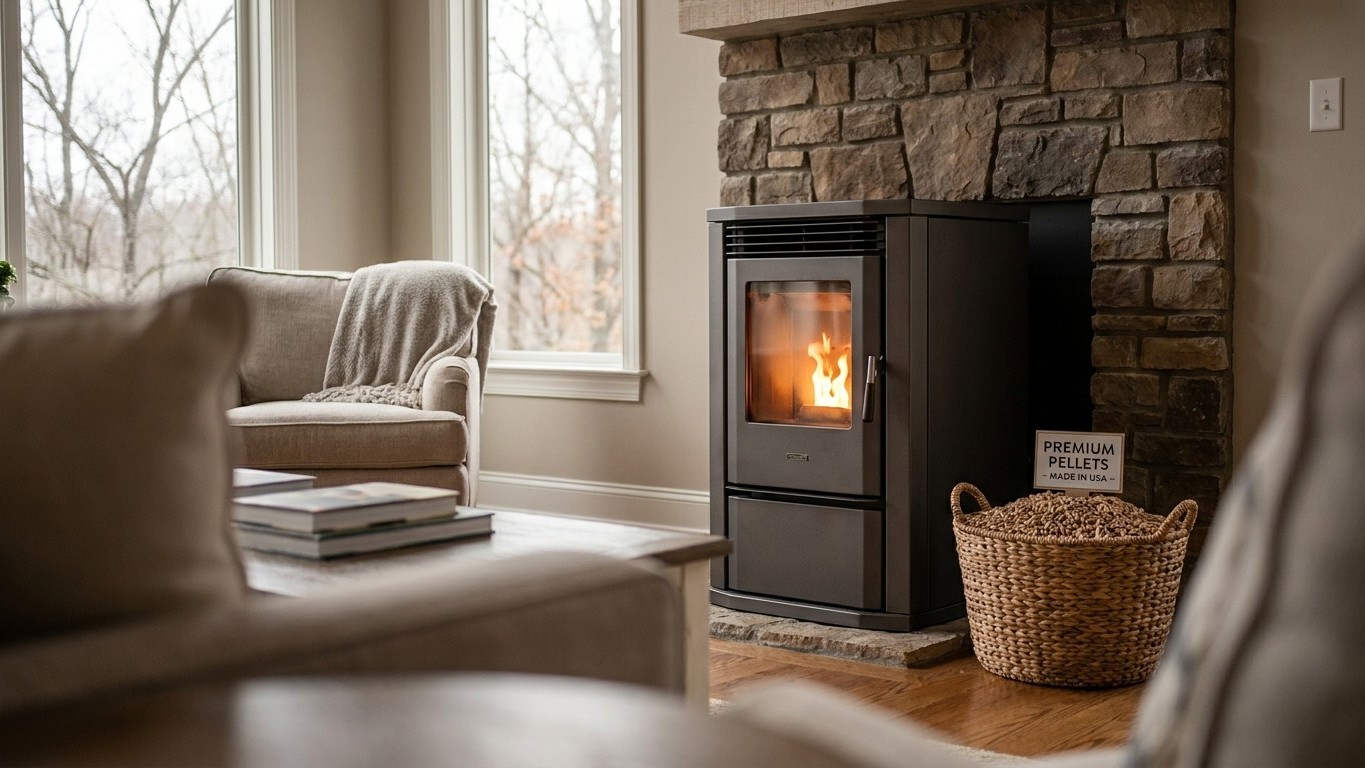

Heating an Idaho home with pellets means budgeting for a long, genuinely cold season rather than a light one, buying two to three tons of fuel before the shelves empty, and having a real backup plan for the nights the power drops with the temperature. The stove itself burns clean and holds a steady heat, but everything around it, how much fuel you’ll need, when to buy, where to keep it dry, depends on the climate at your specific address rather than a state-wide guess.
How hard the winter works here

The number that decides almost everything on this page is about 5,320 heating degree days a year, measured at Boise Air Terminal by NOAA over the 1991-2020 normals period. Heating degree days add up, for every single day of the year, how far the average temperature fell below 65 F. A house that needs twice the degree days needs roughly twice the fuel to stay at the same comfort level, so this figure is the honest starting point for any conversation about tonnage, not the marketing copy on a stove’s box.
5,320 is a serious number. It sits well above a mild southern climate and puts Boise in the range of a real, work-all-winter heating season rather than a supplemental one. That matters because it changes the question a buyer should be asking. In a place with a low degree-day count, a pellet stove is mostly ambiance, something to enjoy on a cool evening. In Boise’s climate, a pellet stove earns its keep as an actual heat source for months at a stretch, whether it’s the main system or a serious supplement to a furnace.
Depth and length are two different numbers
The degree-day total tells you how deep the winter runs. The season length tells you how long that depth is spread out, and in Boise the two point in the same direction: heating demand starts in October, the first month whose normal mean temperature (53.2 F) drops below the 65 F baseline, peaks hard in December at 1,020 degree days for that month alone, and doesn’t fully let go until the mean climbs back above 65 F in June. That’s roughly eight months of the year where a pellet stove could reasonably be running.
A quick gut check on the shape of it: January logs 1,018 degree days and February 770, so the coldest stretch is really December through February, with November and March acting as shoulder months that still call for heat most days. That’s a long runway to keep a hopper fed.
One caution worth repeating: this figure comes from a single weather station, Boise Air Terminal. Idaho is a big, vertically varied state. A household in the Panhandle around Coeur d’Alene, or up in a mountain valley in central Idaho, is very likely colder than this number suggests, sometimes by a wide margin. If you’re not within a reasonable drive of the Boise area, treat 5,320 as a floor, not your personal forecast, and weight your own fuel planning toward the colder side.
How many tons a winter takes here
Nobody, no state agency, no pellet mill, no retailer, publishes a “tons per winter for Idaho” figure, and treat any number that claims to be one with suspicion. What you can do is build the estimate yourself, because the math behind it is simple and it’s the same math a degree-day figure is measuring in the background.
A standard bag of pellets weighs 40 pounds. Fifty of those bags make a ton. How many tons a given house burns over a season comes down to how much heat that house actually needs to replace, which is exactly what the 5,320 heating degree days above is quantifying for the Boise area. More degree days, more heat lost through walls and windows, more pellets burned to replace it. That’s the whole chain, and it’s honest in a way a flat number never can be, because two houses on the same street can land a ton apart depending on what’s inside their walls.
Three things move the number more than anything else:
- How well the house holds heat — insulation, air sealing, and window quality can swing consumption by close to double between a tight newer build and a drafty older one.
- Whether the stove is the only heat source or a supplement — a stove running alongside the furnace 74% of Idaho households already have works fewer hours than one asked to carry the whole load.
- The setting it runs at — a stove left on a high or continuous setting through December and January burns noticeably more than one dialed back and used strategically in the shoulder months.
Given that spread, the most reliable number you’ll ever get isn’t a published estimate, it’s your own first winter. Count the bags you actually burn from October through the last cold snap in spring, and you have a baseline specific to your house, your habits, and your stove’s setting, something no state average can offer. For the general math on translating degree days and hopper size into a season’s fuel need, the national breakdown on how many pellets a winter takes walks through the fuller calculation.
Buying and storing them in this climate
With heating demand starting in October in the Boise area, the buying window that matters is the one that closes before that month, ideally through late summer. Pellets are typically cheapest in the off-season, and a stretch of hard cold anywhere in the region, whether it hits Idaho directly or drives up regional demand from neighboring states, can strip dealer shelves fast in November and December. Buying in July or August isn’t just about price, it’s about making sure the fuel exists when you need it.
What this climate does to stored pellets
Pellets are compressed sawdust held together by natural lignin, with no glue or binder, which means moisture is their enemy in a very literal, physical way. Damp pellets swell, lose their shape, and crumble into sawdust that won’t feed properly through a stove’s auger. Idaho’s high-desert summers run dry, which works in a buyer’s favor compared with a humid climate, but winter is a different story: snowmelt, roof runoff, and a concrete garage floor that sweats when temperatures swing above freezing during a thaw can all introduce the moisture that ruins a season’s supply sitting in bags on the floor.
The practical fix is the same one that applies everywhere pellets are stored, kept off the concrete on pallets or shelving, away from exterior walls that can carry cold and condensation, and under cover if they’re anywhere near a garage door or a window that lets in weather. Idaho’s dry summer air is a genuine advantage for storage; it’s the wet shoulder seasons, the freeze-thaw cycle of a Boise-area winter, that deserve the caution.
On cost, resist comparing bag prices between dealers and instead compare the price per ton, since that’s the only figure that lines up apples to apples once pallet sizes and bag counts start to vary. For the fuller rundown on keeping pellets dry and judging fuel quality by ash content and burn characteristics, see the national guides on pellet storage and pellet quality.
What a winter outage means here
A pellet stove isn’t a wood stove with a hopper bolted on. It depends on electricity to run the auger that feeds pellets into the firebox and the fan that pushes heat into the room. Cut the power, and the stove goes cold within minutes, no matter how full the hopper is. That single fact separates pellet heat from a traditional wood stove more than almost anything else about the appliance.
Cross that dependency with Boise’s 5,320 heating degree days and the eight-month heating season running October through May, and the stakes of an outage become clear. A power cut in July costs nothing. A power cut in a December cold snap, right at the season’s 1,020-degree-day peak, is a heating emergency for a household counting on that stove as its main or primary supplemental heat.
Idaho’s own numbers on what households actually fall back on are useful here. Statewide, 74% of homes report a furnace as their main heating equipment, and 61% heat with natural gas while 26% use electricity and 6% use propane, according to the U.S. Energy Information Administration’s state-level RECS data. Central heat pumps, steam or hot-water boilers, and fuel oil or kerosene heating don’t have published figures for Idaho in that survey, which means the estimates were too small or unreliable to report, not that nobody in the state uses them. Practically, this points to most Idaho households having a furnace as their real backup, though it’s worth checking whether that furnace itself needs electricity to run its blower and ignition, since a gas furnace without power often won’t fire either.
Rather than guessing at a generator size or a battery capacity to cover a stove through an outage, check the wattage printed on your specific appliance’s label, since that draw varies by model and setting, and see the national page on what a power outage means for a pellet stove for how to size a real solution around that number.