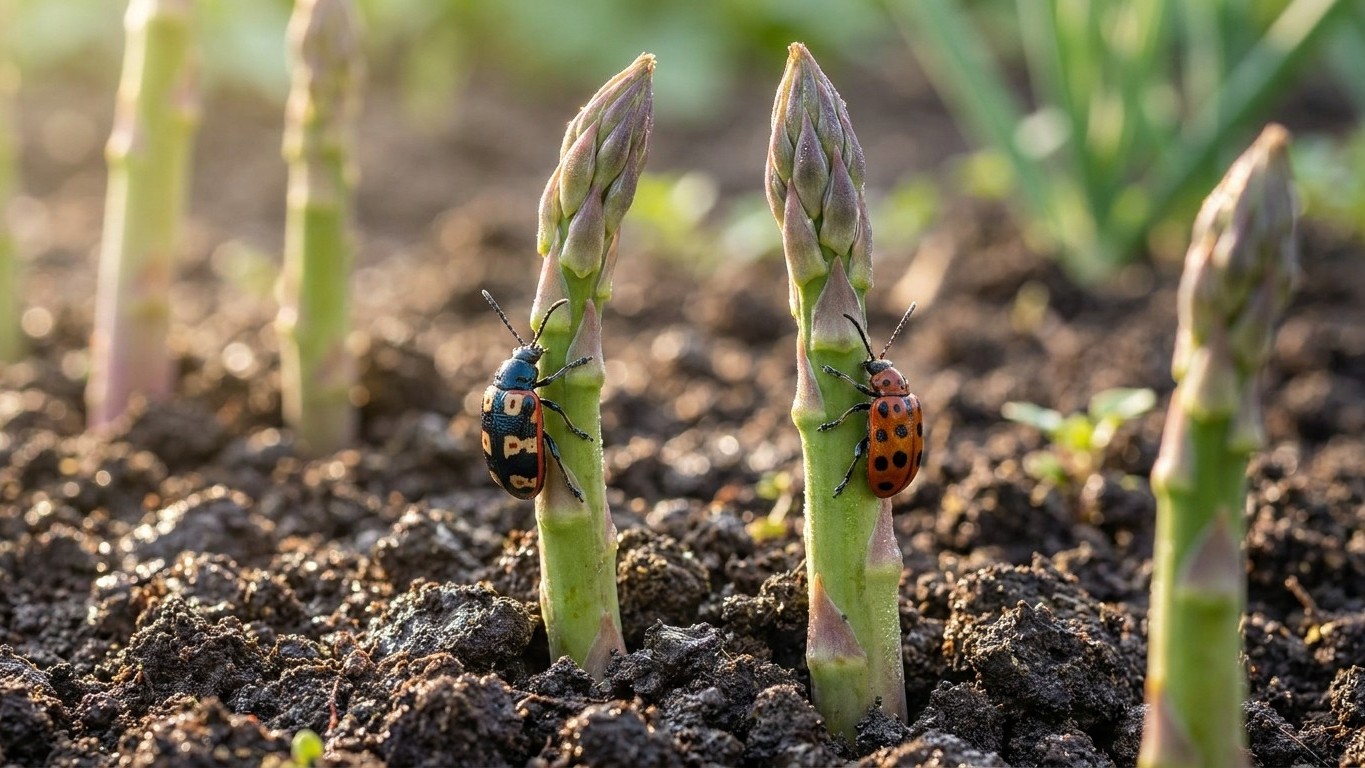

Stop cutting when most of the spears coming up are thinner than a pencil. That is the signal, and no calendar date replaces it. Before you get there, a new bed gets no harvest at all until year 3. After that, the first season runs four weeks, the next six, and later ones eight. Once cut, spears keep best at 32 to 35°F with the butts standing in water. Above 50°F they toughen within hours, and below about 31°F they freeze.
The short answer
Idaho’s state soil is the Threebear series, an Andisol, which is a volcanic-ash soil: light, porous, and unusually good at holding both water and phosphorus. USDA records its mapped surface as loam to silt (35 percent sand, 15 percent clay, 50 percent silt), strongly acid at about 5.0, and moderately well drained. The organic matter figure of about 75 percent describes a natural forest-floor layer on a soil map. No cultivated bed has that. Treat all of it as a description of what Idaho ground tends to do, not as a reading of your yard.
The stakes are unusual here. Most vegetables are a one-season bet, and a heavy soil is a nuisance you amend next year. Asparagus is planted as crowns in 8-inch furrows and produces for 10 to 15 years, so the spot you pick is picked for a decade or more. Utah State University Extension says most soils will do provided they are well drained. That is the only soil requirement it gives.
Does Idaho’s representative soil meet it? Mostly, yes. A silt-heavy loam with only 15 percent clay is not the sticky, water-trapping ground that kills crowns. But “moderately well drained” sits one notch below “well drained,” and your garden may be river bottom, a low spot, or a lot a builder scraped and filled. If water lingers there long after the rest of the yard has dried, build a raised bed of loose soil or choose higher ground. Planting and hoping is the one move you cannot take back. A soil test gives you your own numbers, and Will Idaho Soil Hold an Asparagus Bed for Fifteen Years? walks through the drainage question in more detail.
What the pencil rule protects
The wait and the pencil rule exist for the same reason. A crown builds next year’s spears from what its ferns store after the cutting stops, so every harvest borrows against the plant’s reserves. Waiting until year 3 lets the crown build up first. The short seasons of four, then six, then eight weeks stretch the borrowing out as the crown strengthens.
Within a season, the spears tell you when to quit. Early ones come up thick. Late in the run, most of what emerges is thinner than a pencil, and that is the cue to stop cutting and let the ferns grow. Don’t turn it into a week number, because a cold spring and a hot one will move it. Don’t soften the early rule either: nothing is cut in years 1 and 2, not even a few spears.
Keeping the spears once they are cut
Cut spears have a narrow comfortable range, and both edges bite. UC Davis Postharvest gives the optimum as 32 to 35°F with relative humidity of 95 to 100 percent. Spear toughening occurs rapidly above 50°F. Freezing injury, a water-soaked look followed by extreme softening, is likely at about 31°F or lower. In a home kitchen, the practical way to get near-saturated air is to stand the butts in an inch or two of water, or wrap the cut ends in damp paper. The cut end loses water faster than anything else on the spear.
Will the summer here water it for you?
No. The Boise reference station, using the most recent 30-year normals from NOAA, shows about 1.1 inches of rain across June, July and August combined, out of 11.5 inches for the whole year. June brings 0.75 inches, July 0.21, and August just 0.17, the driest month of the summer. A bed that wants 1 to 2 inches every other week will get almost none of that from the sky.
Here is how the watering plays out, using rough arithmetic and not a published figure.
- Years 1 and 2: The bed wants 1 to 2 inches every other week. Across the 13 or so weeks of summer, that is six or seven waterings, roughly 6 to 13 inches in total. Against about 1.1 inches of rain, you supply nearly all of it.
- Year 3 onward: The schedule relaxes to every three weeks. That is about four waterings a summer, or roughly 4 to 9 inches. Rain still covers only a sliver.
- Adjust for your soil: Threebear-type ash soil holds water well, which suits the long gaps between waterings. A sandy or gravelly yard sheds it faster and may need the interval shortened. A tight clay holds a soaking longer and risks the drainage problem described above.
- Adjust for heat and storms: Hot days drive evaporation, and a single summer thunderstorm mostly runs off instead of soaking in. Count a downpour as less than its gauge reading.
- Put a rain gauge on your own plot: These are normals for one station, not a forecast. A slope, a rain shadow or a city lot changes the picture, and the gauge settles it.
Most of Idaho sits higher and colder than the Boise valley, so these numbers are a baseline for the state’s warmest, lowest corner and not a promise for every county.
When to put the crowns in
Crowns go in during early spring, set into furrows 8 inches deep. In the Boise valley, the last 32°F freeze typically lands around April 23 to May 7, going by the 30 to 70 percent probability band in NOAA’s most recent 30-year normals. A mean date is an average, so some years it comes earlier and some years later. Boise is a low valley, and most of Idaho is higher and colder with far shorter seasons. If you garden on higher ground, expect your window to shift later, and your own frost record beats any normal.
The furrow does not get filled in at once. Over the first year, you backfill about two inches every other month, so the planting trench closes gradually as the plants grow. Once the bed is established, Growing Asparagus in Idaho covers the year-round routine.
Four varieties are named in the Utah State University Extension source, and only by sex. Jersey Giant and Jersey Knight are all-male. UC 157 F1 and Purple Passion are male and female. The source publishes nothing on flavor or yield, and no reason to prefer one over another, so any claim that one tastes better or yields more is not backed by it. I won’t pass one along either.
Growing from seed is the slower alternative. The timing and figures above are for crowns, and the source here does not publish seed-starting dates, so follow the seed packet. A bed from seed begins a step behind one from crowns, because the plants must be raised before they go outdoors. The wait before the first cutting would stretch accordingly, and the first-cut rules still apply once the bed matures.
Common questions
Can I take a few spears in the second year?
No. Nothing is harvested until year 3. The first harvest season lasts four weeks, then six the next, then eight. Every spear you leave in the first two years goes into building the crown that will feed you for 10 to 15 years.
How do I know it is time to stop cutting?
Look at the spears. When most of what is coming up is thinner than a pencil, stop and let the ferns grow. If thin spears show up early, check the bed for stress. What Eats Asparagus in Idaho, and When covers the usual culprits.
How should I store harvested spears?
Aim for 32 to 35°F with near-saturated air, and stand the cut ends in water. Spears toughen quickly above 50°F and freeze and collapse on thawing at about 31°F or lower. The source here gives no keeping time in days, so use the spears while they are still crisp.
Does the state soil tell me whether my bed will drain?
Only as a starting point. Threebear is moderately well drained, but a state spans hundreds of soil series, and river bottoms, hill country and builder-scraped lots can differ completely. A soil test and a look at how water behaves in your own spot give the real answer. Utah State University Extension’s one requirement is that the soil drains.