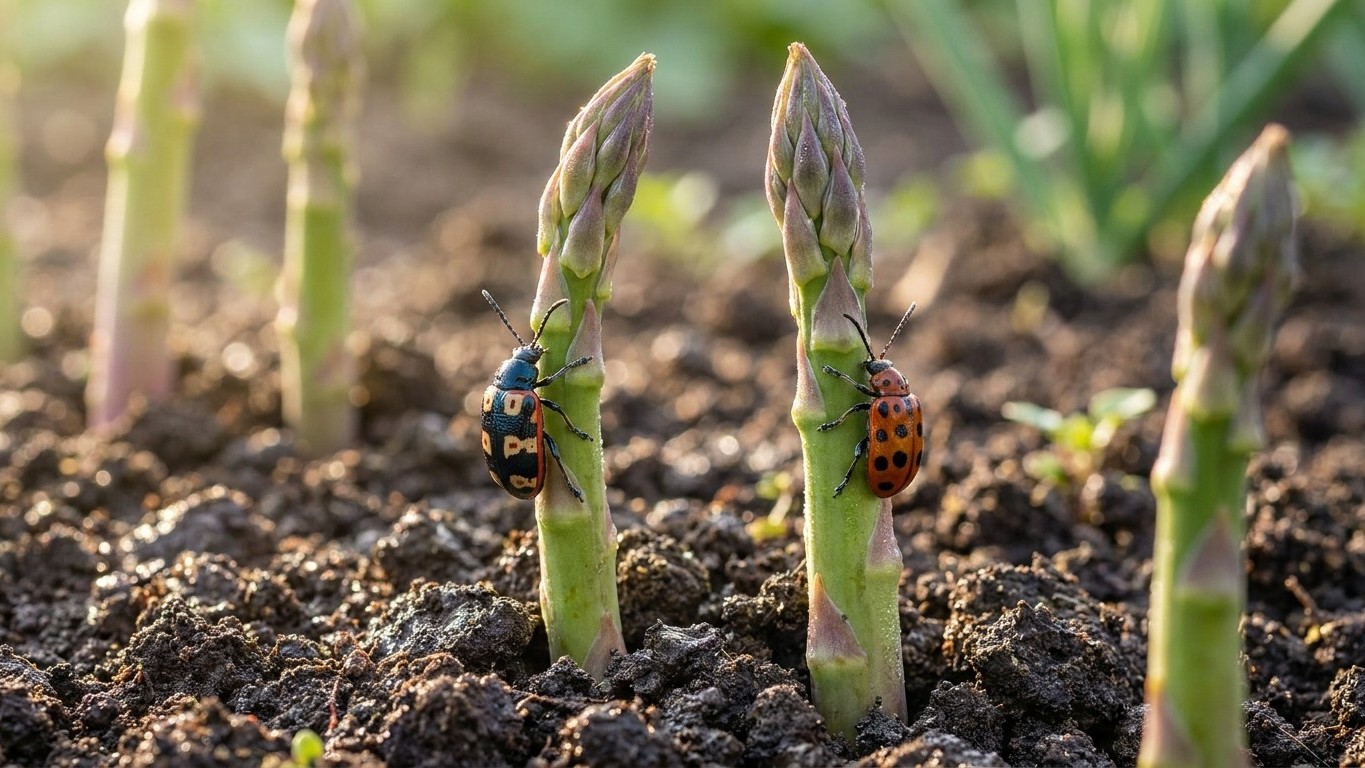

University of Idaho Extension documents eleven insect pests for Idaho vegetable gardens, but only a handful of those actually bother asparagus. The ones that matter are generalist feeders that show up either right at spear emergence, in the weeks tied to the region’s frost-free window, or later in summer once the fern has leafed out. Everything else on the list belongs to a different vegetable family entirely.
Which pests attack asparagus in Idaho
University of Idaho Extension lists eleven pests for Idaho garden crops as a group: Aphids, Carrot rust fly, Colorado potato beetle, Cutworms, Grasshoppers, Imported cabbageworm, Onion maggot, Pea leaf weevil, Squash bug, Tomato hornworm, and Wireworms. That’s the full documented set for this territory, and it isn’t padded here with anything the extension service doesn’t name.
Most of that list has nothing to do with an asparagus bed. Carrot rust fly targets carrots, parsnips and related roots, not a member of the lily family. Colorado potato beetle and tomato hornworm feed almost exclusively on nightshades: potatoes, tomatoes, eggplant. Imported cabbageworm needs cabbage-family leaves. Onion maggot works on onions, garlic and leeks. Pea leaf weevil is built for legumes. Squash bug lives on cucurbits. None of these six have a documented reason to touch an asparagus spear, and a gardener who spots one of them crawling near the bed is very likely watching it pass through on its way to an actual host plant nearby.
That leaves four generalists that do turn up on asparagus in Idaho gardens: Aphids, Cutworms, Grasshoppers, and Wireworms. None of these care what family a plant belongs to. Aphids will colonize the soft fern growth that develops once spring harvest ends. Cutworms feed at the soil line and will sever a young spear as readily as any other tender stem. Grasshoppers chew foliage indiscriminately, asparagus fern included, and they get worse in dry years. Wireworms live underground and tunnel into whatever fleshy root or crown they encounter, which puts an asparagus crown squarely in range since the crown sits in the same ground for 10 to 15 years once it’s planted, giving soil pests far more opportunity than they’d get in an annual bed replanted every spring.
That long lifespan is the reason this shorter list matters more than it might in a garden of annual vegetables. A pest problem that would simply vanish with next year’s rotation instead has over a decade to compound in an asparagus planting, so knowing which four insects are actually documented here, and ignoring the other seven, keeps a gardener from treating for something that was never going to show up in the first place.
When each one shows up, and what it does first
Asparagus crowns go into 8-inch furrows in early spring, and in the Boise area that planting window sits close to the region’s last spring frost, which falls between April 23 and May 7 in a normal year. Cutworms and wireworms are the two to watch for right around that stretch, because both attack low, near or below the soil surface, just as the first spears are pushing up.
Cutworms feed at night and cut tender spears off cleanly at or just below the soil line, so the first sign is rarely a chewed leaf: it’s a spear that toppled over or simply isn’t there anymore, with a clean-cut stub left behind. Wireworms work underground on the crown and on any spear still below the surface, boring narrow tunnels that show up as small dark holes running through the spear once it’s cut for the kitchen. Because both pests act before a spear ever gets tall enough to matter, damage from either one tends to concentrate in that first month or so after crowns are set out, or in the early spears of an established planting each spring.
Aphids and grasshoppers arrive later, once the plant has moved past spear production and into fern growth. Remember that asparagus isn’t harvested at all in its first two years, and even in a producing bed the harvest itself has an endpoint tied to the spears, not the calendar: cutting stops once most spears in the bed come up thinner than a pencil, at which point the plant is left to grow into tall, feathery fern. That fern is what aphids and grasshoppers actually feed on. Aphids cluster on the soft new fern growth and show up as a sticky residue on the foliage along with curling or yellowing at the tips. Grasshoppers chew ragged notches straight into the fern needles and fronds, and their numbers tend to build through the driest stretch of summer, when there’s little rain to knock populations back or keep competing vegetation lush enough to distract them.
Telling the damage apart from everything else
Not everything that looks like insect damage on asparagus actually is. The region’s driest summer month sees only about 0.17 inches of rain, and a fern that’s gone pale or started dropping needles in that stretch is just as likely suffering from drought stress as from any pest. The tell is where the damage sits: uniform yellowing across the whole plant points to water, while patchy chewing concentrated on new growth points to an insect.
Soil chemistry can mimic pest damage too. The soil that represents this state runs strongly acid at the surface, with a pH around 5.0, and fern that yellows evenly with no chewed edges anywhere is behaving more like an acidity or nutrient problem than a feeding one. That said, a garden bed’s actual pH can differ completely from the statewide reference figure, so acidity is a guess worth checking rather than an answer worth acting on.
| What you see | Likely cause | What separates it |
|---|---|---|
| Spear cut off cleanly at soil line | Cutworm | Clean cut, not a ragged tear; happens overnight near spear emergence |
| Dark tunnels inside a harvested spear | Wireworm | Narrow bored holes running lengthwise through the spear |
| Sticky residue and curled tips on fern | Aphids | Clusters of tiny insects visible on new growth, mid to late summer |
| Ragged notches chewed into fern fronds | Grasshoppers | Worsens through the driest weeks of summer |
| Whole plant pale, no chewing anywhere | Drought or soil pH | Uniform across the plant rather than patchy |
When the cause isn’t obvious, a soil test settles more than a guess ever will, and it’s worth sending a sample rather than assuming an insect did what dry weather or acid ground actually did.
What actually works here, and what is a waste of time
Timing beats almost everything else in a short growing season. The only window that matters for a physical barrier against cutworms is before spears break the soil surface, since a collar or cover placed after the spear is already up does nothing for a pest that cuts at ground level. Once the frost-free window opens and crowns or established beds start pushing spears, a barrier set early is worth more than any treatment applied afterward.
Cleaning up old fern debris at the end of the season matters for the same reason timing does: aphids and cutworm larvae both use leftover plant material to overwinter, and a bed cleared of dead fern going into winter gives fewer of either a place to sit out the cold. For wireworms, shallow cultivation around the bed’s edges before planting exposes the larvae to birds and to drying air, which does more good than trying to reach them once they’re already tunneled into a crown ten inches down.
What doesn’t work is spraying fern foliage to control wireworms, since the insect doing the damage is underground and never touches the leaf surface being treated. It’s also a waste of effort to treat for any of the seven pests on the University of Idaho Extension list that aren’t documented as asparagus feeders here: Colorado potato beetle traps set near an asparagus row, for instance, are addressing a pest that has no reason to be there. This site doesn’t recommend specific pesticides or active ingredients; what’s registered and legal to use in Idaho changes, and the county extension office is the source that knows the current answer for a given yard.
Where to check this for your own county
University of Idaho Extension is the right first call, through its county office, because pest presence documented at the state level doesn’t tell a gardener what’s actually in their own bed. A pest list covering the whole state is a starting point, not a diagnosis.
Elevation is the reason that gap matters so much in Idaho specifically. The frost dates used here reflect the Boise area, a low valley, and most of the state sits higher and colder, with a shorter frost-free season than Boise’s. A county an hour outside the valley can see cutworm and wireworm activity shift by weeks compared to what’s typical near Boise, simply because spears emerge later at higher elevation. The same logic applies to soil: the Threebear series represents the state in USDA records, but a river-bottom garden, a hillside plot, or ground a builder has graded and filled can behave nothing like it, whether that’s drainage, acidity, or how long the ground holds summer rain.
The practical next step is a sample, not a guess. A county extension office can look at an actual spear, an actual crown, or an actual soil sample and say what’s really present, rather than what’s merely possible somewhere in the state. That’s a more useful answer than any statewide list can give on its own.
Common questions
Does asparagus rust or fusarium show up alongside these insects in Idaho?
This page covers only the insect pests documented by University of Idaho Extension for the state. Disease pressure isn’t part of that list here, and a county extension office is the right place to ask about it.
Can I plant asparagus in heavy clay if that’s what my yard has?
Utah State University Extension notes that most soils will do provided they’re well drained, and since the crown stays in the same spot for 10 to 15 years, a spot that puddles after rain is a bad long-term bet. Amending or choosing a different spot before planting matters more here than it would for an annual crop.
Should I spray as soon as I see any bug near the asparagus bed?
Not necessarily. Several pests documented in Idaho, like Colorado potato beetle or squash bug, target other vegetables entirely and may just be passing through. Confirming the pest matches one of the four documented asparagus feeders first avoids treating for nothing.
Why does harvest timing matter for pest control?
Harvest stops once most spears in the bed come up thinner than a pencil, and that’s also roughly when fern growth begins, which is when aphids and grasshoppers become the relevant pests instead of cutworms and wireworms. Matching the control method to that stage rather than the calendar keeps effort from being wasted on the wrong pest at the wrong time.