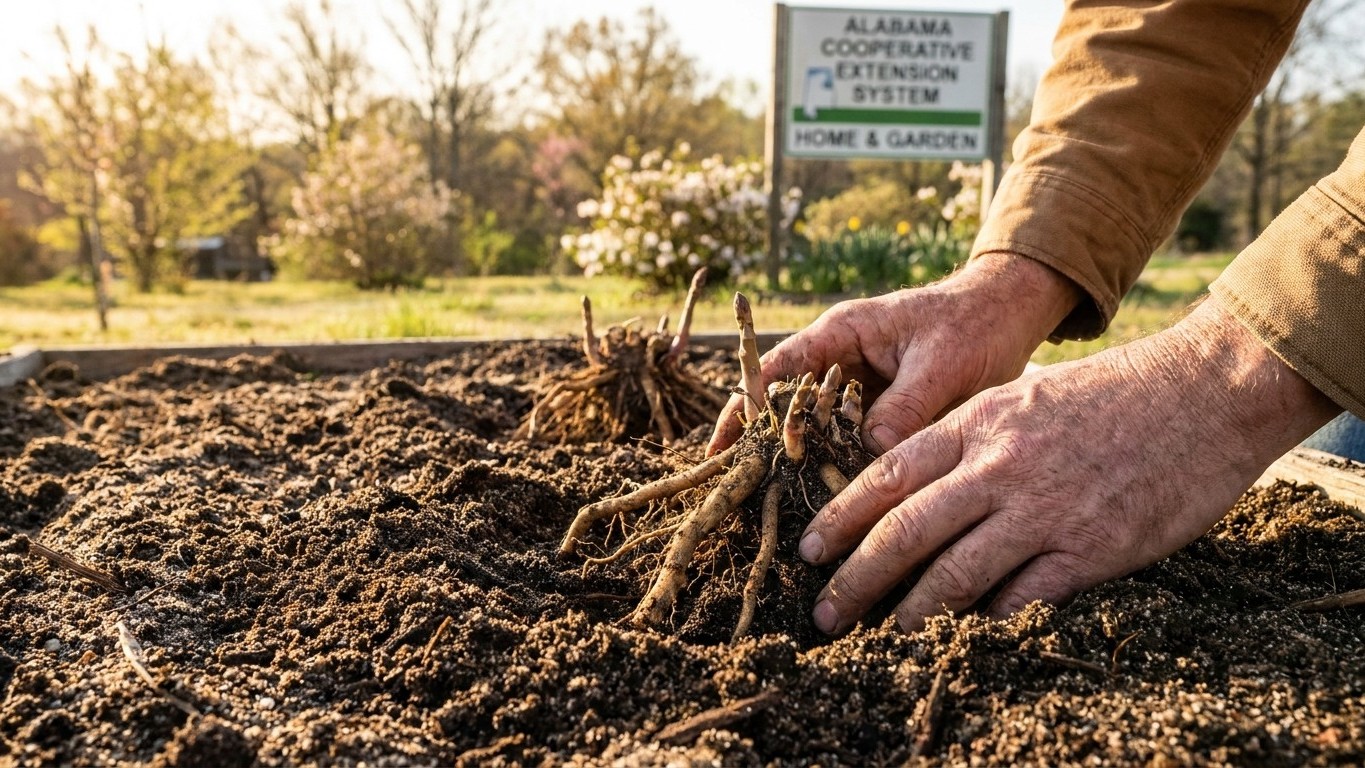

Around early spring, timed to this territory’s last-frost window of April 23 to May 7, is when asparagus crowns go into Idaho ground. That’s the direct answer. What decides whether the planting actually thrives, though, comes down to two things this state controls and one thing you don’t: drainage, water, and how long you’re willing to wait for a spear.
The short answer
an Asparagus Bed isn’t a crop you plant. It’s a fixture. Once those crowns settle in, Utah State University Extension notes the plant produces for 10 to 15 years and won’t give you a single harvestable spear until year three. That timeline changes the entire question of where to put it. You’re not picking a spot for this season. You’re picking a spot for over a decade, which means the one soil requirement that actually matters, drainage, has to be right before the crowns ever touch dirt.
The soil USDA lists as representative of Idaho is the Threebear series, an Andisol built from volcanic ash. It’s light and porous, unusually good at holding onto both water and phosphorus, and runs 35 percent sand, 15 percent clay and 50 percent silt in its surface layer, classed as moderately well drained. On paper, that’s a workable starting point for a bed that needs to shed excess water rather than sit in it. A structure that’s half silt and mostly ash-derived tends to stay loose rather than compact into a brick, which is the failure mode asparagus can’t tolerate.
Two numbers from that same survey deserve a flag rather than a nod. The surface pH runs around 5.0, strongly acid, and the organic matter figure sits near 75 percent. That second number is the tell: organic matter above roughly 20 percent usually means the mapped surface is a natural organic layer, peat, muck, or forest litter, not the kind of worked garden bed a home gardener digs a furrow into. don’t take either figure as your own soil’s number. The Threebear series describes what USDA sampled to represent the state, not what’s under your lawn.
That’s the real caution here. A state soil is a snapshot, not a diagnosis. Idaho spans river bottoms, benchland, hill country and any lot a builder has scraped and refilled, and those can behave nothing like the Threebear profile. If your own ground holds water after a rain, if it’s the kind of clay that stays greasy for days, that’s the signal to act before planting, not after. Raised beds or mounded rows solve it in one move: build the bed up, let gravity do the draining work the native soil won’t. A simple soil test, run through your local extension office, tells you where you actually stand, acid, alkaline, sandy, heavy, far better than any state-level average can.
Will the summer here water it for you?
Not even close. an Asparagus Bed wants 1 to 2 inches of water every other week for its first two years, then tapers to about the same amount every three weeks once established. Idaho’s summer doesn’t come near supplying that on its own.
- Across June, July and August, the reference station near Boise averages about 1.1 inches of rain total for the entire three-month stretch, against 11.5 inches over the full year. Nearly all of Idaho’s moisture arrives outside the growing season.
- Broken down by month, June brings about 0.75 inches, July drops to 0.21 inches, and August, the driest month of the year, delivers just 0.17 inches.
- Compare that to the bed’s own appetite: 1 to 2 inches every two weeks in year one and two means the garden needs roughly that same volume, manually delivered, in July and August alone, since the sky is contributing next to nothing.
- The gap doesn’t close on its own even once the bed matures. An established stand watered every three weeks still needs 1 to 2 inches at each interval, and August’s 0.17 inches won’t cover a fraction of that.
- These are normals from 1991 through 2020 at one reference station, not a promise for any single summer or any specific plot. A slope, a wind pattern, or simple distance from that station changes the real number on your land. A rain gauge staked next to the bed is the only way to know what you’re actually getting versus what you still need to add.
The practical takeaway is that hand-watering or drip irrigation isn’t a backup plan for an Idaho asparagus bed. It’s the plan. July and August, the two months when the bed most needs steady moisture to push root growth before dormancy, are also the two driest months on the calendar. Whatever soil you’ve planted into, sandy Andisol or something heavier, the water has to come from a hose, not a cloud.
When to put the crowns in
Crowns go into the ground in early spring, set into furrows about 8 inches deep. In this part of Idaho, that window sits around the last-frost period of April 23 to May 7. That’s a mean date built from three decades of freeze probabilities at one reference station, an average, not a guarantee, so treat it as a target to plant around rather than a calendar square to circle. Ground that’s still cold and wet in mid-April is a reason to wait a week or two, not a reason to abandon the plan.
It’s also worth remembering that this valley reading runs milder than most of the state. Idaho gains elevation fast outside its river valleys, and higher ground means a shorter, colder season with a later safe planting date than the one this figure reflects. A gardener working benchland or mountain-adjacent ground should expect to push planting later than the April 23 to May 7 window and should lean on local frost history rather than a single lowland station.
Once the furrow is dug and the crowns are spaced along the bottom, the covering doesn’t happen all at once. Soil gets backfilled gradually across the year, about two inches every other month, gradually filling the trench as the young shoots grow up through it rather than burying the crowns under a full 8 inches on day one. That staged backfill protects the emerging shoots while still giving the crown the depth it needs by the time the furrow is level with the surrounding bed.
Seed is the alternative route, though it adds a year to an already long wait, since seed-started plants need that extra season to reach transplant size before they go in the ground as crowns. For most home gardeners, buying crowns directly and skipping the seedling year is the more practical path, especially given that the bed won’t produce a harvestable spear until year three regardless of which starting point you chose.
On variety, Utah State University Extension names four options without ranking them on flavor, yield or hardiness: Jersey Giant and Jersey Knight, both all-male hybrids, and UC 157 F1 and Purple Passion, both male and female. No nursery is named, and no reason to prefer one over another is published here. The choice comes down to what’s available locally, not a documented performance difference.
Common questions
Can I harvest anything the first two years?
No. The bed needs that full two-year establishment period before any spear is cut. Cutting early weakens the crown’s root reserves right when it needs them most to build the system that will feed 10 to 15 years of future harvests.
How do I know when to stop cutting each spring?
Stop when most of the spears coming up are thinner than a pencil. That’s the signal the crown’s energy reserves are running low for the season, not a fixed number of weeks. Once spears thin out, let the remaining growth fern out and rebuild the plant for next year.
Does the source say anything about winter chilling requirements?
No. That figure simply isn’t published in the Utah State University Extension guidance this article draws from, and it shouldn’t be guessed at from Idaho’s hardiness zone. If chilling hours matter for your specific planting decision, that’s a question for your local extension office, not something to infer here.
What if my own soil doesn’t drain well, even though Idaho’s state soil is described as moderately well drained?
Build up rather than dig down. A raised bed or mounded row sidesteps a heavy, slow-draining soil entirely, since the plant’s real requirement is that water not sit around its roots, regardless of what’s underneath. A basic soil test through your local extension office will tell you where your own ground stands before you commit a decade of garden space to it.