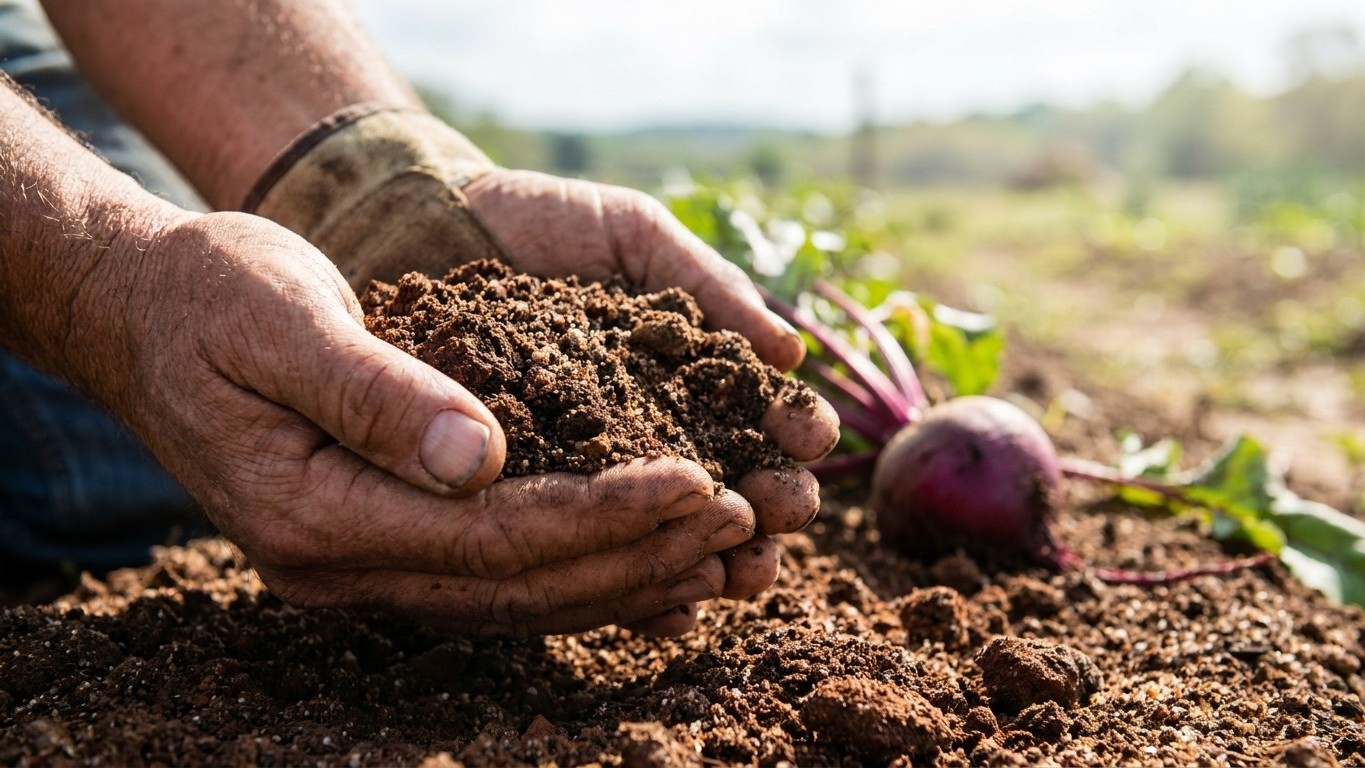

Idaho’s official representative soil, the Threebear series, is a light volcanic-ash Andisol that holds moisture and phosphorus unusually well but runs strongly acid at the surface, around pH 5.0. That acidity is the first thing a beet root meets here, well before texture or drainage become the issue, and it sits far from the near-neutral range beets actually want.
The short answer
The Threebear series is what the USDA NRCS State Soils program lists as representative of Idaho, drawn from Soil Survey Geographic Database records for the surface horizon of its major mapped components. It’s an Andisol, a soil type built from weathered volcanic ash, which gives it a texture that’s light and porous rather than dense or sticky. Measured at the surface, it runs 35 percent sand, 15 percent clay and 50 percent silt, a loam-to-silt mix, with a drainage class of moderately well drained. There’s no state law behind this designation; it’s simply the series the federal soil program treats as characteristic of Idaho ground.
For a beet, that texture is workable. Fifty percent silt and only 15 percent clay means the root shouldn’t hit the kind of dense, compacted layer that forks a taproot or stalls it early. Moderately well drained is a middle grade, not the fast-draining sandy loam Utah State University Extension names as ideal for beets, but not the waterlogged, oxygen-starved ground that rots roots either. The bigger problem is the pH. At 5.0, this soil is strongly acid, and beets grow best closer to neutral. Left unamended, that acidity can lock up nutrients the root needs and stunt growth before the plant ever deals with heat or water.
One number from this soil survey needs a flag before anyone reads it as a gardening target: the recorded organic matter figure sits around 75 percent at the surface. That’s not a number a cultivated garden bed will ever show. An organic-matter reading that high almost always means the mapped surface is a natural organic layer, peat, muck, or built-up forest litter, not mineral topsoil that’s been worked, tilled, or planted. Treat it as a description of undisturbed ground, not as a benchmark for a raised bed or a tilled row.
On heat, the specific count of days the reference city spends above 90 degrees Fahrenheit each year isn’t part of the data set behind this page, so it isn’t something that can be stated here without inventing it. What is documented, from Utah State University Extension, is the mechanism that matters: beets exposed to temperatures above 85 F while also short on water develop woody, fibrous roots. That threshold is the one worth watching, regardless of exactly how many days a given summer clears it.
None of this covers every backyard in the state. Idaho spans hundreds of distinct soil series, and a plot in a river valley, a hillside garden, or a lot with fill dirt from construction can differ completely from the Threebear profile. This is a starting point for understanding what the region’s ground tends to do, not a substitute for a soil test on the actual bed a beet will grow in.
The six weeks that decide it here
Beets are sown directly in place, never transplanted, and the 60 to 80 days to harvest that most varieties need run from that seeding date, not from anything that happens afterward. Utah State University Extension’s timing guidance calls for sowing 2 to 3 weeks before the last spring frost, and in Idaho’s Treasure Valley, that frost date falls between April 23 and May 7, based on NOAA NCEI’s 1991-2020 climate normals for freeze probability at station USW00024131. That puts the first six weeks of a beet’s life, the window Utah State names as the one where water stress does the most damage, somewhere in the stretch from early April through the middle of June.
That’s a low-valley date. Boise sits at a lower elevation than most of the state, and the caution attached to this frost data matters more than the date itself: most of Idaho is higher and colder, with growing seasons considerably shorter than what a Boise-area gardener works with. A garden in the mountains or on the higher plains further north or east should expect the frost-free window to open later and close earlier, which pushes the entire six-week bolting-risk period into a different, often less predictable stretch of the calendar.
Within that early-spring window, the risk isn’t heat, it’s inconsistency. Utah State University Extension is specific that water stress in these first six weeks, not heat, is what triggers premature flowering, or bolting. Spring in this part of the country tends to swing rather than hold steady, with dry stretches interrupted by rain rather than a smooth, gradual warmup. A young beet planted into that pattern can go from adequately moist to dry in the span of a week if nobody’s watching the bed, and that dry stretch is enough to push the plant toward flowering instead of root growth. The soil’s own drainage class plays into this too: moderately well drained ground doesn’t hold surface moisture as generously as a poorly drained clay would, so a gap in watering shows up faster than it might in heavier soil elsewhere.
Nothing in this window has anything to do with the woodiness risk that shows up later, once real summer heat arrives. Those are two separate failures, and treating them as the same problem, just “keep it watered,” misses what’s actually happening at each stage.
What goes wrong here
- Acidic soil stunts early root development. At a surface pH near 5.0, this ground sits well below what beets prefer. Nutrients like phosphorus can become less available to the plant at that acidity even when they’re physically present in the soil, which this Andisol type is otherwise good at holding. A soil test before planting, followed by lime worked into the bed if the test confirms low pH, addresses this directly rather than guessing.
- Early bolting from inconsistent spring moisture. Utah State University Extension is clear that water stress in the first six weeks after seeding causes premature flowering, and Idaho’s swinging spring pattern makes that stretch harder to manage than a steadier climate would. Even watering through that window, rather than letting the bed dry out between rains, is the fix Utah State names.
- Over-amending based on a misread organic-matter figure. The Threebear series shows organic matter around 75 percent at the surface, but that number describes an undisturbed natural layer, not a tilled bed. A gardener who reads that figure as a target and piles on compost accordingly will overshoot what Utah State University Extension actually recommends, which caps composted organic matter at 1 inch per 100 square feet.
- Woody roots from summer heat combined with dry soil. Once temperatures climb past 85 F, any water stress at that stage makes the root fibrous and tough rather than tender, per Utah State University Extension. This is a distinct problem from early bolting and needs steady watering through the hottest stretch of the season, not just at planting.
- Assuming Boise’s frost window applies statewide. The April 23 to May 7 last-frost range comes from a low-valley station. Gardens at higher elevation across most of Idaho face a shorter season and a later safe planting date, and using the Boise window without adjustment risks seeding into ground that still freezes.
Common questions
Does Idaho’s state soil need lime before planting beets?
The Threebear series surface pH runs around 5.0, which is strongly acid and below what beets grow best in. A soil test on the actual garden bed is the way to confirm the pH there, since a state’s representative soil is a starting point, not a measurement of any one yard. If a test confirms similar acidity, lime is the standard correction, though Utah State University Extension’s beet guidance doesn’t specify an application rate for this page’s purposes.
How much compost should I add to a bed like this?
Utah State University Extension caps composted organic matter at 1 inch per 100 square feet for beets. That guidance holds regardless of the Threebear series’ unusually high mapped organic-matter figure, which reflects a natural, undisturbed surface layer rather than a worked bed and shouldn’t be used to justify heavier amending.
When should beets go in the ground in Idaho?
Utah State University Extension recommends sowing 2 to 3 weeks ahead of the last spring frost. For the Boise-area station used in NOAA’s climate normals, that frost date falls between April 23 and May 7. Gardeners elsewhere in the state, particularly at higher elevation, should expect that date to land later given Idaho’s shorter, colder seasons outside the low valleys.
What’s the difference between bolting and a woody root?
They come from different causes at different times. Bolting, or premature flowering, results from water stress during the first six weeks after seeding, according to Utah State University Extension. Woodiness happens later, when temperatures exceed 85 F and the plant is also short on water. Consistent moisture matters at both stages, but the failure and its timing are not the same problem.