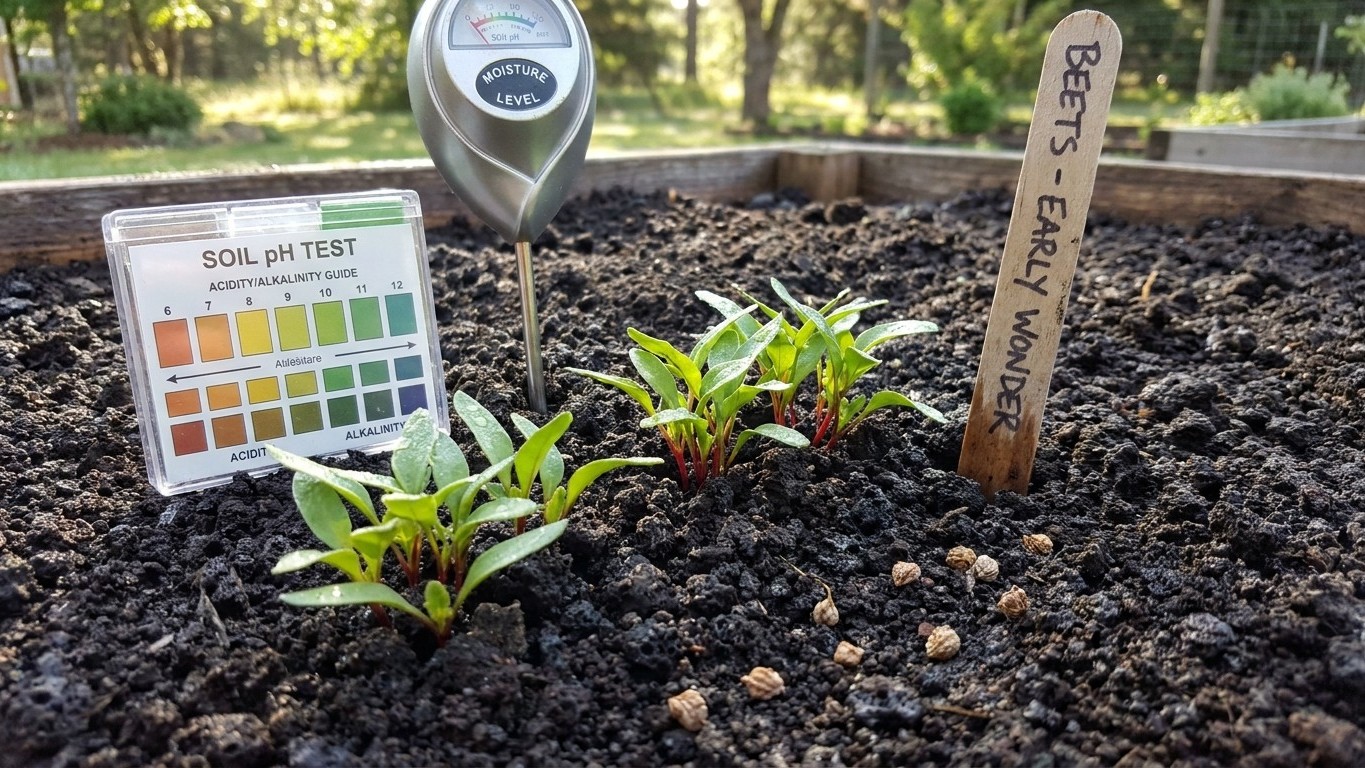

Beets grow reliably in Idaho once two things line up: the ground’s acidity gets checked before a seed goes in, and the first six weeks after sowing stay consistently damp. The state’s representative soil, the volcanic-ash Threebear series, runs strongly acid and drains fast, both traits that work against a beet root. For guidance on When to Sow Beets in Idaho, aim for two to three weeks ahead of the last spring frost, hold moisture through establishment, and watch what summer heat does once it climbs past 85 F.
The short answer
USDA’s soil scientists point to the Threebear series as representative of Idaho ground, and it’s an unusual one. It’s an Andisol, meaning it formed from volcanic ash rather than the more familiar mix of weathered rock and river sediment. That gives it a light, porous structure that holds both water and phosphorus better than most soils manage, which sounds like a gift to a root vegetable until you look at the rest of the profile. Surface pH runs around 5.0, which is strongly acid. Texture comes in loam to silt: 35 percent sand, 15 percent clay, 50 percent silt, classed as moderately well drained.
None of that is a diagnosis for any one backyard. Idaho spans hundreds of mapped soil series, and the ground under a Boise subdivision, a Palouse wheat field, or a scraped-and-filled new build lot can differ completely from the Threebear profile. Treat this as a starting point for what the region’s ground tends to do, not a reading of your own dirt — for a deeper look at Beet Soil in Idaho, the Threebear series is just one piece of the picture.
The organic matter figure attached to this series, about 75 percent, looks startling next to a typical garden bed, and it should. That number describes the surface horizon of the series as mapped in its natural state, closer to a forest-litter or volcanic-ash surface layer than to a worked vegetable row. A cultivated bed that’s been turned, planted and amended for a few seasons will not carry anything close to that organic-matter load. Don’t read it as a number to aim for.
Utah State University Extension, whose beet guidance underlies most of the advice here, is blunt about what the crop actually wants: deep, sandy, well-drained soil rich in organic matter, built up with no more than 1 inch of composted organic matter per 100 square feet. Idaho’s ash-derived ground gets the drainage and the porosity half right on its own. The acidity is the part a gardener has to correct, and only a soil test on the actual bed will say by how much.
Boise’s exact count of days above 90 F each summer isn’t part of the record used for this page, so it won’t get invented here. What matters more directly is the mechanism Utah State describes: heat above 85 F paired with water stress is what turns a beet root woody, and Idaho’s low valleys spend a good stretch of most summers pushing past that mark.
The six weeks that decide it here
NOAA’s 1991-2020 climate normals put the last spring freeze at the Boise station, USW00024131, somewhere between April 23 and May 7. Sowing beets two to three weeks ahead of that date, the standard timing for the crop, lands the seed and the first six critical weeks of growth in early-to-mid spring in the valley. That’s the window Utah State flags directly: water stress during those first six weeks after sowing is what triggers premature flowering, the failure gardeners call bolting.
Idaho’s low valleys, including the Snake River Plain that runs through Boise, sit in a dry, irrigation-dependent belt. Spring rainfall there is modest at best, and evaporative demand climbs fast as the days lengthen and warm. That combination means the six-week window from seed to established seedling rarely gets carried by natural rain alone. Bolting risk in this state isn’t really a weather event waiting to happen. It’s an irrigation gap waiting to happen, on a soil that drains quickly enough to punish a missed watering within days rather than weeks.
The Threebear series’ texture, 50 percent silt against just 15 percent clay, holds some water but nowhere near what a heavier clay loam would retain between waterings. Paired with volcanic-ash porosity, that means the top few inches where a beet’s crown sits can dry out faster than the moderately-well-drained classification might suggest at a glance. A gardener watering on a once-a-week schedule through those first six weeks is gambling with exactly the failure Utah State describes.
None of this changes above roughly 4,700 feet or in the state’s colder benchlands, where the last frost date runs later than Boise’s and the whole six-week window shifts later in the calendar. NOAA’s own note on the Boise normals is explicit that the city sits in a low valley; most of Idaho sits higher and colder, with a shorter season bracketing both ends.
What goes wrong here
- Sowing into unchecked acid soil. Ground resembling the Threebear series sits around pH 5.0, strongly acid, without a gardener ever knowing it. Test the actual bed rather than assuming the state’s representative number applies, and follow the test’s own lime recommendation rather than a general rule.
- Letting the first six weeks go dry. This is the bolting failure specifically, triggered by water stress right after sowing, per Utah State University Extension. A missed watering or two during germination and early growth in Boise’s dry spring is enough to set it off. Water on a schedule tight enough that the fast-draining ash-derived topsoil never fully dries between sessions.
- Letting the bed dry out again once summer heat arrives. This is a separate failure from bolting: once temperatures push past 85 F, water stress at that stage makes the root turn woody rather than causing it to flower early. Mulching and deep, regular watering through the heat of summer address this specifically; it isn’t solved by whatever was done during the first six weeks.
- Over-amending because the state soil’s organic-matter figure looks high. The roughly 75 percent organic matter tied to the Threebear series describes an undisturbed surface layer, not a cultivated bed, and piling on compost to match it works against a beet’s need for a loose but not overly rich rooting zone. Cap organic matter additions at 1 inch per 100 square feet, as Utah State recommends, regardless of what the mapped soil series shows.
- Using Boise’s frost dates at elevation. A gardener in a mountain valley or foothill town sowing on the Boise-area last-frost window is planting into ground still frozen or newly thawed, with a shorter season on both ends. Local frost timing, not the valley date, should set the sowing schedule anywhere above the low valleys.
Checking this against your own county
Everything above describes tendencies tied to a single representative soil series and a single valley climate station. Idaho’s actual ground varies by county, by elevation and often by which side of a single hillside a garden sits on. The University of Idaho Extension is the direct resource for county-level soil test recommendations, local frost date records and variety notes suited to a specific area’s growing season.
A soil test through a county extension office will return an actual pH and nutrient reading for the bed in question, replacing the Threebear series’ pH 5.0 with the reader’s own number. That test result, not the state average, is what should decide how much lime or amendment actually goes into a given bed before beet seed goes in.
Common questions
Can beets handle the acidity typical of Idaho’s ash-derived soils?
Strongly acid ground, the pH 5.0 associated with the state’s representative Threebear series, works against most vegetable crops including beets. Utah State University Extension’s guidance centers on soil rich in organic matter with good drainage, not on a specific pH target, so the right move is a soil test on the actual bed and adjustment based on that result rather than assuming the state figure applies.
How many days does it take beets to reach harvest size from seed in Idaho?
Beets are sown directly in place rather than transplanted, and the maturity clock starts at seeding, not at any later stage. Local variety timing and specific day counts for Idaho conditions aren’t part of the sourced record for this page, so a county extension office is the better source for a locally tested figure.
Why did my beets bolt even though I watered them later in the season?
Bolting is triggered by water stress specifically in the first six weeks after sowing, per Utah State University Extension. Watering generously later in the summer doesn’t reverse a stress event that already happened during germination and early growth; once a beet has bolted, it has bolted.
My beets grew fine but turned woody and tough. What caused that?
That’s a separate failure from bolting, tied to heat above 85 F combined with water stress later in the growing season rather than to early-season stress. Consistent deep watering and mulching through the hottest stretch of Idaho’s summer address this specifically.