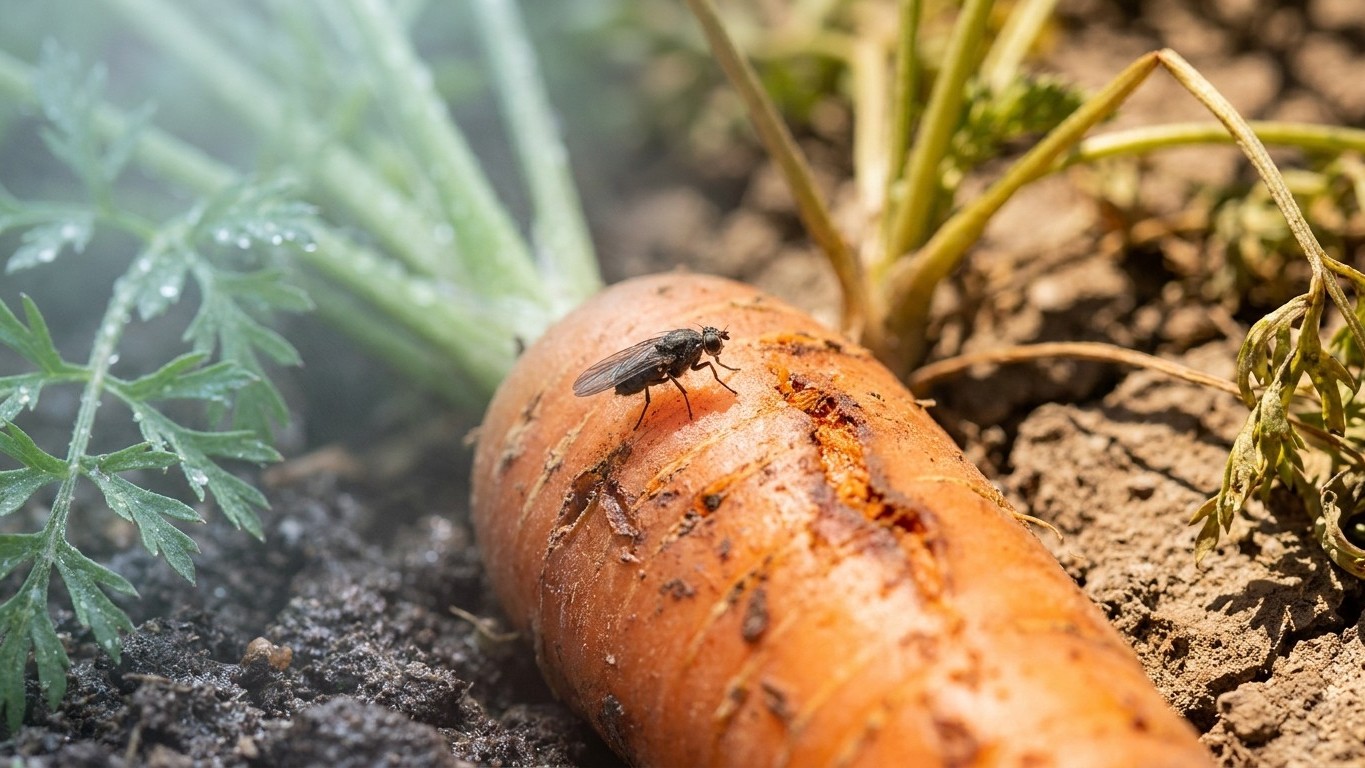

University of Idaho Extension documents eleven insect pests statewide, but only five of them touch a carrot: aphids, carrot rust fly, cutworms, grasshoppers, and wireworms. The rest feed on potatoes, cabbage, onions, peas, squash, or tomatoes instead. Timing depends on when you seed, not the calendar month, because carrots go straight into the ground with no transplant date to anchor around.
Which pests attack carrot in Idaho
University of Idaho Extension lists eleven pests it tracks in home gardens across the state: aphids, carrot rust fly, Colorado potato beetle, cutworms, grasshoppers, imported cabbageworm, onion maggot, pea leaf weevil, squash bug, tomato hornworm, and wireworms. That’s the full documented set for this territory. Nothing beyond it belongs on this page.
Of those eleven, five actually feed on carrot. Aphids cluster on the ferny foliage and stunt growth by sucking sap. Carrot rust fly is the one most gardeners dread, because its larvae tunnel straight through the root. Cutworms attack at the soil line, usually right after seedlings emerge. Grasshoppers chew foliage in a general, opportunistic way, especially in dry years when their populations spike. Wireworms live in the soil and bore into roots much like rust fly larvae do, though they arrive from a different direction and a different life cycle.
The other six on the University of Idaho Extension list have no business on a carrot bed. Colorado potato beetle targets the nightshade family, potatoes and their relatives, not root vegetables like carrot. Imported cabbageworm is a brassica specialist, cabbage, broccoli, kale, and skips carrot entirely. Onion maggot follows the allium family, onions, garlic, leeks, and has no interest in a carrot root. Pea leaf weevil feeds on peas and other legumes. Squash bug sticks to cucurbits, squash, pumpkins, cucumbers. Tomato hornworm is another nightshade feeder, drawn to tomato and pepper foliage, not carrot tops.
That sorting matters because a gardener who spots a fat green hornworm on a nearby tomato plant and assumes it’s chewing the carrots next to it will waste time treating the wrong bed. Five pests, not eleven, is the real number for this crop in Idaho, and that’s a shorter list than most vegetable gardeners expect.
When each one shows up, and what it does first
Carrots are direct-seeded, never transplanted, so every timing reference here runs from the day seed goes into the ground. Carrots typically mature 70 to 100 days from seeding, and that window is the backbone for reading pest activity, because different pests show up at different stages of that stretch rather than on a fixed date.
Right after seeding, before the row even shows green, the soil is where the risk sits. Wireworms are already present if they’re going to be a problem, feeding on seed and on the first thread-thin roots before a gardener sees any foliage at all. Once seedlings emerge, typically within the first couple of weeks, cutworms become the threat to watch for. They work at night and the first sign is usually a seedling clipped clean at the soil line, sometimes several in a row, with the top of the plant lying wilted next to an otherwise undisturbed bed.
As true leaves develop and the row fills in, aphids tend to arrive, clustering on the undersides of the fine, feathery foliage. The first sign is usually curled or yellowing leaf tips rather than visible insects, since aphids are small and easy to miss until a colony has already built up. Grasshoppers can show up at almost any point once foliage is substantial enough to chew, and their damage looks like ragged notches taken out of leaf edges, worse in hot, dry stretches when grasshopper numbers tend to build.
The pest that shows up latest and does the most damage to the part you actually eat is carrot rust fly. Its larvae work underground, tunneling into the root itself, and the first visible clue often isn’t in the foliage at all. It’s a rusty-colored tunnel exposed only when a root is pulled or when foliage above ground starts wilting for no obvious reason, well into the root-bulking stage of that 70-to-100-day window.
Telling the damage apart from everything else
Not every ugly carrot came from an insect. Idaho’s representative garden soil, the Threebear series, is an Andisol built from volcanic ash: light, porous, and unusually good at holding water and phosphorus, but with a surface pH around 5.0, which is strongly acid. That acidity, combined with a texture that runs 35 percent sand, 15 percent clay, and 50 percent silt, can produce symptoms that look like pest damage but aren’t. Heavy or compacted soil is what makes a carrot root fork, not an insect, and Utah State University Extension notes that carrots specifically want deep, sandy, well-drained ground rich in organic matter to grow a straight root at all.
That said, the Threebear series numbers describe a mapped surface horizon, not a dug garden bed. An organic-matter figure as high as the roughly 75 percent recorded for this series signals a natural, undisturbed surface layer, peat, muck, or forest litter, not what a tilled vegetable bed will ever show. Treat the state soil as a general tendency for the region, not a stand-in for a soil test on the actual bed in question.
| Symptom | Likely pest | What it isn’t |
|---|---|---|
| Root tunneled, rust-colored streaks inside | Carrot rust fly or wireworm | Not a disease; disease lesions are usually surface cankers, not internal tunnels |
| Seedling clipped at soil line | Cutworm | Not damping-off disease, which collapses the stem without a clean cut |
| Curled, yellowing leaflets, sticky residue | Aphid | Not nitrogen deficiency, which yellows leaves evenly rather than curling them |
| Ragged notches out of leaf edges | Grasshopper | Not hail or wind damage, which tends to shred rather than notch |
| Forked or stunted root, foliage otherwise healthy | Not a pest at all | Heavy, compacted, or rocky soil, or inconsistent watering |
When the cause isn’t obvious from the table, a county extension office can look at an actual sample rather than a description. That’s a more reliable step than guessing from a photo alone.
What actually works here, and what is a waste of time
On a 70-to-100-day crop, timing beats intervention almost every time. A floating row cover put in place at seeding, before carrot rust fly is active, does more than any treatment applied after the fact, because once larvae are inside the root there’s nothing to reverse the damage for that crop. The same physical barrier also keeps grasshoppers and egg-laying adults off young foliage during the vulnerable seedling stage.
Crop rotation matters more for wireworms than for any other pest on this list, since wireworms persist in soil for multiple seasons and build up wherever the same root crops or a recently broken sod area keeps feeding them. Moving carrots to a different bed section from year to year starves that buildup down over time. For cutworms, a simple collar around each seedling, a strip of cardboard or similar material pushed into the soil, physically blocks the nighttime feeding that clips stems at the base.
What tends to waste time is chasing aphids or grasshoppers with anything after damage is already visible and heavy, since by that point the population has usually moved on or is protected within curled foliage. Reacting late costs effort without changing the outcome much. This site doesn’t name products, active ingredients, or dosages, because what’s labeled and legal to use on a food crop varies by state and changes over time. University of Idaho Extension is the authority that knows what’s currently approved for home garden use in Idaho, and that’s the resource to check before applying anything at all.
Where to check this for your own county
University of Idaho Extension is the source behind every pest name on this page, and it’s the right first stop for anything specific to a particular garden. A statewide list doesn’t mean every pest on it is active in every county, or even in every yard within a county. Elevation, local moisture, and what’s been planted nearby all shift which of these five carrot pests actually show up in a given season.
The most useful next step is contacting the University of Idaho Extension office for the county where the garden sits. County offices track local timing and local pressure than a statewide page ever can, and staff there can look at an actual sample rather than a written description. If forking or stunting looks more like a soil issue than a pest issue, that same office can also point toward a proper soil test, which settles the pH and texture question for a specific bed rather than relying on the statewide Threebear series figures as a stand-in.
Bring a physical sample if possible: a few affected roots, a section of damaged foliage, or an insect itself. That’s far more useful to an extension agent than a phone description, and it’s usually the fastest way to get a confirmed answer instead of a guess.
Common questions
Do all eleven pests University of Idaho Extension tracks affect carrot?
No. Only five feed on carrot: aphids, carrot rust fly, cutworms, grasshoppers, and wireworms. The other six, Colorado potato beetle, imported cabbageworm, onion maggot, pea leaf weevil, squash bug, and tomato hornworm, target other vegetable families entirely.
How many days after seeding should I expect carrot to mature?
Carrots typically mature 70 to 100 days from seeding, since they’re direct-seeded and never transplanted. That window is what pest timing is measured against, not a calendar month.
Is Idaho’s state soil a reliable guide to my own garden?
Only as a general tendency. The Threebear series represents the state at large, but a state contains hundreds of soil series, and a builder-scraped lot or a river-bottom garden can differ completely. A soil test on the actual bed is the only way to get a real number.
Can forked carrots be a sign of insect damage?
Usually not. Forking is a soil problem, tied to heavy, compacted, or rocky ground rather than insect feeding. Insect damage tends to show up as internal tunneling or surface scarring, not a split or forked shape.