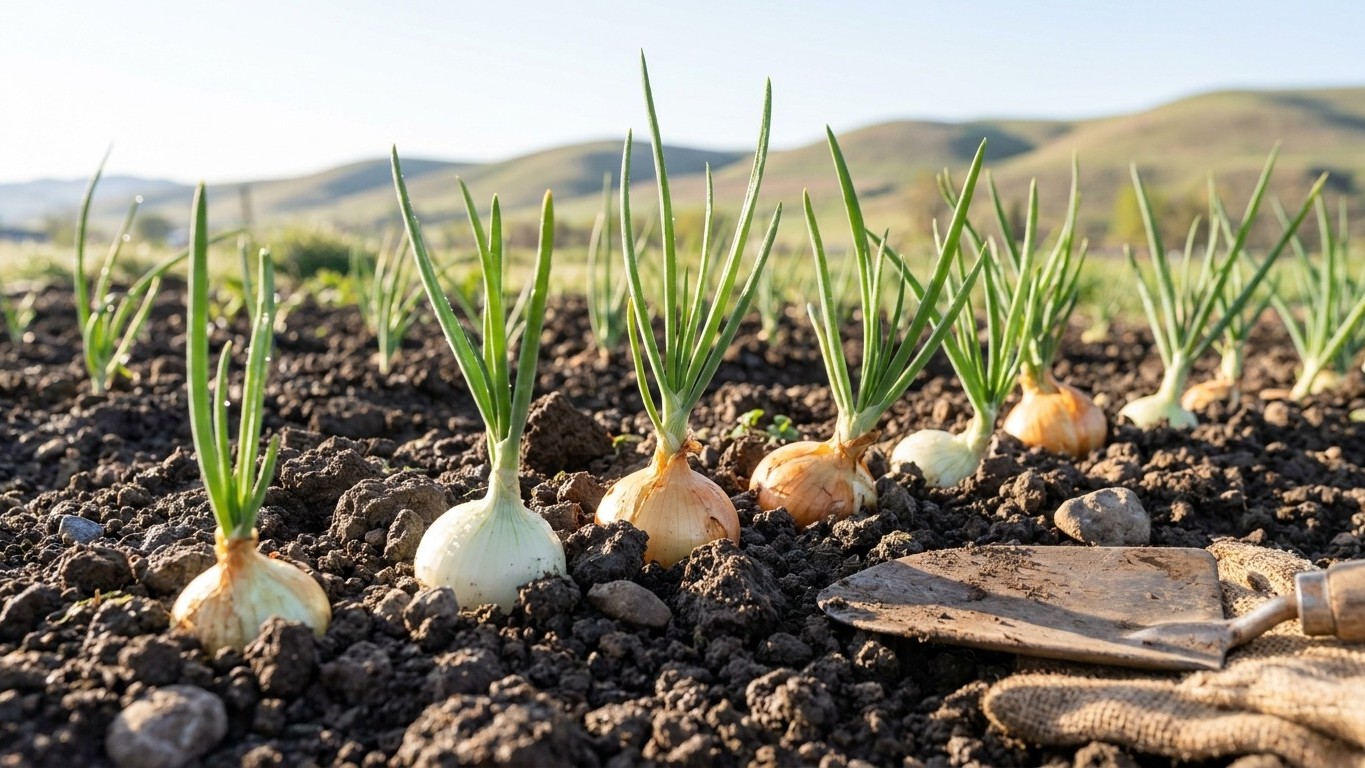

Onions in Idaho go into the ground in late winter to early spring, once the soil can be worked, not in autumn. That timing isn’t a tradition, it’s tied to two numbers: how far north Boise sits and how long the sun stays up on the longest day of the year. Get either one wrong and the mistake isn’t a smaller harvest a few weeks later, it’s a permanently smaller bulb, or none at all.
The short answer for Idaho

The reference point for this page is Boise, sitting at 43.57 degrees north latitude, according to NOAA climate station data. On the longest day of the year, Boise gets 15 hours and 15 minutes of daylight. That single figure decides more about your onion harvest than soil, water, or fertilizer combined, because bulbing is triggered by day length, not by temperature. Once the sun stays up long enough, the plant stops making leaves and starts making a bulb, whether it’s ready or not.
At 15 hours 15 minutes, Boise falls squarely into territory that suits long-day and intermediate-day onions. Long-day types wait for roughly 14 to 16 hours of daylight before they bulb; intermediate-day types trigger a bit earlier, around 12 to 14 hours. Both windows are comfortably covered by what southern Idaho gets each June. That’s why the planting calendar here runs opposite to what a gardener in Georgia or Louisiana follows.
Why the season is spring, not fall
Mild-winter states plant onions in autumn because the seedlings can survive outdoors all winter, sitting quietly until spring, then racing to size before the long summer days trigger bulbing. Idaho’s winters don’t allow that. The ground freezes hard, and a fall-planted seedling has no chance of overwintering the way it would in the Gulf South. So Idaho gardeners plant sets or transplants in late winter to early spring instead, as soon as the ground thaws enough to dig, giving the plant the longest possible run at building leaf mass before day length flips the switch to bulbing.
That compressed window is the whole game. The plant has from planting day until the daylight hits its threshold, sometime in June, to grow as large as it’s going to get. Every week lost at the start is a week the bulb never gets to make up later.
What will not work here
Two separate mistakes ruin an Idaho onion crop, and neither one is a feeding problem or a watering problem. The first is planting late. Gardeners often assume a late start just means a late harvest, that the onions will simply catch up. They don’t. Day length doesn’t wait for the plant. Whatever size the onion has reached when the daylight threshold arrives is the size the bulb locks in. Plant three weeks late, and you don’t get a slightly delayed harvest of full-sized onions, you get a bulb the size of a golf ball, because the plant only had three fewer weeks to build the leaf mass a bulb is made from.
The second mistake is planting the wrong day-length group entirely, and this one is worse because it doesn’t shrink the harvest, it erases it. Short-day onions are bred for latitudes far south of Idaho, where the day never gets long enough to stop them early. Plant a short-day variety in Boise and the daylight threshold that should trigger bulbing arrives while the plant is still tiny, weeks or months before a long-day variety would even start. The result is a small, premature bulb at best, or a plant that pushes leaves all season with nothing forming underground.
Five varieties documented on this site are published for latitudes below Idaho and have no business in an Idaho garden:
- Candy (intermediate-day, catalogued for 33-40N), bulbs too early for Boise’s day length, giving small onions before the plant has sized up
- Gabriella (short-day, 20-35N), triggers weeks too soon in Idaho’s summer daylight, no true bulb forms
- Madalyn (short-day, 20-35N), same short-day mismatch, small premature bulbs at best
- Red Rock (short-day, 30-36N), bulbs before the plant has any real size behind it
- White Castle (short-day, 30-38N), too far south of Boise’s latitude to ever size up properly
What changes across Idaho
Idaho is not one latitude, and treating the whole state as if it matched Boise is where a lot of planting-calendar advice falls apart. The state stretches from around the low 42s at the Nevada and Utah border up to roughly 49 degrees north at the Canadian line, one of the longer north-south spans of any state in the Lower 48. Boise, at 43.57N, describes southern Idaho reasonably well, but a gardener up in the Panhandle is gardening under noticeably longer summer days and a shorter frost-free window than the figures above assume.
That gap matters for variety choice specifically. Several intermediate-day types with published ranges reaching only into the mid-40s, such as varieties capped around 45 to 46 degrees north, sit comfortably in Boise’s zone but fall outside their range entirely once you’re up near the Panhandle. Long-day varieties with wider northern reach, including one documented up to 65 degrees north, hold up across the whole state without issue. A gardener near the Idaho-Canada border is better served leaning toward the long-day end of the list and skipping the intermediate-day options that work fine two hundred-plus miles south.
| Location | Approximate latitude | What it changes |
|---|---|---|
| Boise (reference city) | 43.57N | 15h15 daylight on longest day; both intermediate-day and long-day varieties fit |
| Northern Idaho, near the Canadian border | ~49N | Longer summer days than Boise; most intermediate-day varieties fall outside their published range, so long-day types with wider northern reach are the safer pick |
Sweet now, or onions that last
Idaho gardeners get to pick a side of a real chemical trade-off, not a marketing label. According to University of Missouri Extension, sweet onion varieties don’t store as well as the more pungent ones, and the reason is the same compound that makes an onion sharp in the first place. Volatile sulfur compounds are what give a pungent onion its bite, and those same compounds act as a natural defense that slows the bulb’s breakdown in storage. A sweet variety simply has fewer of them, which is exactly why it’s better sliced raw in July and exactly why it won’t still be good in a pantry come March.
Southern Idaho’s latitude puts it in a spot where both intermediate-day and long-day varieties bulb successfully, which means a gardener there genuinely gets to choose which side of that trade-off they want. Lean intermediate-day and you’re eating sweeter, milder onions sooner, but you’re eating through them faster because they won’t hold. Lean long-day, particularly toward varieties bred with storage in mind, and the onions carry more of that sulfur sharpness that keeps them firm and usable well past harvest.
Further north in the state, where the day-length math pushes harder toward long-day varieties regardless of preference, the pantry outcome is decided for you: sharper onions, but ones still good for cooking when the snow is on the ground. There’s no variety on Idaho’s compatible list that gives you both the sweetness of a short-keeper and the shelf life of a long-day type. Pick the one your winter actually needs.
Checking this against your own garden
Everything above is built around Boise’s numbers, and Boise is only one point on a very long state. Before locking in a planting date or a variety list, a few things are worth confirming against your own backyard rather than trusting a statewide average.
- Look up your own latitude if you’re gardening well north or south of Boise, since even a few degrees shifts which day-length group actually fits your summer
- Check your local last frost date rather than assuming Boise’s, since higher elevations and northern counties push that date later into spring
- Contact your county’s University of Idaho Extension office for frost data and variety trial results specific to your area
- Note your garden’s elevation, since higher ground anywhere in the state can shorten the frost-free window even at a similar latitude
- Track how long your own soil takes to thaw and dry enough to dig, since that’s the real start date for the planting window, not a calendar date