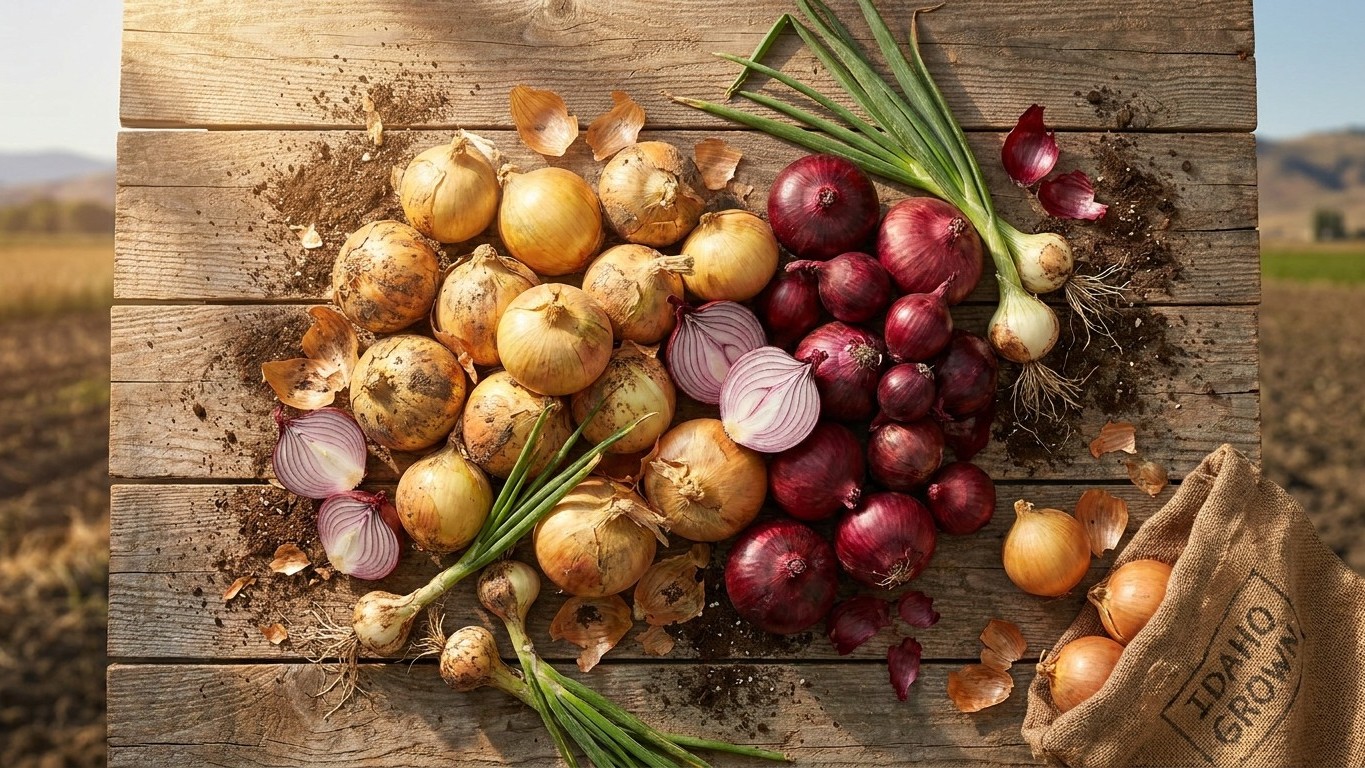

At 43.57 degrees north, Boise’s longest day delivers 15 hours and 15 minutes of daylight. That number, not the summer heat, is what an onion actually pays attention to. It’s the reason the long-day group is the one built for Idaho gardens, and the reason so many catalog favorites simply don’t belong here at all.
The short answer for Idaho

Onions are day-length plants. They stop building leaves and start building a bulb once daylight crosses a threshold, and that threshold is fixed by genetics, not by the calendar or the thermometer. At Boise’s latitude of 43.57 degrees north, the solstice brings 15 hours and 15 minutes of daylight, comfortably past the 14-hour mark that triggers bulbing in long-day varieties. That single fact settles the question: Idaho is long-day onion territory, full stop.
Within that group, the state has a wide bench to pick from. Documented long-day varieties whose published latitude range covers Boise’s 43.57 degrees north include Ailsa Craig, Barolo, Blush, Bridger, Frontier, New York Early, Patterson, Powell, Red Carpet, Redwing, Rossa di Milano, Safrane, Talon, and the well-known Walla Walla Sweet, which shares its name with the Pacific Northwest but grows just as reliably across southern and central Idaho.
A handful of intermediate-day varieties also show up on this list because their published ranges happen to stretch far enough north to include Boise: Cabernet, Calibra, Elsye, Expression, Monastrell, Red Long of Florence, Red Long of Tropea, Scout, and Sierra Blanca. These will bulb here, but they respond to roughly 12 to 14 hours of daylight rather than 14 to 16, so they trigger earlier in the season and tend to size up smaller than a true long-day type planted at the same time. Treat them as a secondary option, not the default.
The takeaway for a first-time Idaho onion grower is simple: shop the long-day list first, and if a variety isn’t on either list above, check its range before buying seed.
What will not work here
Five varieties documented on this site have published ranges that stop short of Idaho’s latitude, and planting any of them here is a variety mistake, not a feeding or watering mistake. A short-day onion is built to start bulbing at around 12 hours of daylight, a length Boise reaches weeks before the plant has had time to grow real size. The bulb still forms, but it forms small, because whatever leaf growth the plant managed before the trigger hit is all the bulb will ever have to draw on.
- Candy (intermediate-day, 33-40N), bulbs before the plant reaches full size this far north, producing undersized onions rather than the plump bulbs it’s known for in its home range.
- Gabriella (short-day, 20-35N), triggers into bulbing far too early at 43.57N, leaving little to show at harvest.
- Madalyn (short-day, 20-35N), same short-day mismatch; the plant never gets the growing window it needs.
- Red Rock (short-day, 30-36N), bulbs small and early outside its southern range.
- White Castle (short-day, 30-38N), another southern short-day type that can’t size up before Boise’s daylight crosses its trigger point.
None of these varieties will simply fail to grow. They’ll germinate, leaf out, and look perfectly healthy through early summer. The disappointment shows up at harvest, when a gardener pulls a marble-sized onion where a fist-sized one was expected. It’s a common mistake for anyone buying seed from a catalog written for a warmer climate, since short-day onions dominate shelf space in much of the country’s seed trade. In Idaho, that packet is the wrong tool for the job, regardless of how well the soil was prepped or how faithfully the bed was watered.
What changes across Idaho
Idaho is not one climate. The state runs from roughly the 42nd parallel at its southern border near Nevada and Utah, up through the Panhandle to nearly the 49th parallel at the Canadian line, a spread of about seven degrees of latitude. Every figure above is anchored to Boise, at 43.57 degrees north, so a gardener working land well north or south of that reference point is planting under a different sky than the one these numbers describe.
| Idaho region | Approximate latitude | Summer daylight vs. Boise’s 15h15 | What changes |
|---|---|---|---|
| Southern Idaho (near the Nevada/Utah line) | ~42N | Slightly less | Intermediate-day varieties on the list, such as Sierra Blanca or Scout, fit comfortably alongside long-day types |
| Northern Idaho Panhandle | ~49N | more | Only long-day types make sense; varieties with a documented far-north range, like Redwing (43-65N), are the safer bet |
The practical effect isn’t just which seed packet to buy. A gardener in the Panhandle is working with a longer summer day than Boise sees, which pushes the bulbing trigger even earlier relative to the calendar, so timing transplants and sets a bit sooner than the Boise-based schedule matters more the farther north the garden sits. Someone gardening near the southern border, by contrast, has a little more room to lean on intermediate-day varieties without losing bulb size. The rule of thumb: the closer a garden sits to Boise’s latitude, the more directly these figures apply; the farther it strays, north or south, the more it’s worth treating this page as a starting point rather than a final answer.
Sweet now, or onions that last
Every onion grower eventually runs into the same trade-off, and it isn’t about flavor preference so much as chemistry. The volatile sulfur compounds that give an onion its bite are the same compounds that protect it in storage. A variety bred to be mild and sweet has fewer of those compounds, which is exactly why it tastes better raw and exactly why it won’t make it to spring in a root cellar.
Walla Walla Sweet, on the long-day list for Idaho, is the clearest example: it’s prized for eating fresh, sliced onto a burger or diced into a salad within weeks of harvest, but it isn’t built for the pantry shelf come winter. Varieties like Talon, Patterson, and Redwing sit at the other end of that spectrum. They carry more of those sulfur compounds, which means a sharper bite in the kitchen but a bulb that holds firm in storage for months rather than weeks.
That split lines up with the day-length pattern already at play across the state. Southern gardens, closer to the shorter end of the intermediate-day range, tend to lean toward sweeter, shorter-keeping onions. Gardens farther north, further into pure long-day territory, tend to grow sharper types that store longer, since colder winters historically demanded a root cellar that could carry a family’s onion supply into March. A gardener planting a single bed has to decide up front which need matters more this year, because no variety documented here delivers both a sweet bite and a long shelf life. Planting a mix of both types, one for the kitchen now and one for the cellar later, is the practical way most Idaho gardeners split the difference.
Checking this against your own garden
Everything above is built on Boise’s numbers, and Boise is one point in a state that spans a lot of ground. Before ordering seed based on this page, it’s worth confirming a few things against the actual plot of dirt being planted.
- Look up your own town’s latitude if you’re gardening well north of Boise (toward the Panhandle) or south of it (toward the Nevada or Utah line), since a few degrees either way shifts which day-length group fits best.
- Check your local average last-spring-frost and first-fall-frost dates, since onion transplant timing depends on both frost risk and the bulbing trigger, not on day length alone.
- Call or visit your county extension office; Idaho’s extension network tracks planting windows and variety trials specific to each region of the state, and their guidance will be more local than any statewide figure.
- Note your garden’s elevation, since higher mountain valleys often see a shorter frost-free window even at similar latitudes to Boise.
- Keep the seed packet’s stated day-length type in hand when shopping, and cross-check it against the lists above before buying.
A single state-wide number can point a gardener in the right direction, but it can’t replace a look at the actual sky over the actual garden bed.