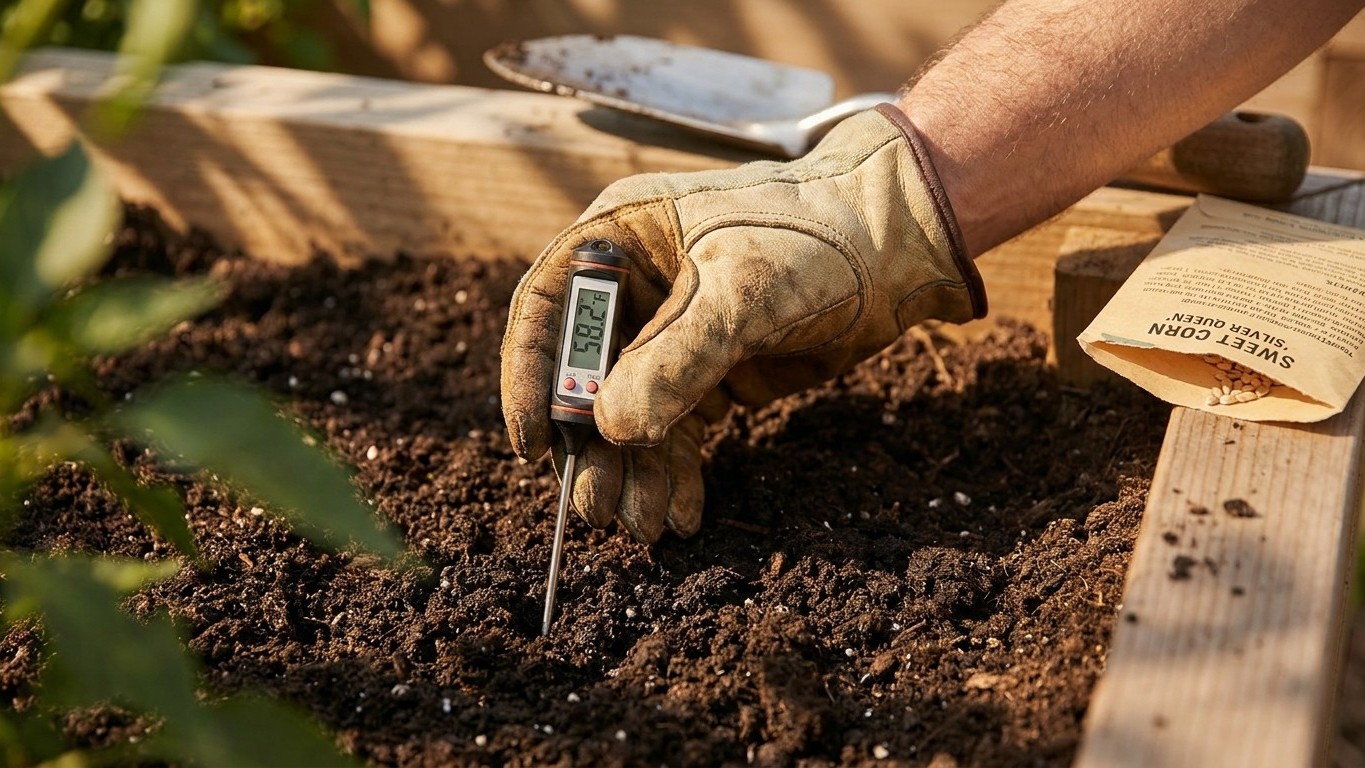

In most of Idaho’s valleys, soil warms enough for sweet corn seed by late May, sometimes into early June at higher ground, well after the last frost has passed. That gap matters: a 60- to 90-day variety only fits the season if you count from when the soil is actually warm, not from frost-out day. Get that sequence backward and the corn either rots in cold ground or runs out of season before the first fall freeze.
The short answer
Here’s what trips people up every spring: the last frost date and the soil-warm date are not the same event, and treating them as one is the single biggest reason sweet corn seed fails to come up. At the reference station used for this region, the last spring frost typically falls somewhere between April 23 and May 7. That’s a useful marker for tender transplants, but sweet corn seed doesn’t care about frost. It cares about soil temperature, and that threshold is 60°F. Soil doesn’t hit 60°F the moment the air stops freezing, it lags behind by weeks, because bare ground releases heat slowly even after nighttime lows climb above 32°F.
That lag is exactly why so many gardeners plant too early. They see a frost-free forecast in late April, get the itch, and put seed in ground that’s still in the 40s. The kernels sit. Some rot before they ever germinate. The safest habit is to check the soil directly with a simple soil thermometer pushed a few inches down, rather than trusting the calendar alone, especially since Idaho’s elevation swings mean a garden forty miles away can warm two or three weeks later than a valley floor plot.
Once that 60°F soil threshold is met, the second clock starts: sweet corn needs 60 to 90 days from planting to reach harvest, depending on the variety. The question then becomes whether that window closes before the first fall frost, which at the reference station runs between October 7 and October 21. Do the arithmetic honestly. If soil hits 60°F in late May and you’re growing something that needs the full 90 days, you’re pushing toward late August or early September for harvest, comfortably ahead of an October frost in a good year, tighter in a cool one. If soil warming drags into June, that same 90-day variety is cutting it close, and a cooler microclimate or higher elevation could make it a gamble rather than a plan.
The heat load matters here too. This region averages 47.5 days a year at 90°F or hotter, which is a lot of stress on a crop that also needs steady moisture through pollination. That heat pushes germination and early growth along quickly once soil is warm enough, but it also means water demand climbs fast in midsummer, corn silking during a stretch of 90-degree days needs consistent irrigation, not just a wetting now and then, or kernels fail to fill properly regardless of how well the timing worked out.
Does a late variety fit here?
Not every sweet corn is built the same, and the difference between a fast variety and a slow one can decide whether you’re eating fresh corn in August or watching green stalks get caught by an early snap.
A 60-day variety
A variety that matures in roughly 60 days from planting is the forgiving choice in this territory. If soil reaches 60°F even on the later side, say into the first half of June at higher elevation, a 60-day type still has a comfortable buffer before the October 7-to-21 fall frost window closes. Sixty days from a mid-June planting lands harvest in mid-August, leaving weeks of margin even if fall frost arrives on the early end of that range. This is the safer bet for gardens at elevation, for anyone whose soil warms late, or for anyone who simply doesn’t want to watch the forecast nervously every September.
A 90-day variety
A 90-day variety asks a lot more of the calendar. Ninety days from a late-May planting (soil finally at 60°F) puts harvest around late August, which does fit ahead of the earliest fall frost date. But push that same variety to a June planting, which is realistic in cooler pockets of the state, and 90 days lands in early-to-mid September, uncomfortably close to, or past, the earlier edge of the October 7-to-21 frost window once you account for a slow, cool summer that stretches maturity beyond its stated day count. In the higher, colder parts of Idaho, where both the last frost and the soil-warm date arrive later than at the valley reference station, a 90-day variety plainly does not fit the season with any real safety margin. That’s not a maybe. Gardeners at elevation are better off choosing something faster and banking the extra weeks as insurance rather than hoping for a long, mild fall.
What goes wrong here
- Soil sown too cold. Planting right after the last frost date, before checking actual soil temperature, is the most common failure. Seed sits in ground below 60°F, germination stalls, and rot sets in before a single sprout appears. The fix is simple: test the soil with a thermometer a few inches down and wait for a real 60°F reading, not a frost-free forecast, before dropping seed.
- A variety too late for the season. Choosing a 90-day type in a cooler or higher-elevation garden, or planting it late because soil warmed slowly, leaves too little runway before the first fall frost arrives between October 7 and October 21. The remedy is matching variety length to how early your soil actually warms each year, and defaulting to a shorter-season type whenever there’s doubt.
- Sweetness lost to a bad neighbor. This failure has nothing to do with climate. Su, se, and sh2 sweet corn types cross-pollinate if they tassel at the same time, and the result is starchy, disappointing ears even when the season itself went perfectly. The source publishes no isolation distance to rely on, so don’t plant by feet or rows of separation. Plant in blocks of three or more rows for good pollination, and manage timing so different types are not tasseling together, either by growing only one type or by staggering plantings so their tassel windows don’t overlap.
Common questions
Can I plant sweet corn as soon as the last frost has passed?
Not reliably. The last frost date only tells you the air won’t freeze; it says nothing about soil temperature, which typically stays below the 60°F threshold sweet corn seed needs for weeks afterward. Check the soil directly instead of planting on the frost date alone.
How do I know which variety length is safe for my specific spot in Idaho?
Work backward from your own soil-warm date and your local fall frost risk, since both shift with elevation across the state. A 60-day variety leaves the widest margin almost anywhere; a 90-day variety only works where soil warms early and frost arrives late, which is not the case in higher, colder parts of Idaho.
Does the number of days on the seed packet tell me exactly which week to harvest?
No, and this is a different clock entirely. The 60-to-90-day figure tells you whether the crop fits your season at all, counted from planting. Once ears form, judge harvest by three signs together: dry brown silks, husks still moist and green, and milky juice from a punctured kernel. None of those signs alone is a reliable test.
Do I need a measured distance between different sweet corn types to protect flavor?
The available guidance doesn’t publish a distance in feet or rows, so don’t rely on one. What matters is timing: su, se, and sh2 types must not be tasseling at the same time, or cross-pollination will dull the sweetness of the harvest regardless of how far apart the plants stand.