
Yes, in most of the Treasure Valley around Boise, sweet corn ripens reliably in a normal season, a question explored in more depth in Will Sweet Corn Ripen in Idaho?. The frost-free window there runs long enough, and summer heat builds fast enough, to carry a 60 to 90 day crop from seed to harvest. But that answer changes fast once you leave the valley floor. Higher, colder parts of Idaho work with a much shorter season, and the same variety that ripens in Boise may not finish at all a few thousand feet up.
The short answer
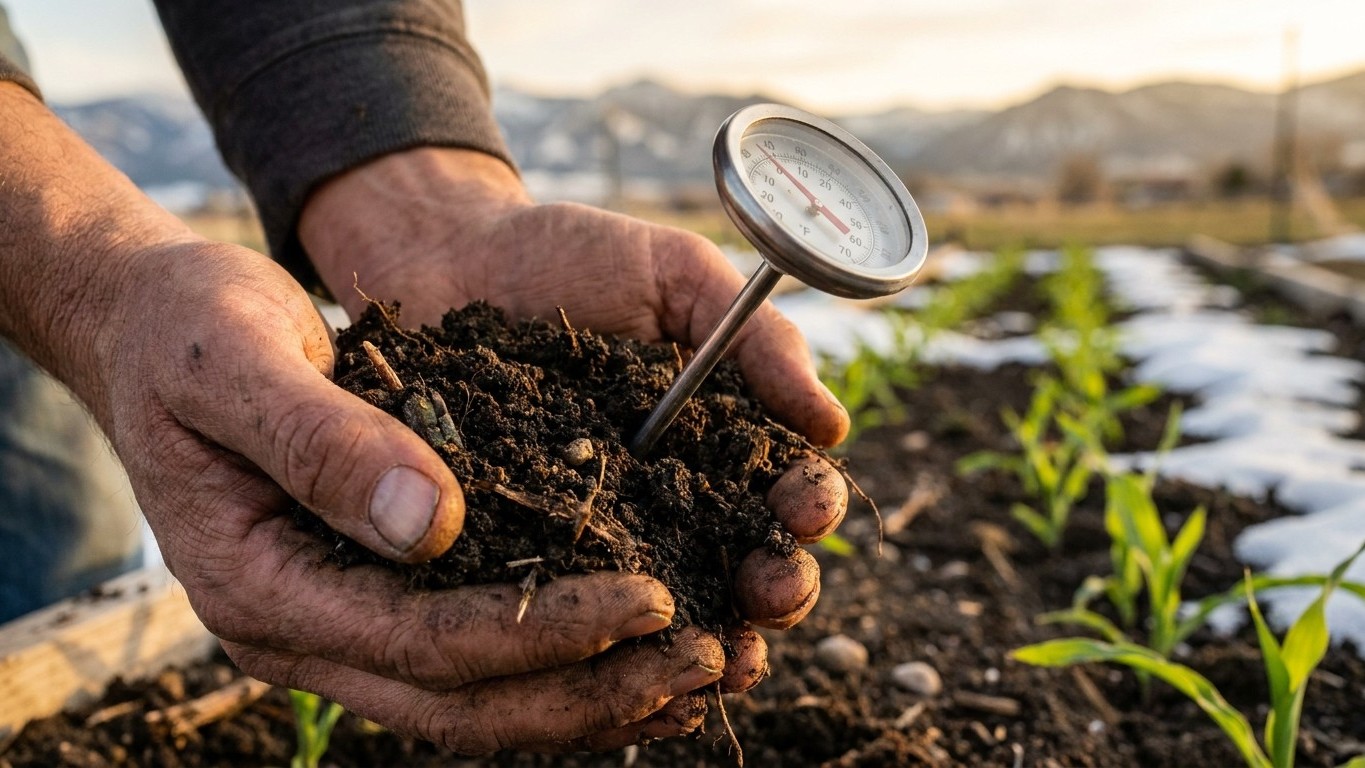
Soil temperature is the gate sweet corn actually waits behind, not the frost date. The seed needs the ground above 60 F to germinate well, and that threshold arrives later than the last spring frost, sometimes by several weeks, because soil warms more slowly than air. No fixed date for that 60 F crossing is published for individual Idaho counties, so the honest move is to check it yourself with a soil thermometer rather than plant by the calendar alone. For a closer look at When to Sow Sweet Corn in Idaho, the frost window around it helps frame the timing: at the Boise-area reference station, the last spring frost falls between April 23 and May 7, and the first fall frost arrives between October 7 and October 21.
Do the arithmetic on that frost window alone and you get somewhere between 167 and 197 days from last spring frost to first fall frost, depending on where in that range a given year lands. That is five and a half to nearly six and a half months of frost-free ground before winter starts pressing in again. Sweet corn needs 60 to 90 days from planting to maturity. Even after you subtract the weeks it takes soil to climb past 60 F following the last frost, a valley grower is still left with a wide comfortable margin, easily enough for the full range of sweet corn maturities the market sells.
Heat is the other half of the equation, and here the Boise-area numbers help too. The reference station averages 47.5 days a year at 90 F or hotter. That is not a summer-average temperature, it is a measure of heat load, the kind of sustained warmth that pushes soil past 60 F reliably, drives strong stalk growth, and helps ears fill out fast once pollination happens. A season with that much heat rarely leaves sweet corn short on warmth. It can, in dry years, leave it short on water, since heat load and irrigation demand rise together.
None of this transfers automatically to the rest of the state. Idaho outside the low valleys sits higher and colder, and the frost-free window narrows sharply the further you climb. A mountain valley or a high desert bench can lose a month or more of growing season compared to Boise on both ends, spring and fall alike. The short answer for the state as a whole is really two answers: yes in the warm low valleys, with margin to spare, and a much tighter, sometimes impossible, yes in the higher and colder ground that makes up most of Idaho’s land area.
Does a late variety fit here?
A 60-day variety
A variety built to mature in around 60 days fits almost anywhere in Idaho that grows corn at all. Set against a frost-free window of 167 to 197 days in the Boise area, 60 days uses less than half the available season, leaving generous room for a cool spring or a slow soil warm-up to eat into the schedule without threatening the harvest. In higher, shorter-season parts of the state where that window shrinks considerably, a 60-day variety is usually the safer bet, since it asks the season for the least.
A 90-day variety
A 90-day variety still fits comfortably inside the Boise-area window, even allowing for soil that takes its time reaching 60 F after the last frost. Planted once the ground has actually warmed, rather than by the frost date alone, it has room to finish well before the first fall frost arrives in the October 7 to October 21 range. That margin shrinks fast outside the valley floor, though. In the colder, higher ground that covers most of Idaho, a shorter frost-free window may not leave 90 days to work with once you account for the delay before soil is warm enough to plant at all. In those places, a 90-day variety does not fit, and pushing it anyway risks a fall frost catching ears before they finish. This is exactly the kind of local math a soil thermometer and a look at your own elevation should settle before you buy seed.
What goes wrong here
- Soil sown too cold. Planting on the calendar date of the last frost, rather than once soil actually clears 60 F, is the most common failure. Cold, wet soil rots seed before it germinates or produces weak, uneven stands. The remedy is simple: test the soil with a thermometer a few inches down and wait for 60 F, even if that means planting well after the last frost has already passed.
- A variety too late for the season. Choosing a 90-day variety in a higher, colder part of the state where the frost-free window barely covers 90 days, once the soil-warming delay is subtracted, leaves no margin for a cool stretch or an early fall frost. The remedy is matching maturity length to your actual local window, not to the length that worked at a friend’s place in the valley.
- Sweetness lost to the wrong neighbor, nothing to do with weather. Standard (su), sugary-enhanced (se), and supersweet (sh2) sweet corn types cross-pollinate if they tassel at the same time, and the result is starchy, disappointing ears even in a perfect growing season. Climate has no part in this failure. The remedy is timing: stagger plantings so the types you are growing do not shed pollen and silk in the same window, and keep each type planted in its own block of three or more rows so it pollinates itself rather than a neighboring planting.
Checking this against your own county
The frost dates and heat figures above come from a single reference station in the Boise area, and Idaho’s terrain makes that a poor stand-in for the whole state. A backyard forty minutes away, at a different elevation, can run weeks behind or ahead of it in both spring warm-up and fall cooldown. Before committing to a variety, or a planting date, check local conditions with University of Idaho Extension, which tracks county-level frost data and growing-season guidance suited to your actual ground. That single step catches the gap between a statewide answer and what will really happen in your garden this year.
Common questions
Can I just plant sweet corn on the last frost date and be safe?
Not really. The last frost date only tells you when freezing air is unlikely, not when the soil has warmed enough to germinate corn well. Soil crosses 60 F later than that, and planting before it does often causes rot or weak stands rather than an early harvest.
How do I know when my ears are actually ripe?
Look for three signs together, not just one: silks that have turned dry and brown, husks that are still moist and green, and milky juice when you puncture a kernel with a thumbnail. Any single sign alone can mislead you.
Is the 60 to 90 day figure the same as the wait after silks appear?
No, and mixing these up causes a lot of confused harvests. The 60 to 90 day figure runs from planting and tells you whether the crop fits your season at all. A separate, much shorter window, roughly two to three weeks after silks first emerge, tells you which week to actually pick.
Do I need a set distance between different sweet corn types?
The guidance behind this article gives no distance in feet or rows, and none should be assumed. What matters is timing: keep different types (su, se, sh2) from tasseling and silking during the same stretch of days, and grow each type in its own block of three or more rows so it pollinates itself rather than crossing with a neighboring block.