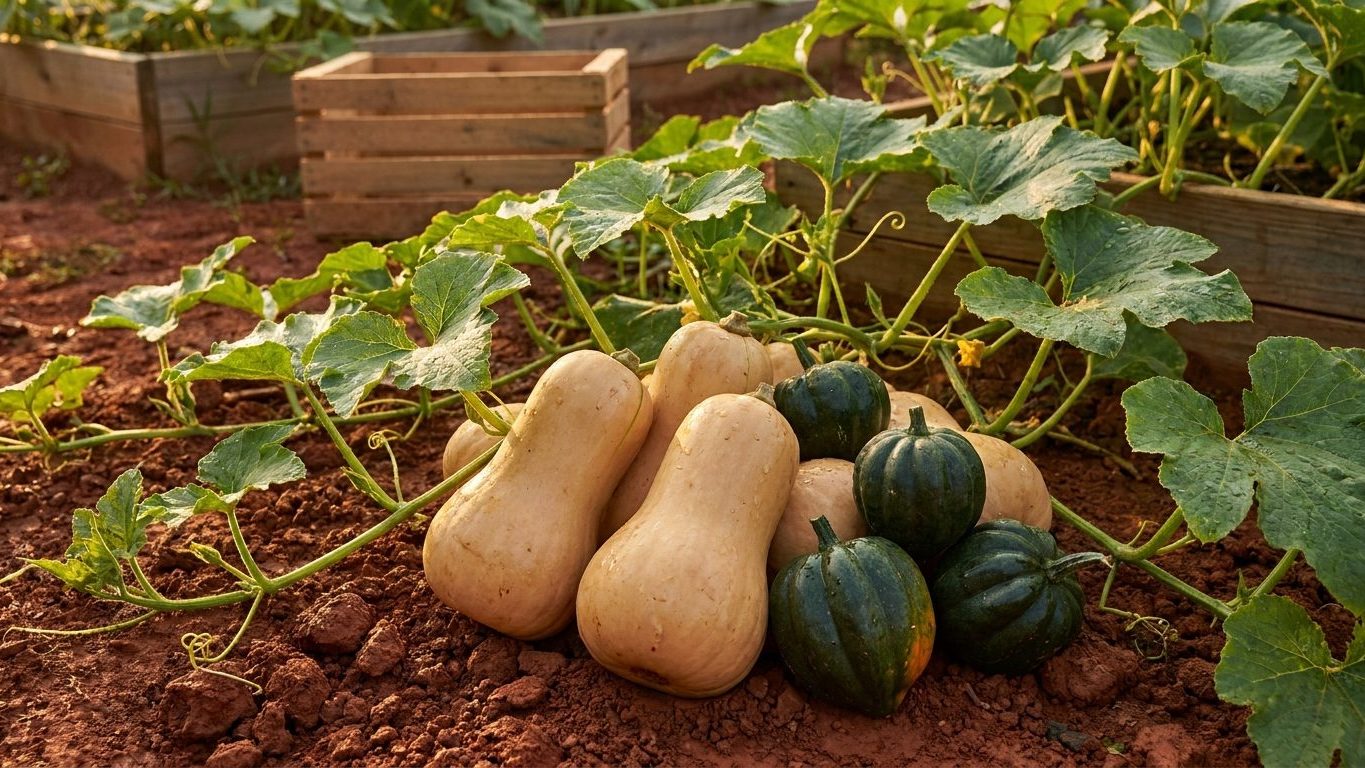

Idaho’s growing season runs long enough in the low valleys for almost any winter squash, but short and cold enough at elevation to rule out the slow ones. The safest bet statewide is a squash that matures in 80 to 100 days, like acorn, delicata or buttercup. Save the 110-day-plus types, Hubbard and the big storage pumpkins, for the warmest valley gardens.
The short answer for Idaho
Boise’s reference station gives a last spring frost landing somewhere between April 23 and May 7, and a first fall frost between October 7 and October 21. Do the math on the worst-case combination, a late spring frost paired with an early fall one, and the frost-free window in the Boise valley still runs about 153 days. Pair the earliest spring frost with the latest fall one and it stretches to 181 days. That’s the number that should drive the variety decision, not a seed packet’s generic “days to maturity” chart.
A 153-day floor covers almost every winter squash type sold in catalogs. Acorn, delicata, spaghetti and most buttercup varieties finish in 80 to 100 days and leave a comfortable margin even in a short year. Butternut, typically 100 to 110 days, fits inside the window too, though with less room for a cool, delayed spring. The long-season group, big Hubbard types, banana squash, and storage pumpkins bred to run 110 to 120-plus days, is where the math gets tight: they need close to the full 181-day stretch to reliably cure on the vine before frost, which means they belong in the warmest, lowest pockets of the state, not the general recommendation.
Heat load matters just as much as season length here. Boise averages 47.5 days a year at or above 90°F, which is real stress for squash blossoms and a driver of moisture demand all summer. Combine that with a summer that delivers only about 1.1 inches of rain across June, July and August, with August itself down to 0.17 inches, and the type decision folds into a management decision: whatever variety gets planted, it is not surviving on rainfall alone.
So the short answer, by type: choose short-season squash as the default statewide choice, treat butternut as a solid mid-season option specifically for valley gardens with a typical or early spring, and reserve the long-season Hubbard and pumpkin types for gardeners in the state’s warmest, lowest-elevation locations, with irrigation planned from the start rather than added later.
What will not work here
The clearest failure mode in Idaho is a long-season winter squash planted somewhere other than a low, warm valley. A 120-day Hubbard needs nearly every day of the 181-day best-case window just cited for Boise, and Boise is the state’s low, warm reference point, not its typical garden. The caution attached to these frost dates is direct: Boise is a low valley, and most of Idaho sits higher and colder, with seasons considerably shorter than 153 to 181 days. A gardener at elevation who plants a 120-day pumpkin on a Boise-length assumption is very likely watching it get caught green by the first fall frost.
The second failure is treating Idaho summer rainfall like it can carry a squash patch. Winter squash are thirsty plants, especially once fruit starts sizing, and the reference station’s summer total of roughly 1.1 inches over three full months isn’t close to what a squash bed needs during a stretch of 90-degree days. August, the month when many varieties are bulking up fruit and curing rind, averages just 0.17 inches. A garden watered “when it rains” in an Idaho August is a garden watered almost never. That’s a fast route to blossom drop, stunted fruit and thin, soft rinds that won’t store.
A third, less obvious failure: over-managing for humidity problems this climate doesn’t really have. Advice written for the Southeast often stresses wide spacing to fight powdery mildew and fungal rot in sticky, humid summers. Idaho’s dry heat and minimal summer rain make that a lower-priority threat here. Spending effort on humidity-driven spacing while ignoring irrigation scheduling is solving the wrong problem for this climate.
Finally, planting on a fixed calendar date rather than the frost probability band invites trouble in both directions. Because the last spring frost falls somewhere in a two-week window (April 23 to May 7), a gardener who plants tender squash transplants on April 24 every year, regardless of the actual spring, is gambling against roughly the back half of that probability band.
What changes across Idaho
Idaho’s USDA hardiness zone range, per the USDA Plant Hardiness Zone Map, spans 3b to 7b. That’s not a narrow band, it’s most of the practical range gardeners deal with in the continental United States, built from a single measure: average annual extreme minimum temperature. A spread that wide means there is no single “Idaho answer” to winter squash timing or variety choice. A garden rated 3b sits in a fundamentally different growing reality than one rated 7b, and both are legitimately “Idaho.”
Zone 3b territory, generally the state’s higher mountain valleys and northern highlands, runs a much shorter frost-free season than the Boise figures above and a lower heat load, meaning fewer of those 90-degree days that push squash to size up fast. A short-season type like acorn or delicata isn’t just the safer choice there, it may be close to the only realistic one for the long-season group. Zone 7b territory, generally the lowest, warmest valleys in the southern part of the state, can carry the full range including the 110-to-120-day types with more confidence, closer to the Boise reference numbers.
The heat and rainfall figures cited here come from one reference station and describe Boise’s low valley specifically. A garden at higher elevation or further north should expect both a shorter frost-free window than the 153-to-181-day range given above and likely fewer days above 90°F, which changes irrigation demand as well as variety risk. Specific numbers for Boise should not be assumed to transfer directly to a mountain valley or a northern county garden.
Which of those zones applies to an individual plot is a local question. That call comes from the USDA Plant Hardiness Zone Map itself, checked against a specific address, not from a state-level summary.
Where to check this for your own county
The state-level answer above is a starting point, not a substitute for what University of Idaho Extension publishes for a specific county. The service is reachable at https://www.uidaho.edu/extension, and it’s the right next stop before finalizing a variety list or a planting date.
Two things are worth looking for there specifically. First, a local planting calendar built around the frost dates and season length for that county rather than the Boise reference station, since most of the state runs colder and shorter than the Boise valley. Second, any list of winter squash varieties that extension agents or master gardener programs have actually trialled in that county’s soil and climate. A variety that performs reliably in a university trial plot down the road carries more weight than a generic seed catalog description written for a national audience.
This matters more in Idaho than in a smaller, more climatically uniform state, precisely because of the hardiness zone spread already noted: 3b to 7b within one state’s borders is enough variation that a county-level recommendation and a state-level one can point to different variety types entirely. A county extension recommendation, built from local trial results and local frost records, will always be the more precise source for the actual plot being planted. Where the two disagree, defer to the county source, not this one.
Checking this against your own garden
Every date and average describes a probability, not a guarantee, and the garden itself will always have the final word. Three direct observations settle what the frost tables and extension calendars can only estimate.
Soil warmth by feel is the first and most practical check. Winter squash seed germinates poorly in cold soil regardless of what the calendar says. Pushing a finger a couple of inches into the planting bed and feeling for warmth close to body temperature, rather than the chill of early spring dirt, is a better planting signal than any fixed date.
The first flush of male flowers is the second signal worth tracking. Squash plants typically produce male flowers before female ones, and their appearance marks the point where the plant has shifted from vegetative growth into reproductive mode. Female flowers, recognizable by the small swelling at the base that will become the fruit, follow within a week or two. If male flowers show up unusually early or late relative to a typical local season, that’s the plant reporting on this particular year’s heat and moisture, not a fixed number in a chart.
The first true leaves, the second set that emerges after the initial rounded seed leaves, tell a third story: how the plant is handling the specific microclimate of that bed, whether it’s a warm south-facing slope or a shaded corner that lags the rest of the yard. Slow, pale true-leaf development in a spot expected to run warm is worth investigating before assuming the whole season is on track.