
Winter squash goes into Idaho soil once the risk of a hard freeze has passed and the ground itself has warmed, which at the Boise valley reference station lands between late April and early May. Elsewhere in the state, especially at higher elevation, that window shifts weeks later. The right squash type for your garden depends less on the calendar than on how long your local season actually runs and how much heat and rain you can count on.
When the soil is warm enough in Idaho

The NOAA NCEI 1991-2020 Climate Normals put the last spring frost at station USW00024131 (Boise) somewhere between April 23 and May 7, based on the 30-70% freeze probability band for 32F. That’s the frost date most Idaho gardeners quote. But frost date and planting date aren’t the same thing, and treating them as interchangeable is where a lot of squash starts go wrong.
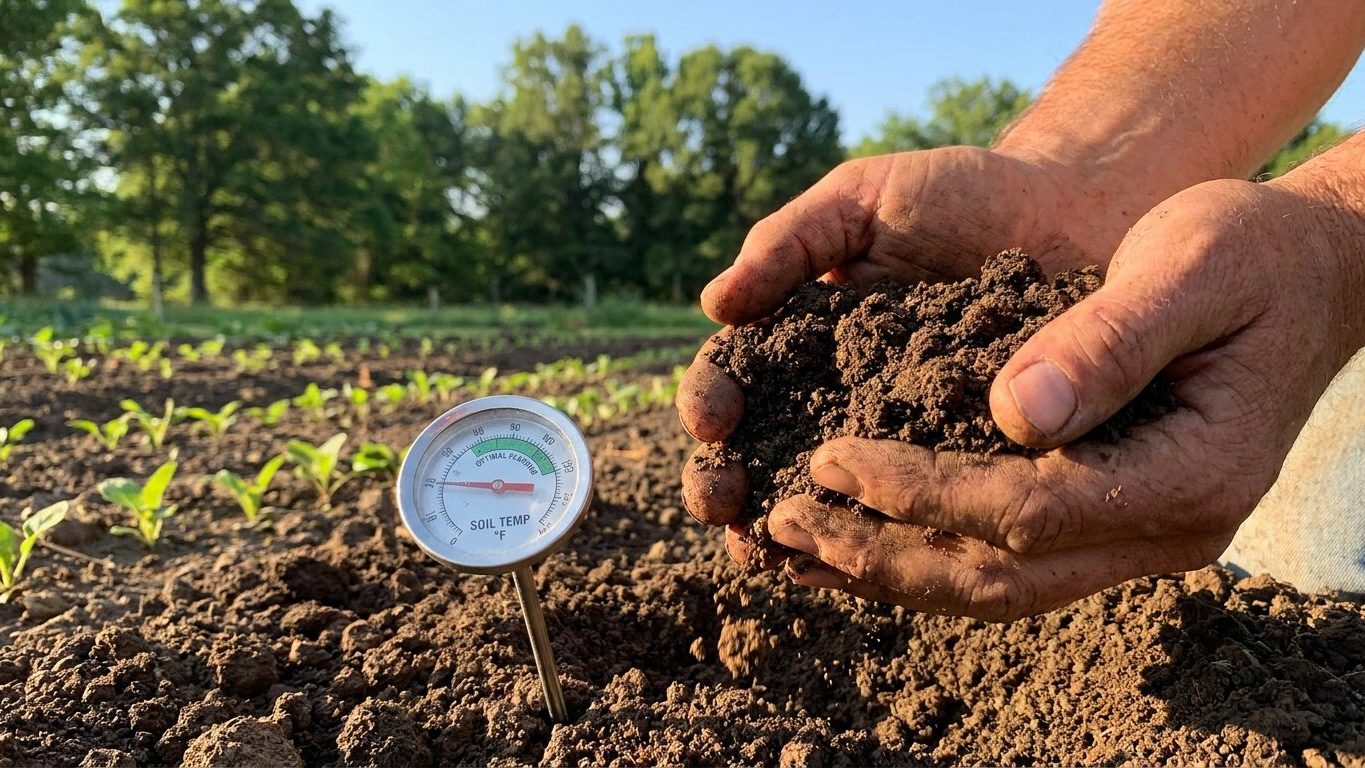
Winter squash seed doesn’t care what the calendar says. It cares whether the soil around it is warm enough to germinate without rotting first. Cold, wet soil in early spring can sit for two or three weeks with nothing happening, and by the time seedlings finally push through, direct-seeded squash from a week later, into warmer ground, often catches up and passes them. That’s the mechanism the frost date hides: the soil trails the air by days, sometimes longer under cloud cover or in heavy soil that holds moisture.
There’s also the probability itself to reckon with. A 30-70% band for the last frost isn’t a guarantee it happens April 23 or May 7 sharp, it’s the range where freeze risk sits in the middle, meaning some years bring a frost earlier, some later, and the safe move is to wait until the ground itself, not just the sky, gives the green light.
Why Boise’s numbers aren’t Idaho’s numbers
The frost dates above come from a single low-valley station. Idaho’s official hardiness range runs from zone 3b to zone 7b under the USDA Plant Hardiness Zone Map, and that spread tells the real story: most of the state sits higher and colder than Boise, with springs that stay cold weeks longer and seasons that close weeks earlier. A gardener in a mountain valley working from the Boise frost date alone will get burned, literally, by planting too early for their own elevation.
The fix isn’t a different frost date pulled from memory, it’s checking soil temperature directly and, where possible, comparing notes with a local extension office or nearby gardeners who’ve tracked their own microclimate over a few seasons. Nobody guesses their way to a reliable planting date in a state with this much vertical range.
How long the season lasts here
Run the numbers from both ends of the frost window and Idaho’s frost-free season at the Boise reference station stretches somewhere between about 152 and 181 days, depending on which year you land in relative to those probability bands (last frost April 23 to first frost October 21 gives the long end; last frost May 7 to first frost October 7 gives the short end). Call it roughly five to six months, and that range matters more than a single average number would, because it’s the difference between a season with slack in it and one with none.
At the long end, near 180 days, there’s enough room to absorb a setback. If a first direct-seeded planting fails to germinate, a gardener working the long end of that window can often replant and still bring squash to full maturity before the first fall frost arrives. That buffer is a real asset, and it’s one reason valley-floor Idaho gardens can afford to direct-seed rather than fuss with transplants.
At the short end, near 150 days, there’s no such cushion. A failed first sowing at higher elevation, where the frost-free window runs even shorter than Boise’s own low-end figure, can mean no crop at all that year. That’s the point where starting seedlings indoors three to four weeks before the last frost, then transplanting once the soil has warmed, stops being optional and becomes the only way to bank enough calendar days for the fruit to mature and cure properly.
Winter squash isn’t a crop most gardeners succession-sow the way they would lettuce or bush beans, since each planting needs the full season to reach maturity rather than a quick early harvest. But the timing principles still apply directly, and the site’s succession sowing guide walks through how to stagger sowings where the season allows it and when a single, well-timed planting is the smarter move instead.
Heat and water in Idaho

The Boise reference station averages 47.5 days a year at or above 90F, per the 1991-2020 Climate Normals. That’s a genuine heat load, not a rounding error, and it’s the number that drives how much water a squash vine loses through its leaves on a summer afternoon. Winter squash roots run deep and the vines sprawl to cover a lot of ground, both adaptations to exactly this kind of dry heat, but adaptation only goes so far without irrigation behind it.
Rainfall doesn’t pick up the slack. Summer rain across June, July and August averages only about 1.1 inches combined at the same station, out of 11.5 inches for the whole year. That means nearly all of Idaho’s precipitation falls outside the growing season, and the squash patch is largely on its own from June through August.
| Month | Average rainfall |
|---|---|
| June | 0.75 in. |
| July | 0.21 in. |
| August | 0.17 in. |
August, the driest month on record here, arrives right when squash fruit is filling out and needs steady moisture most. A single inch of rain spread thin across the whole summer, combined with 47.5 days of 90F heat pulling moisture back out of the soil, adds up to one conclusion: irrigation isn’t a backup plan for a Boise-area squash patch, it’s the plan. Drip lines or soaker hoses at the root zone, run consistently through the driest weeks, carry the fruit through sizing and into the curing stage that gives winter squash its keeping quality.
That said, this is a valley-floor picture, and Idaho’s higher ground tells a different story. Mountain valleys and higher-elevation gardens see far fewer 90F days than the Boise count, and where the heat load drops off, the risk flips. Cooler, damper summer air at elevation slows fruit ripening and creates the kind of conditions where powdery mildew and other foliar disease take hold on squash leaves, especially where air doesn’t move freely through a dense planting. A gardener above the valley floor is managing airflow and disease pressure where a Boise gardener is managing drought stress, and the two problems call for different responses even within the same state.
Which winter squash suit Idaho
None of this points to a single named variety, and that’s deliberate. The right squash for a short-season mountain garden, a hot dry valley plot, or a cool damp higher-elevation site are different plants entirely, and picking by type rather than by seed packet name is what actually holds up across Idaho’s range.
Where the frost-free window runs toward the shorter end of Idaho’s spread, the earliest-maturing types within the winter squash category are the safer bet, since they leave the least margin for a late-season frost to catch fruit before it’s fully cured. Where summer heat runs high, as it does around the Boise reference station’s 47.5 days above 90F, types that tolerate dry heat and benefit from a bit of afternoon shade at the root zone, achieved through spacing or a living mulch, hold up better than ones bred for cooler, wetter climates. Where humidity and cooler air linger, as they do at higher elevation, disease resistance becomes the first thing to check before anything else, since powdery mildew can undo a season’s growth in a few humid weeks.
This is also the point where a cultivar name would do more harm than good. A variety trialled and recommended for the Snake River plain may perform nothing like it does in a mountain valley three thousand feet higher, and this page has no way to know which seed lines your local extension office has actually tested for your county’s soil, elevation and season length. That’s exactly the information the University of Idaho Extension tracks year over year, through its own regional trials, and it’s a far more reliable source for a specific variety recommendation than any generic list could be. Refusing to name one here isn’t a gap in the page, it’s the honest answer for a state built on this much climate variation.