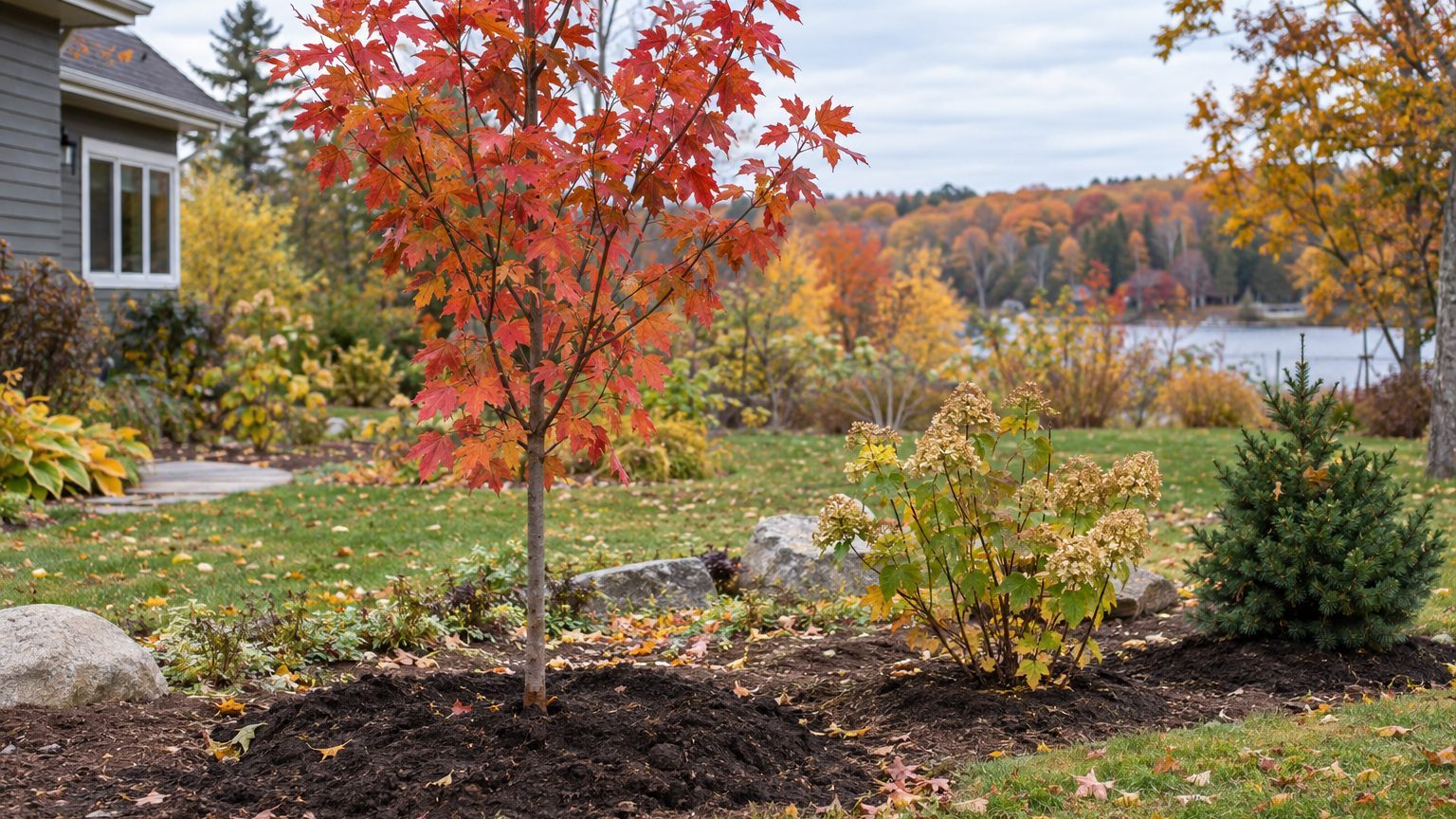

In Illinois, the conservative deadline for planting trees and shrubs in fall runs from September 12 to September 22, which is six weeks before the first fall frost, due October 24 to November 3 at Chicago’s airport weather station. Roots keep growing in cool, workable soil long after the leaves drop, so a planting that slips past that window is not doomed. It just gets riskier with every week, and the ground freezing is what finally closes the season.
The deadline in Illinois
Why roots outlast the leaves
Air cools fast in fall. Soil doesn’t. Dirt holds summer heat like a cast-iron skillet, so the ground stays workable and above freezing for weeks after the first frost blackens the tomato plants. Tree and shrub roots don’t go dormant when the leaves do. They keep growing as long as the soil is unfrozen, and that is the whole logic of fall planting. The plant spends October and November building roots with no foliage to feed, then wakes in spring already anchored.
Cornell Cooperative Extension states the rule this way: “Fall is an excellent time for transplanting, provided you get them to their new home at least 6 weeks before the ground freezes, allowing them time to establish roots before winter dormancy.” Notice what the clock counts from. It’s the ground freezing, not the first frost, and nobody can name the freeze date months ahead. So the practical version works backward from something you can look up.
Working backward from the first frost
NOAA’s 1991-2020 Climate Normals for Chicago’s airport station put the first fall freeze (32°F) in a band from October 24 to November 3, based on the 30 to 70 percent probability range. Count six weeks back from that band and you land on September 12 to September 22. That is the safe target, and it is deliberately conservative. Because the ground freezes later than the air does, the true limit usually falls well after those dates. If you’re reading this in late September, that safe window has just closed, but the real cutoff is still ahead of you.
Two cautions keep the numbers honest. First, these figures describe the reference city. They are not a state-wide guarantee. Suburban and rural gardens typically see the first fall frost one to two weeks earlier than an airport station, and the colder northern part of the state reaches both the frost and the frozen ground sooner than the south. Southern Illinois gets extra time; the far north gets less. Check your own county’s dates in First and Last Frost Dates in Illinois and shift the window accordingly.
Second, this deadline does apply here. Chicago’s coldest month has a mean daily minimum of 18.8°F (NOAA NCEI Climate Normals, 1991-2020), well below freezing, so the ground really does lock up each winter. In places where that figure stays above 32°F, fall and even winter would be the best planting season and no deadline would matter. Illinois isn’t one of those places.
What to plant late, and what to wait on
Past the safe window, the plant matters more than the calendar. Container-grown and balled-and-burlapped stock that is fully hardy in your zone establishes well into late fall, because its roots are intact and it only has to push them into cool soil. The USDA Plant Hardiness Zone Map 2023, built on the average annual extreme minimum temperature from 1991-2020, spans 5a to 7b across Illinois. That is a wide spread, so look up your own zip code before you buy, and treat a plant rated for your zone as fit for a late planting. A plant rated for one zone colder than yours is a spring project.
A quick sorting table
| Type of plant | Late-fall outlook | How to handle it |
|---|---|---|
| Hardy deciduous trees and shrubs, container-grown | Good, even after the safe window | Plant while soil is workable, water in well, mulch |
| Hardy trees, balled and burlapped | Good if the root ball is intact and firm | Set at the right depth, remove any wire and twine that would bind roots |
| Needled evergreens (pine, spruce, arborvitae) | Fair, best planted early in the window | Water thoroughly until freeze-up, shield from wind if exposed |
| Broadleaf evergreens (boxwood, holly, rhododendron) | Risky after the window closes | Wait for spring unless planted early, pick a sheltered spot |
| Plants at the edge of your zone | Poor | Wait for spring and give them a full season of growth first |
Why evergreens are the gamble
A deciduous tree drops its leaves and stops losing water. An evergreen keeps its foliage all winter, and that foliage keeps releasing moisture on sunny, windy days while the roots sit in cold or frozen soil and cannot replace it. A newly planted evergreen has a small root system to begin with, so it runs a deficit. Established plants get through that. A fresh transplant with roots barely out of the container may not. That is why the safest plan is to get evergreens in early and leave the borderline hardy plants until spring.
Bare-root plants are a separate case. They ship dormant and belong in the ground in early spring, not in the fall race. For more on choosing, digging and setting plants at the right depth, see Planting and Caring for Trees, Shrubs and Perennials. The decision worth writing on the calendar: plant hardy deciduous stock while the soil stays workable, and hold broadleaf evergreens and borderline plants until spring once the September window is behind you.
Watering and mulch until the ground freezes
Water deeply, then keep watching
A new tree’s first winter is about roots, not growth. Above ground, the plant is shutting down: buds set, leaves fall, sap slows. Below ground, roots are still extending into settled soil, and they can only do it if the soil holds moisture. Autumn in Illinois often turns dry after a wet summer, and fall-planted trees have no reserves. Water slowly and deeply so it soaks the root ball and the soil just beyond it, then keep at it until the ground freezes. A short sprinkle wets the surface and does almost nothing for roots. When you’re unsure, push a trowel in beside the root ball and check the soil down there. If it’s dry, water.
Skip the urge to push top growth. Heavy pruning and a shot of fertilizer in late fall only invite tender new shoots that winter will kill. Remove what is broken or dead and leave the rest alone. Whatever leaf growth happens this year matters far less than the roots that will feed the plant next spring.
Mulch in a ring, not a volcano
Mulch does the quiet work here. It slows moisture loss, evens out soil temperature, and keeps weeds from competing with a young root system. NC State Extension’s Gardener Handbook gives two depths for two purposes. For weeds: “A 2-inch to 3-inch layer of mulch suppresses most annual weed seeds and makes it easy to hand-pull any that do germinate.” For trees: “Provide a 3-inch layer of mulch to reduce water loss and maintain uniform soil moisture and temperature around roots.” The two sentences point to the same range, so spread a 2-inch to 3-inch layer, in a ring around the planting area.
More is not better. Mulch piled against the trunk in a cone holds moisture on the bark, invites rot and gives rodents a warm hiding place through winter. Keep the trunk flare bare, spread the mulch wide and flat, and let it reach at least as far out as the planting hole. The details of what to use and how to avoid smothering the plant are in Mulching Without Killing the Plant. Mulching is also a fair task to do after the ground has chilled, once the soil has had a few weeks of cool weather.
What goes wrong
Timing and weather failures
The most common mistake is planting too late for the local climate, and that means running out of ground time in the north first. A tree planted in northern Illinois at a date that works in the south gets less time for roots before the soil locks up. The colder part of the state reaches its limit earlier, which means the safe window there falls toward the early end of September 12 to September 22, or before it. Gardeners in the neighboring lake states face the same arithmetic. How Late Can You Plant Trees and Shrubs in Fall in Michigan? shows how it plays out across the border.
A dry fall causes the quieter failure. The plant looks fine in November, then declines the next spring, because the roots never got moisture to grow into the surrounding soil. It was not the winter that killed it. It was the autumn. Regular deep watering until freeze-up is the fix, and it is the cheapest one available.
Winter damage: burn and heaving
Winter burn shows up in late winter as brown, scorched needles or leaf edges on evergreens, especially on the windward side. Dry wind and bright sun pull water from foliage that the frozen roots cannot replace. Choosing a sheltered site, watering well before the freeze and mulching help, and a burlap screen on the windward side can protect a marginal plant during its first winter.
Frost heaving is the other risk, and shallow, small root balls are its main victims. As soil freezes and thaws repeatedly, it expands and can push a lightly anchored plant upward, exposing roots to air. Fall-planted specimens haven’t had time to grip the soil, so they are most at risk. A layer of mulch evens out the freeze-thaw swings. In spring, check the base of new plantings after thaws, and gently press the root ball back down and re-cover exposed roots. If a planting has slipped past the safe window and the plant is on the tender side, heel it into a sheltered bed with mulch and move it in spring.
Common questions
Is it too late to plant a tree in October in Illinois?
Past the conservative September 12 to September 22 window, October planting is less safe, but it’s often workable. A hardy, container-grown deciduous tree planted while the soil is still workable and watered thoroughly has a good chance. Evergreens and borderline plants fare worse. The colder your part of Illinois, the earlier October becomes a gamble.
Does the first frost mean planting season is over?
No. Frost is an air temperature, and roots respond to soil. A light frost in late October leaves the ground warm enough for continued root growth. What ends the season is the ground freezing, which arrives later than the first frost. The safe deadline is set six weeks before the first fall frost to leave a margin for exactly that gap.
Do the same dates apply in southern Illinois?
The reasoning applies, but the dates move. The southern part of the state is warmer, so its first frost and its frozen ground come later, and the deadline shifts later with them. The figures here come from Chicago’s airport station, so use your own county’s frost dates and count the same six weeks back. Illinois guides collect more state-specific timing for garden jobs.
How will I know the ground is about to freeze?
There’s no single date, but you can test it. If a trowel or spade still slices in without a fight, roots can still grow, and it is still worth watering and planting hardy stock. When the top layer turns crusty or won’t yield, stop planting and mulch. Chicago’s coldest month averages a daily minimum of 18.8°F, so that lockup does come each winter, and the ground can stay hard well into spring.