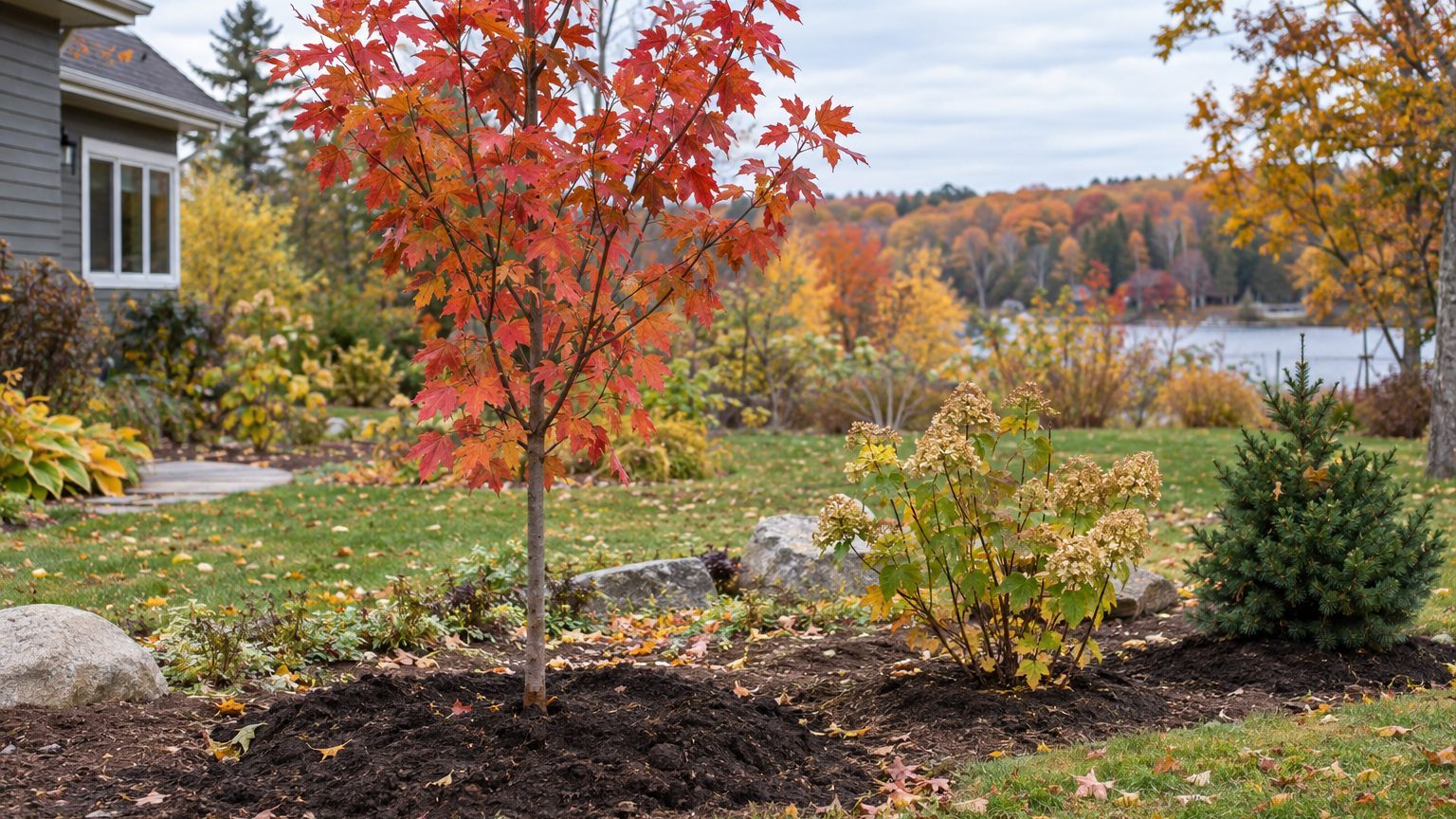

In Indiana, the safe target for fall planting is September 9 to September 18, which is six weeks before the first fall frost (October 21 to October 30 at Indianapolis, per NOAA). Miss that window and the season isn’t lost. Hardy container and balled trees and shrubs can still root in well into late fall, as long as the soil can be dug and hasn’t frozen. The later you go, the more the outcome depends on water, mulch, and what you’re planting.
The deadline in Indiana
Roots run on soil temperature, not on the air. A maple can look finished for the year, leaves down and branches bare, while its roots keep pushing outward as long as the soil is workable and above freezing. Fall planting takes advantage of that gap. The top of the plant has no leaves to feed and no July heat to survive, so nearly all of its energy goes underground.
Cornell Cooperative Extension states the rule this way: “Fall is an excellent time for transplanting, provided you get them to their new home at least 6 weeks before the ground freezes, allowing them time to establish roots before winter dormancy.” Look at what it counts from. The clock starts when the ground freezes, not at the first frost, which is only an air temperature. Soil holds summer heat well into autumn, so the ground freezes later than the first frost.
Here is how that plays out in Indiana. NOAA’s 1991-2020 Climate Normals for the Indianapolis station (USW00093819), using the 30-70% band of 32°F freeze probabilities, put the first fall frost between October 21 and October 30. Count six weeks back from those dates and you land on September 9 to September 18. That is the conservative planting deadline, the one to write on the calendar if you want the most margin. Because the ground freezes after the first frost, the true limit usually falls later than that range. Plants that go in after mid-September aren’t doomed. They just have less time to spare.
Location moves the whole schedule. The colder north gets its first frost earlier and its ground locks up earlier, so the deadline slides earlier there. Southern Indiana runs later in autumn than the north by a fortnight or more, which gives southern gardeners extra room. Indianapolis is the anchor for the dates above, so check your own county against the First and Last Frost Dates in Indiana before you commit to a planting weekend.
Frozen ground is a real feature of Indiana winters, not a northern quirk. NOAA’s normals for Indianapolis put the mean daily minimum of the coldest month at 20.9°F, which is the figure that decides whether a plant survives winter here at all. It is a monthly average of nightly lows, not a record low, so individual nights run colder. The USDA Plant Hardiness Zone Map (2023, built on 1991-2020 normals) places the state in zones 5b to 7a, so a plant’s hardiness rating should be checked against your own corner of the state. More Indiana guides cover the regional differences.
What to plant late, and what to wait on
Container-grown and balled-and-burlapped plants that are fully hardy in Indiana are the best fit for late planting. They come with most of their root system intact, so there is little to rebuild before winter. The risky group is smaller and easy to spot. It includes plants rated only marginally hardy for your part of the state, and evergreens that keep losing water through their foliage all winter while frozen soil can’t resupply it.
| Plant type | After the September window | Why |
|---|---|---|
| Hardy deciduous trees and shrubs, container or balled | Good while the soil is workable | Roots keep growing, and there are no leaves to support |
| Hardy perennials in containers | Good, earlier is better | Small root systems settle quickly in cool soil |
| Needled evergreens (pine, spruce, arborvitae) | Best in the window, risky after | Needles lose water all winter |
| Broadleaf evergreens (boxwood, holly, rhododendron) | Wait unless planted early | Leaves scorch in winter sun and wind |
| Plants borderline hardy for your area | Wait for spring | No time to build strength before hard cold |
Good candidates once the window has passed
Shade trees such as maples and oaks, along with hardy flowering shrubs and container-grown perennials, are the usual late-fall success stories. A tree in a container can be slid out and planted on any day the shovel goes in. Balled-and-burlapped stock behaves the same way, provided the ball hasn’t dried out at the nursery. Both types keep a big share of their roots, which is why nurseries push fall sales in Indiana and why the results are generally good.
The Indianapolis first-frost range of October 21 to October 30 doesn’t shut the door. A hardy shrub planted in early November into soil that still crumbles can settle in fine. Plan for the weather to decide it. Once a shovel hits frozen crust, planting is over until the ground thaws.
What to hold until spring
Evergreens are the exception, because they never fully shut down. A pine or holly planted late has to get through winter with roots that haven’t yet reached out into the surrounding soil, while wind and sun keep pulling water from the needles. If you must plant them in fall, do it inside the September window. After that, hold evergreens and marginally hardy plants until spring. With the coldest-month minimum at 20.9°F at Indianapolis, a plant already stressed by borderline hardiness has little room for a weak first winter. The Planting and Caring for Trees, Shrubs and Perennials guide covers spring planting for these.
Watering and mulch until the ground freezes
Roots can’t grow in dry soil, and some Indiana falls turn dry right when new plantings need moisture most. Water slowly enough that it soaks down through the root ball and into the surrounding soil, rather than running off across the surface. A hose at a trickle for a good stretch does more than a quick sprinkle. Check the soil beside the root ball before each watering: if it’s still damp below the surface, wait.
Keep going after the leaves drop. Keep watering until the ground freezes, including on mild days in early winter when the soil is still soft. Evergreens especially benefit from that final soak before freeze-up, since they keep losing water through the cold months. Once the ground is frozen, hose water has nowhere to go, so stop.
Mulch in a ring, not a volcano
Mulch does two jobs here, and the guidance for both lands at about the same depth. The NC State Extension Gardener Handbook (chapter 11, Woody Ornamentals) says: “A 2-inch to 3-inch layer of mulch suppresses most annual weed seeds and makes it easy to hand-pull any that do germinate.” On trees, it adds: “Provide a 3-inch layer of mulch to reduce water loss and maintain uniform soil moisture and temperature around roots.” More is not better. Deeper mulch holds too much moisture against the bark and invites rot and rodents.
Spread it in a wide ring, not a cone stacked against the trunk. Keep it off the bark and leave the flare at the base of the trunk visible, so the mulch looks like a doughnut rather than a volcano. The Mulching Without Killing the Plant guide covers how to fix a ring that has already turned into a mound.
Why the first winter is about roots
A newly planted tree is a root project for its first cold season. Nothing visible happens above ground, and that’s the way it should be. Skip pruning for looks and skip the fertilizer, because a flush of tender new shoots in fall only gives the cold something to kill. What matters is that the roots reach out from the container or ball into native soil while the ground is still open. Stem and leaf growth comes in spring, on the strength of what the roots built over winter.
What goes wrong
The most common failure is simply planting too late for the climate. The plant goes in just before the ground freezes, the roots never leave the root ball, and the first hard winter hits a plant with nothing anchoring it. Working from the safe range of September 9 to September 18 keeps you clear of that. Plant while the soil can still be dug, and treat anything after mid-September as extra care, not routine.
Winter burn is the second problem, and it mostly hits evergreens. Brown, crisp needles or leaves show up in late winter or spring because the foliage lost more water than frozen roots could supply. Sun and wind make it worse, especially on plants in exposed spots. A good fall soak, a proper mulch ring, and a burlap screen on the windward side of a young evergreen all help. The best prevention is choosing a hardy plant and putting it in early.
Heaving comes next. Indiana winters swing between freeze and thaw, and shallow root balls can be pushed upward as the soil expands and contracts, leaving roots exposed to drying air. Mulch evens out soil temperature and slows the cycle. After a thaw, check young plants and press any lifted root ball gently back into place. Planting depth at the start matters as much as anything you do later.
Drying out is the sneakiest. A dry fall, a dry hard freeze, and a plant that never got its deep soak add up to slow dieback, and it often looks like cold damage. Watering to the point of freeze-up is the single best insurance.
Common questions
Can I plant trees in Indiana in November?
Yes, if the ground is still workable and the plant is fully hardy and container-grown or balled. Hardiness matters more than the date. Skip evergreens and borderline plants at that point, and water after planting until the soil freezes. The safe deadline is September 9 to September 18, but the real cutoff is a frozen shovel blade.
Is fall better than spring for planting trees?
Cornell Cooperative Extension calls fall “an excellent time for transplanting” when the six-week condition is met. Cool soil and no leaves to support let roots settle in without heat stress. Spring is the safer choice for evergreens and borderline plants, though summer heat then arrives before roots are ready.
Does the six-week rule change in northern Indiana?
The rule stays the same, but its dates move. The north gets its first frost earlier and its ground freezes earlier, so the safe window shifts to earlier in September. Southern Indiana runs later in autumn than the north by a fortnight or more. If you’re comparing notes with a neighboring state, Delaware follows the same logic on a different calendar; see How Late Can You Plant Trees and Shrubs in Fall in Delaware?
How deep should mulch be around a new tree?
NC State Extension says to “Provide a 3-inch layer of mulch to reduce water loss and maintain uniform soil moisture and temperature around roots,” and a 2-inch to 3-inch layer works for weed control. Spread it in a ring, and pull it back so it never touches the trunk. The depth range is a ceiling, not a starting point, because thicker mulch can smother roots and shelter pests.