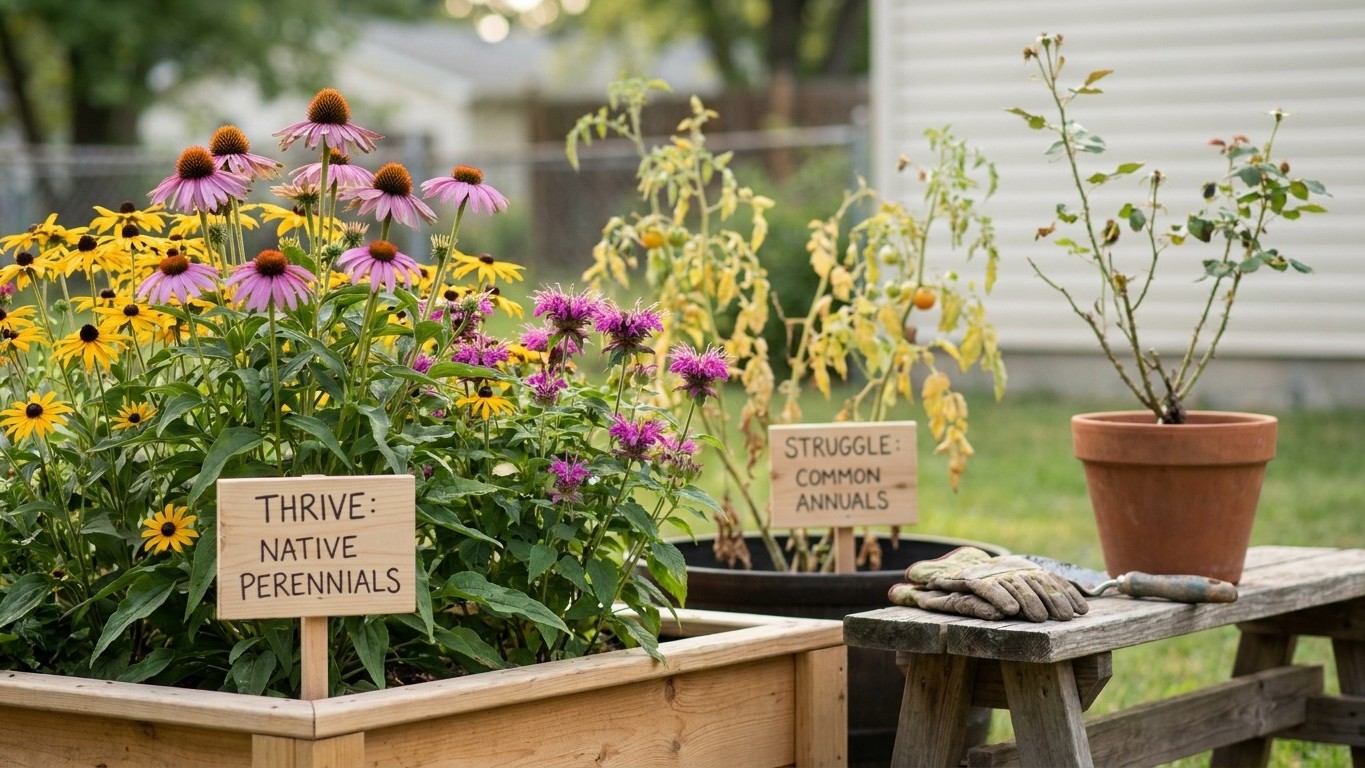

Illinois grows a wide range of flowers well, but winter cold is what separates the plants that come back from the ones that don’t. NOAA’s 1991-2020 climate normals put the coldest month’s average low at 18.8°F at the Chicago reference station, and the USDA Plant Hardiness Zone Map puts the state at zones 5a to 7b overall. Flowers built for that kind of cold and for Midwest summer humidity, like purple coneflower, black-eyed Susan and garden phlox, thrive here without much coddling. Before you buy anything, check your county’s USDA zone against the number on the plant tag, since a zone 7 label bought at a big-box store often won’t survive a northern Illinois winter.
What thrives in Illinois

Zone 5b winters here can bottom out near -15°F, and that single fact eliminates more flowers from an Illinois bed than any summer heat wave ever will. Peonies and daylilies shrug it off; a lavender bred for coastal England often doesn’t make it to March. The plants that actually thrive share deep roots and a tolerance for both hard freezes and humid, soggy summers, while the ones that struggle usually fail at one end or the other, not both.
Heat and humidity matter too
Summer is the other half of the equation, and it’s a gentler test here than in the Deep South. NOAA’s Chicago normals show 14.0 days a year reaching 90°F or hotter, a moderate heat load that most temperate perennials handle without extra irrigation once they’re established. The bigger stress in a wet Illinois summer is often humidity and soggy soil rather than heat itself, which is why good drainage matters as much as sun exposure when you’re choosing a planting spot.
The plant families that carry both traits, cold tolerance and heat-and-humidity tolerance, are worth learning by name rather than by vague description:
- Asteraceae: coneflower, black-eyed Susan, aster, tickseed
- Lamiaceae (the mint family): catmint, bee balm, salvia
- Iridaceae: Siberian iris, bearded iris
- Fabaceae: false indigo, wild lupine
These families evolved or were bred across a wide swing of temperature and moisture, which is exactly the swing an Illinois garden delivers. Drought resistance matters less here than in the arid West, but it still counts in a dry August, and the same deep-rooted plants that tolerate winter cold usually shrug off a few dry weeks too.
Native plants worth the space
A native plant that’s spent thousands of years adapting to the tallgrass prairie region doesn’t need the babying an imported ornamental does. Once its root system is established, usually by the second full season, it asks for less water, less fertilizer and less fungicide than a bred cultivar, because it already matches the local rainfall pattern and the local soil microbes. That’s the practical argument for natives. The ecological one is just as strong: native flowers are what native pollinators evolved to use, and many specialist insects can’t complete their life cycle on an exotic substitute no matter how similar it looks.
Plants to look for
Rather than reaching for a vague label like “pollinator-friendly,” look for these species native to the wider tallgrass prairie and Midwest region:
- Purple coneflower (Echinacea purpurea) — coarse, upright, blooms through summer heat
- Black-eyed Susan (Rudbeckia hirta) — short-lived but self-seeds reliably
- Butterfly milkweed (Asclepias tuberosa) — the host plant monarch caterpillars actually need
- Wild bergamot (Monarda fistulosa) — draws bumblebees and hummingbird moths
- New England aster (Symphyotrichum novae-angliae) — late-season nectar when little else is blooming
- Prairie blazing star (Liatris pycnostachya) — tall spikes, good for cutting
None of these need a specialty nursery. Most garden centers across the state carry the straight species or a named cultivar of it. The one thing not to skip is checking that a “native” cultivar hasn’t been bred so heavily for double flowers that pollinators can no longer reach the nectar, which does happen with some coneflower selections.
Gardeners just across the state line deal with the same tallgrass-prairie palette and the same buying decisions, which we cover in our guide to Flowers That Actually Thrive in Indiana, and the Ones That Struggle.
Perennials that come back

“Perennial” on a plant tag is a conditional promise, not a guarantee. It means the plant lives more than one growing season somewhere. Whether it lives more than one season in your yard depends on matching its listed hardiness zone against your own. Illinois spans zones 5a to 7b, and the Chicago reference station sits at the colder end of that spread, so a tag reading “hardy zones 4-8” is a safe bet almost anywhere in the state, while “hardy zones 7-10” is a plant you’ll be replanting every spring.
Reading the tag against your zone
| Plant | Hardy to USDA zone | Bloom season | Typical height |
|---|---|---|---|
| Peony (Paeonia lactiflora) | Zone 3 | Late spring | 2-3 ft |
| Garden phlox (Phlox paniculata) | Zone 4 | Mid to late summer | 2-4 ft |
| Russian sage (Perovskia atriplicifolia) | Zone 4 | Summer to fall | 3-4 ft |
| English lavender (Lavandula angustifolia) | Zone 5 | Early summer | 1-2 ft |
The lavender is the borderline case worth noting. It’s rated to zone 5, which technically covers the northern part of the state, but it dislikes the wet, heavy clay common in many Illinois yards more than it dislikes the cold itself. Good drainage, not zone alone, decides whether it survives a winter here.
Plenty of garden-center favorites are perennial by nature but grown here strictly as annuals, because the winter kills them outright rather than just setting them back. Dahlias, tuberous begonias, verbena bonariensis and most geraniums (technically Pelargonium) fall into this group. Their roots or tubers can be dug and stored indoors over winter if you want to keep the same plant going, but left in the ground they won’t take an Illinois winter low anywhere close to NOAA’s 18.8°F average for the coldest month.
Gardeners farther north face an even colder version of the same sorting problem, which we cover in our guide to Flowers That Actually Thrive in Ontario, and the Ones That Struggle.
Putting a border together
A border reads as a planned space rather than a scattered collection when it’s layered by height, front to back or short to tall around an island bed. Put low edging plants like catmint or dwarf coreopsis at the front, mid-height bloomers like coneflower and phlox in the middle, and taller anchors like Russian sage or blazing star at the back or center. Skipping this layering is the single most common reason a new border looks messy even when every individual plant is healthy.
Bloom succession and spacing
Illinois’s growing season, framed by a last spring frost of April 11 to April 22 and a first fall frost of October 24 to November 3 at the Chicago reference station according to NOAA’s NCEI normals, runs long enough to plan for three overlapping bloom windows rather than one big spring show. Peonies and iris carry late spring. Coneflower, bee balm and phlox carry the middle of summer. Aster, blazing star and Russian sage carry it into fall. Planting for all three means something is always in flower, instead of three weeks of color followed by a green wall of foliage.
Repeating the same two or three colors at intervals down the border, rather than using one of everything, is what makes a bed look intentional in a photograph and from across the yard. A border of one purple coneflower, one orange butterfly milkweed and one yellow black-eyed Susan repeated three or four times reads as designed. The same three plants used once each, scattered among a dozen other one-offs, reads as cluttered.
Leave real space at planting time. A perennial in a one-gallon pot looks lonely at 12 inches from its neighbor, but most of the plants named above reach 2 to 3 feet of spread within two seasons, and crowding them now just means digging and dividing sooner than you’d like.
Local help
Illinois Extension runs county-based Master Gardener programs that keep plant lists tailored to local soil and microclimate rather than the state-wide average. Since conditions shift noticeably between the Chicago area and southern Illinois, a county office’s advice will fit your actual yard better than any state-wide figure can. Start at the Illinois Extension website to find your county office, and browse our other Illinois guides for more county-specific planting advice.
Common questions
Can I grow lavender in Illinois?
Yes, in most of the state, but drainage matters more than the winter cold itself. English lavender is rated hardy to USDA zone 5, which covers much of Illinois, but it rots in heavy wet clay long before a normal winter would kill it. Raised beds or gritty, amended soil solve this more often than picking a “hardier” variety does.
Why did my perennial come back one year and die the next?
Usually it’s an unusually harsh or unusually wet winter, not a one-time fluke. A plant rated for your zone on paper can still fail in a winter with a hard freeze right after a warm spell, or in a spot with poor drainage that lets roots sit in ice water. Check whether the same plant struggled elsewhere in your yard that same year before assuming it’s simply not suited to your area.
Do I need to deadhead native flowers?
Not for the plant’s health, but it does control reseeding. Black-eyed Susan and purple coneflower will self-sow readily if you leave the spent flower heads on, which some gardeners want for a naturalized look and others find too aggressive in a formal border. Leaving seed heads through fall also feeds birds, so many native-plant gardeners skip deadheading on purpose.
What’s the difference between an annual and a perennial that’s “grown as an annual”?
A true annual completes its life cycle and dies in one season no matter where it’s grown. A plant “grown as an annual” here, like dahlias or most geraniums, is genuinely perennial in a warmer climate but can’t survive an Illinois winter, so gardeners either replant it each spring or dig and store the tubers indoors over winter.
Related guides
- Flowers That Actually Thrive in Wisconsin, and the Ones That Struggle
- Flowers That Actually Thrive in Iowa, and the Ones That Struggle
- Flowers That Actually Thrive in Indiana, and the Ones That Struggle