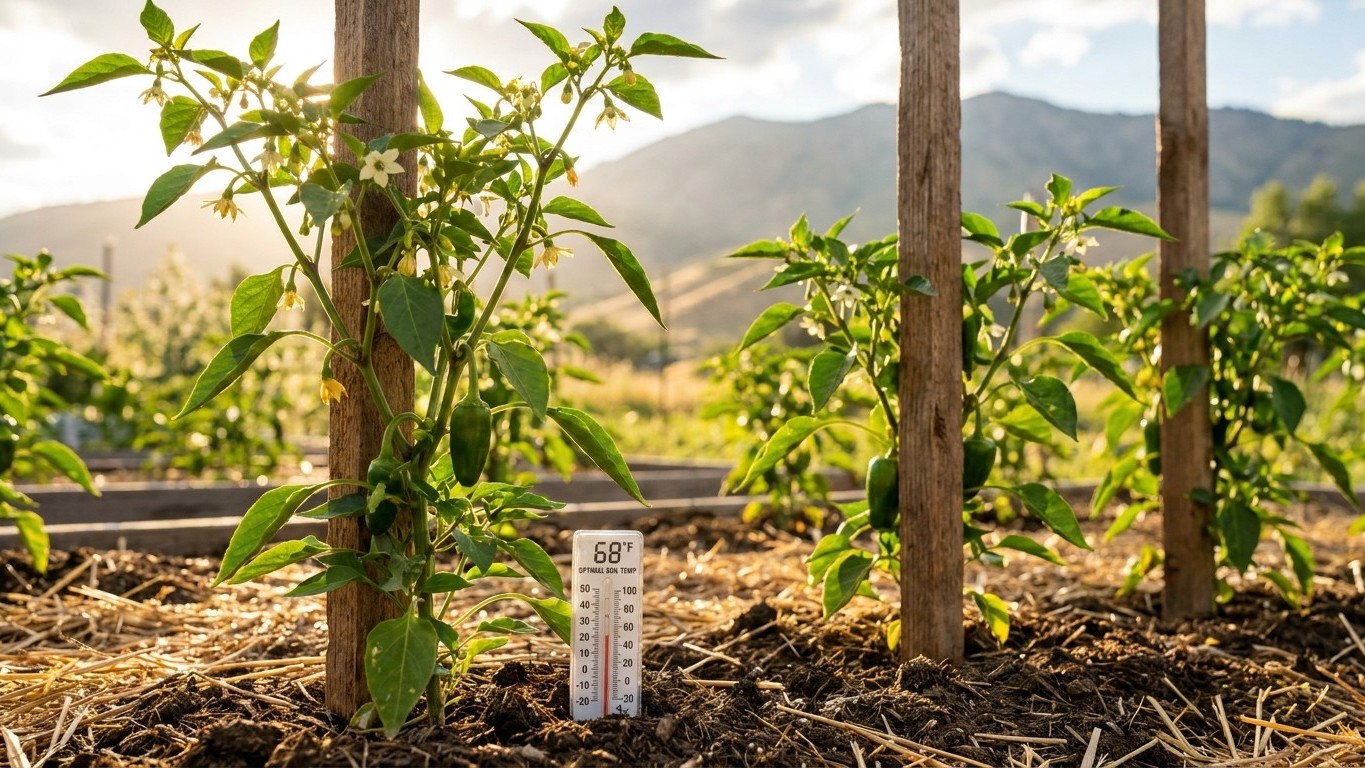

Illinois gardeners can ripen a full pepper crop if they match variety maturity to the state’s frost-free window and start seed early enough indoors. The season runs roughly from mid-April to early October in most counties, with heat spikes in July and August that pepper flowers don’t always tolerate. Getting the timing right matters more than the variety label on the seed packet.
The short answer

The Chicago reference station averages 14.0 days a year at or above 90 F, based on NOAA’s 1991-2020 climate normals. That number sounds small, but those days rarely spread out evenly across the summer. They tend to cluster in July and into early August, often stacking two or three in a row during a heat wave. That clustering matters more than the annual total, because pepper flowers can abort pollen when daytime temperatures climb past that 90 F mark for several days running. A plant loaded with blossoms can drop most of them during one bad week, then recover and set fruit again once temperatures ease back down.
Fourteen days a year isn’t a crisis. It’s a predictable stretch of weather that shows up most summers, and gardeners who know it’s coming can plan around it, shading plants or simply expecting a lull in fruit set during the hottest run of the season.
The other failure point sits at the opposite end of the thermometer. Pepper fruit set also stalls when nighttime temperatures drop below 55 F, according to Utah State University Extension. Cool nights interfere with pollen viability just as surely as extreme heat does, and this is the threshold gardeners overlook most often, because they’re watching daytime highs and forgetting what happens after sundown.
This is where the data runs out. This site tracks daytime heat, not summer overnight lows, for Illinois territories. Illinois covers a lot of ground, from river-bottom microclimates to open prairie to lakefront neighborhoods, and nighttime lows vary by more than a few degrees between those settings even on the same calendar date. A gardener in a low-lying spot near a creek can see nights dip into the mid-50s in early June or again in September, while someone a few miles away on higher ground stays warmer. Don’t guess at this number from latitude or from how cold January gets in your area. Those figures tell you nothing about a June or September night. Keep a simple outdoor thermometer nearby during the shoulder months and check it before bed. If nights are running below 55 F for several days straight while your plants are flowering, expect fewer peppers to set until temperatures climb back up.
When to start seed here
Working backward from transplant date is the most reliable way to figure out when to start pepper seed indoors, and the math holds up no matter which county you garden in.
- Find your local last spring frost date. The Chicago-area reference station shows a 30 to 70 percent probability band of a 32 F freeze running from April 11 to April 22. That’s a airport-station figure, and suburban and rural gardens typically see their last frost land later than this, often by one to two weeks, sometimes more at higher elevation or in low-lying cold pockets. Check your own county’s extension data or frost history rather than borrowing the airport number outright.
- Wait for the soil, not just the calendar. Pepper transplants need soil at 60 F before they go in the ground, per Utah State University Extension. Air temperature can feel warm on a sunny April afternoon while the soil underneath is still cold from winter. This gap between frost date and 60 F soil can run anywhere from one to three weeks depending on how quickly spring warms up in a given year.
- Set your transplant date. Combine the frost clearance with the soil-warming lag. For most Illinois locations, that lands somewhere in the back half of April through mid-May, but the only way to know your date is to track soil temperature yourself with a simple probe thermometer.
- Count back 8 to 10 weeks from that transplant date. This gives you the date to start seed indoors. Use the full 10 weeks if you’re germinating without a heat mat, since pepper seed can be slow and uneven in cool rooms. Use closer to 8 weeks if you’ve got bottom heat and consistent warmth, since germination and early growth move faster under those conditions.
- Mark both dates on a calendar and check them against your own weather, not a generic schedule. A late cold snap or a slow spring can shift the transplant date by a week or more, and it’s easier to hold seedlings a few extra days indoors than to rush tender transplants into cold soil.
This backward count is worth redoing every year rather than relying on a fixed date, since Illinois springs vary enough from one year to the next that a date locked in from memory can leave seedlings too small or too leggy by the time the ground is actually ready.
What goes wrong here
- Blossom drop during a heat spell or a cool snap. Pepper flowers abort at both extremes: daytime highs above 90 F (which the Chicago reference station logs an average 14.0 days a year) and nighttime lows below 55 F. During a heat wave, rig 30 percent shade cloth over plants during peak afternoon hours to knock a few degrees off the leaf and flower temperature. During an unexpected cool night in late spring or early fall, cover plants with row cover or a bedsheet to trap ground heat overnight. Neither fix reverses damage already done, but both reduce how many flowering cycles get hit.
- Sunscald on exposed fruit. Illinois summer sun is intense enough to scorch pepper fruit that loses its leaf cover, whether from over-pruning, leaf drop after disease, or wind damage. Scalded spots turn pale, then papery, and the fruit often rots from that point inward. Keep the plant’s natural canopy intact rather than pruning heavily for airflow, and add shade cloth over exposed rows during the hottest stretch of summer if leaf cover thins out on its own.
- Blossom-end rot on the fruit’s bottom end. This shows up as a flat, dark, leathery patch opposite the stem and comes from a calcium delivery problem inside the plant, usually triggered by uneven watering rather than a true soil calcium shortage. Illinois summers swing between dry stretches and heavy downpours, and that swing is exactly what interrupts a plant’s ability to move calcium into developing fruit. Mulch heavily to even out soil moisture, water on a consistent schedule rather than waiting for visible wilting, and avoid heavy nitrogen fertilizer, which pushes leafy growth at the expense of calcium uptake into fruit.
Common questions
How many pepper varieties actually finish ripening in an Illinois season?
That depends on matching a variety’s maturity length to the safe window between your transplant date and your first fall frost, not on any fixed count. Seed packets and Utah State University Extension both point gardeners toward checking days-to-maturity against their own local season length rather than assuming a specific number of varieties will work statewide.
Is 8 weeks or 10 weeks better for starting pepper seed indoors?
Both fall within the range Utah State University Extension recommends. Ten weeks gives slower, cooler-room germination more room to catch up; eight weeks works if you’re using bottom heat and steady warmth to speed things along.
Can pepper seed be sown directly into Illinois garden soil?
Direct-seeding isn’t the practical route here. The combination of a frost-dependent start date and the 8 to 10 week indoor lead time means transplants are the only way to get pepper plants flowering early enough to use the full season.
Does watering on a schedule fully prevent blossom-end rot?
Consistent watering handles most of the problem, since it’s usually the swing between dry and soaked soil that interrupts calcium movement into fruit. It won’t fix rot caused by a genuine soil calcium deficiency, which is a separate issue best confirmed with a soil test rather than assumed.