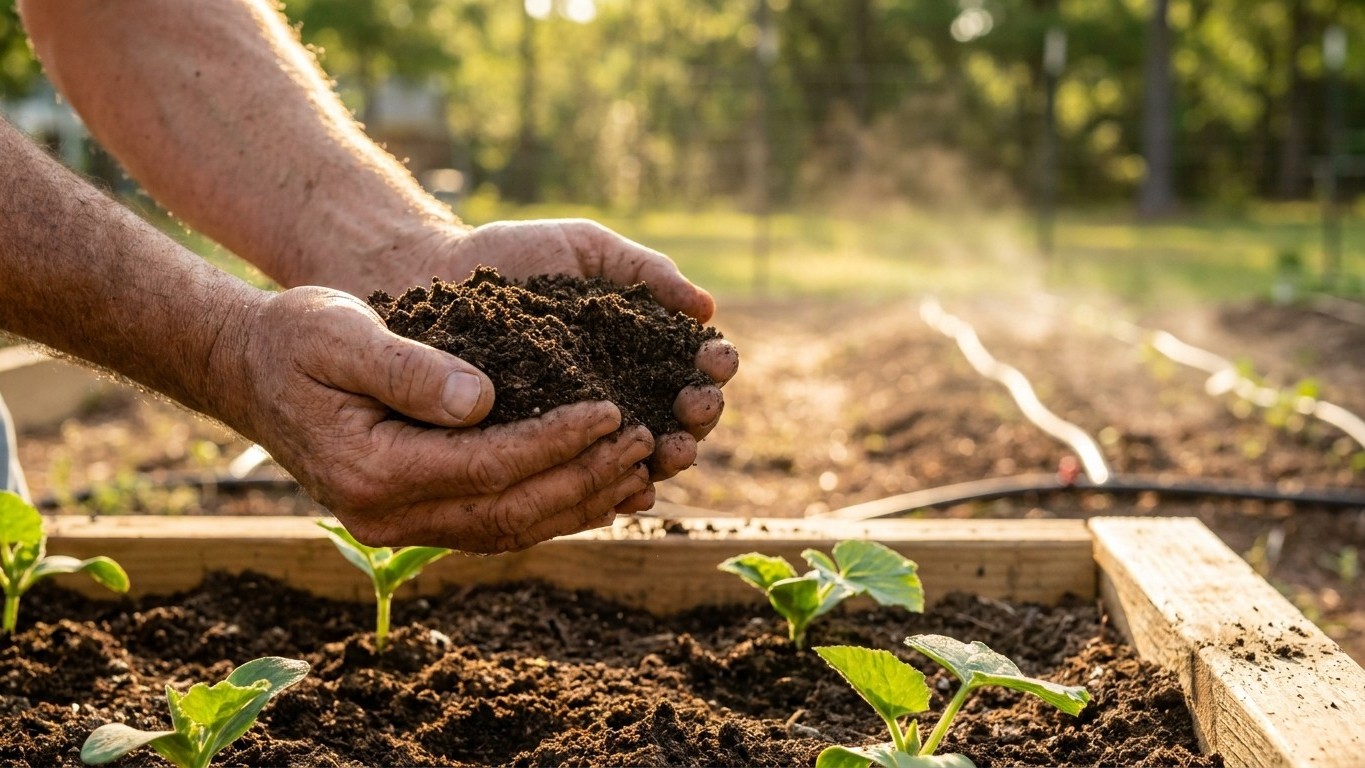

Summer squash goes into Michigan gardens once the soil itself has warmed, which lags a week or two behind the last frost date. Most of the Lower Peninsula can start seeding or transplanting in mid-May, and the plants keep producing until the first hard frost in October, giving a working season of roughly five months for gardeners who plant on time and manage the state’s damp, moderately warm summers.
When the soil is warm enough in Michigan
The question every Michigan gardener asks first is when to actually put seed in the ground, and the honest answer starts with frost, not soil. According to MSU Extension’s Frost-Free Dates data, the last spring frost falls around April 30 in the Detroit area, with early to mid May the pattern across most of the Lower Peninsula. That date matters, but it is a proxy, not the real trigger. Summer squash doesn’t care about frost directly. It cares about soil temperature, and soil takes longer to warm than the air does after the last freeze passes.
A frost date is also a probability, not a promise. MSU’s figure is an average drawn from decades of records, which means some years bring a freeze after April 30 in the Detroit area, and some years the ground stays cold well past the calendar date even with no frost at all. Planting exactly on the average date is a reasonable bet, not a guarantee.
What this means in practice is that squash planted the same week as the last frost date often sits in cold, wet soil and simply rots instead of germinating. The safer approach is to wait until the soil has had a stretch of warm days behind it, which in most of the Lower Peninsula lands somewhere in the back half of May rather than right at the frost line itself. Gardeners in the far northern counties or at higher elevations should push that later still, since the same frost-free date listed for the Detroit area doesn’t apply evenly across the whole state.
Types, not names
This is also the point where it helps to think in terms of squash types rather than specific varieties. Zucchini, yellow straightneck, crookneck, and scallop or pattypan types all behave differently in cool, damp soil, and the specific cultivars that perform best in a given Michigan county change from year to year based on what the local extension trials show. Rather than naming a variety here, the more useful move is checking with MSU Extension’s outreach directory for the trial results closest to a specific address, since that’s the only recommendation grounded in local data rather than guesswork.
Direct seeding versus starting transplants indoors comes down to the same soil-temperature logic. Transplants give a head start on a short window, but squash seedlings are notoriously fussy about root disturbance, so any transplanting should include a quick root check before the plant goes into the garden, confirming the roots haven’t circled the container and bound up on themselves.
How long the season lasts here
Michigan’s growing window for summer squash runs from that mid-to-late May planting point to the first fall frost, which MSU Extension’s Michigan Garden Calendar places between October 6 and October 21 for zone 6a. Stacking the two dates together gives a working season of somewhere around 145 to 175 days, depending on exactly where in the state a garden sits and which end of each frost range applies locally. That’s a wide window by northern-state standards, and it changes what’s worth attempting in a single year.
A season that long isn’t just enough for one planting to limp to the finish line. It’s enough to justify a second sowing partway through summer, timed so the new plants mature before the fall frost risk climbs back up in October. Squash plants also tend to slow down and get woody or disease-prone by midsummer even without a frost forcing the issue, so a fresh planting in late June or early July often outproduces a single spring planting that’s been fighting powdery mildew and squash vine borer for two months straight.
Whether that second sowing makes sense for a specific garden depends on the details of spacing, soil fertility, and how the first planting is doing, which is exactly the kind of decision covered in more depth in this site’s guide to succession sowing for summer squash. Michigan’s frost-free stretch is generous enough that skipping the second planting is a choice, not a necessity forced by a short calendar.
The flip side is transplanting strategy. In territories where the frost-free window barely covers one planting, starting seedlings indoors to shave a few weeks off the calendar is almost mandatory. Michigan’s longer window takes some of that pressure off, which means direct seeding outdoors, simpler and easier on the roots, is a perfectly viable default for most gardeners here rather than a compromise.
Heat and water in Michigan
Summer squash fails in two opposite ways: heat that kills pollen viability and dries out those enormous leaves faster than shallow roots can keep up, or cool, damp conditions that invite mildew and stall ripening. Michigan’s climate normals point clearly toward the second problem, not the first.
NOAA’s Climate Normals for 1991-2020, measured at the Detroit reference station, put the average number of days reaching 90°F or higher at just 10.3 a year. That’s a low heat load. It means the classic hot-climate squash problems, poor pollen set from extreme heat and leaves wilting faster than roots can pull water, aren’t the main threat in most Michigan gardens most summers. Nights stay cool too, which is generally kinder to fruit set than a run of scorching days would be.
The bigger risk in Michigan is the opposite: a cool, humid summer that slows ripening and gives powdery mildew and other fungal diseases time to take hold on squash’s broad, low-hanging leaves. Rainfall data backs this up. The same reference station recorded about 10.0 inches of rain across June, July, and August, with a fairly even split of 3.26 inches in June, 3.51 in July, and 3.26 in August, the driest of the three summer months. That’s a moderate, steady rainfall pattern rather than a drought-prone one, and it’s exactly the kind of humidity that keeps foliage damp longer than it should be.
None of this means irrigation is irrelevant. August’s dip to 3.26 inches, combined with whatever heat does occur, can still leave a garden short on water during fruit sizing, especially on sandy soil that drains fast. On clay, the same rainfall total behaves very differently, holding moisture for a week or more instead of a day. A rain gauge on the actual plot is the only way to know which situation applies, since these are 30-year averages for one reference station, not a forecast for any specific yard.
Watering at the soil line rather than overhead, and giving plants enough spacing for airflow between leaves, does more for a Michigan squash patch than shade cloth or heat mitigation ever would. USDA’s Plant Hardiness Zone Map, built on 1991-2020 average extreme minimum temperatures, places Michigan across zones 4a to 6b, with Detroit itself typically cited as the reference point for dated advice. Gardeners farther north or at higher ground should expect that range to run colder still.
Which summer squash suit Michigan
Given a moderate heat load, a season long enough for two plantings in many counties, and a humid climate that favors fungal disease over heat stress, the type of summer squash that makes sense here follows fairly directly from those three facts. Disease resistance, particularly against powdery mildew, matters more in Michigan than in a hotter, drier state, since the humidity and rainfall pattern here give mildew plenty of opportunity across a long growing season.
Earlier-maturing types are worth favoring for anyone planning a second sowing, since a faster type leaves more room for that midsummer succession planting to finish before the October frost risk sets back in. Types with more open, airy growth habits also help, since better air circulation around the leaves counters the same humidity that pushes mildew.
Broadly, the squash types worth considering for a Michigan garden fall into a few familiar categories:
- Zucchini types, generally fast to mature and widely available with mildew-tolerant selections
- Yellow straightneck and crookneck types, similar timing to zucchini with different fruit shape
- Scallop or pattypan types, often a bit slower but with a distinct flavor and texture some gardeners prefer
What this page won’t do is name a specific cultivar within any of those categories, and that’s a deliberate choice rather than an oversight. Which particular variety of zucchini or straightneck actually performs best against Michigan’s mildew pressure and moderate heat changes from year to year and from county to county, based on trial results that only the state’s own extension network tracks in real time. Naming one here would mean guessing, and a guess dressed up as a recommendation is worse than no recommendation at all.
The reliable next step is checking MSU Extension’s outreach directory for the office covering a specific county, since that’s where the actual trial data on which varieties held up against local disease pressure and local weather actually lives. That’s not a brush-off. It’s the only source close enough to a specific garden to be worth trusting over a general answer.