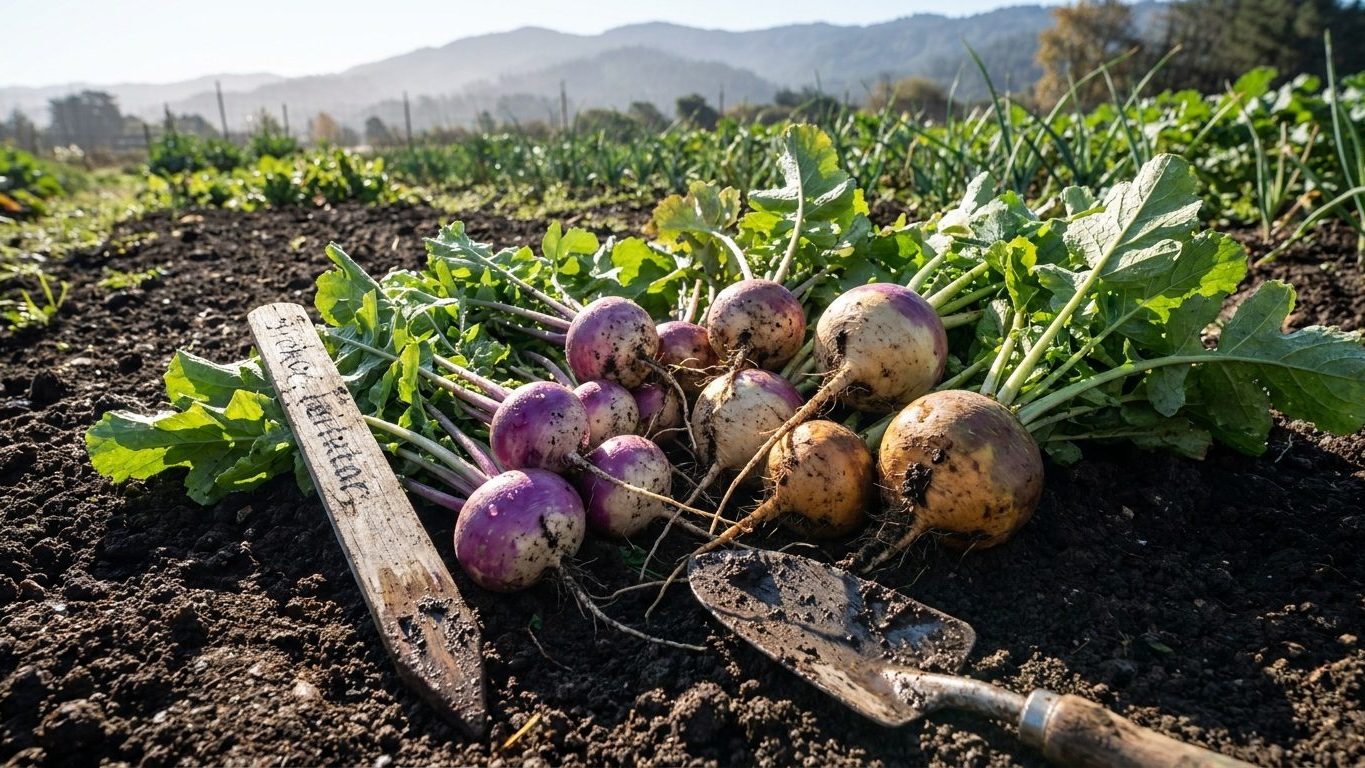

Illinois gardeners get roughly six months between the last spring frost and the first fall freeze at the reference station, which is enough for both crops but not enough to grow them the same way. Fast turnip varieties handle a spring and a fall planting here; rutabaga only works as a single fall crop, timed backward from autumn frost.
The short answer for Illinois
Turnips and Rutabaga are not interchangeable in this state, and the difference comes down to days to maturity against Illinois’s frost calendar. At the reference station, the last spring frost falls between April 11 and April 22, and the first fall frost arrives between October 24 and November 3. That’s a working season of roughly six months, but summer in between runs hot and humid, and neither crop tolerates that stretch well.
Turnips mature fast, most varieties in the 40 to 60 day range, which means Illinois gardeners can run two crops around that summer gap: one sown as soon as the soil is workable in April, harvested before June heat turns roots woody, and a second sown in late summer for a fall harvest that finishes in the cool, sweet weather turnips actually prefer. Rutabaga is a different animal. It needs 90 to 100 days and actively dislikes heat, developing bitter, tough roots if it matures during a hot stretch. That rules out a spring planting almost everywhere in Illinois. The only planting that reliably works is a single fall crop, sown so the 90-to-100-day clock finishes close to that October 24 to November 3 frost window, which puts the sowing date around mid-July for most of the state.
So the short version: pick fast turnip varieties for a spring crop, plan a fall turnip crop as insurance, and treat rutabaga as a one-shot fall planting anchored to Illinois’s autumn frost dates, not its spring ones. Varieties bred for quick maturity and heat tolerance earn their keep here; anything marketed as slow and mild-climate is fighting the state’s summer from the start.
What will not work here

The clearest failure mode in Illinois is timing a spring turnip crop by the calendar instead of the weather. The last frost window itself, April 11 to April 22 at the reference station, is an 11-day spread of roughly even odds, not a fixed date, and a cold snap after germination followed by a fast warm-up is a known trigger for turnips bolting to seed instead of forming a root. Gardeners who sow the moment the calendar says “safe” and then get a late cold pulse often lose the whole planting to premature flowering by early June.
Summer heat is the second failure point. Illinois summers run hot and humid enough that any turnip or rutabaga root still sizing up in July gets pithy, cracked, or bitter, regardless of variety. This is why rutabaga has no realistic spring option here: even the earliest sowing puts root development squarely inside the hottest six to eight weeks of the year. Watering on a weekly schedule compounds the problem. Roots that need even soil moisture to stay tender go woody when irrigation is stretched to convenience rather than to the soil’s actual dry-down rate during a heat spell.
Humidity creates a third, quieter failure: disease pressure from planting too tight. Turnip and rutabaga foliage packed close together in Illinois’s muggy summer air holds moisture on the leaves longer after rain or dew, which is exactly the condition that lets downy mildew and other foliar fungal issues take hold. Wider spacing than the seed packet’s minimum is not optional here; it’s what keeps air moving through the row.
Winter storage is the fourth trap, and it’s specific to how cold Illinois nights actually get. The coldest month here averages a nightly low of 18.8°F, a mean, not a record low. Rutabaga left in the ground unmulched into December, on the assumption that “roots are tough,” meets that average regularly, and unprotected roots do split or rot at the crown when soil freezes hard around them. Anyone planning to leave roots in the ground past the first freeze needs to mulch heavily before winter sets in, not after the first cold snap makes the ground too hard to work.
What changes across Illinois
Illinois is not one climate for root vegetables. The USDA Plant Hardiness Zone Map places the state across a spread of 5a to 7b, and that range describes a real difference in winter cold, not a rounding error. A garden at the cold end of that spread sees average extreme lows meaningfully harsher than one at the warm end, which changes both when it’s safe to plant and how long roots can safely stay in the ground come fall.
The practical shift for a gardener in the colder part of the state is to move the whole fall schedule earlier. Because the growing season effectively ends sooner where winter arrives harder, rutabaga’s 90-to-100-day clock has to start earlier than the July date that works for the reference station, and any mulching for overwinter storage needs to go down sooner rather than being timed to a single statewide date. A gardener in the milder end of the range has the opposite adjustment: fall turnip plantings can go in later, and there’s more room to let rutabaga sit in the ground a few extra weeks past frost without the same freeze-and-split risk.
None of this can be pinned to a single number for “Illinois” as a whole, because the state genuinely spans that zone range from north to south. A reader trying to time a fall rutabaga sowing gains more from finding where their own garden sits on the hardiness zone map than from any statewide average. Shifting timing by roughly two to three weeks earlier or later than the reference-station dates in this guide is a reasonable adjustment once a gardener knows which end of that 5a-to-7b range they’re actually gardening in.
Where to check this for your own county
Everything above is built on one weather station and one statewide hardiness range, and Illinois is too long, north to south, for a single planting date to fit every county. The University of Illinois Extension, at extension.illinois.edu, is the source built to close that gap, and it’s worth using for two specific things rather than a general browse.
First, look for the local planting calendar tied to your county or region rather than a statewide one. County-level guidance from an extension office accounts for local frost patterns, soil types, and microclimates that a statewide average, like the frost dates cited throughout this page, can’t capture. If a county calendar gives a different sowing window than the one here, the county figure wins, because it’s built from more localized data than a single reference station can provide.
Second, look for which turnip and rutabaga varieties have actually been trialled in your area. Extension offices and university trial programs test varieties under regional conditions and publish which ones held up to local heat, disease pressure, or storage demands, information a national seed catalog description can’t offer. A variety that performs well in trials run in the northern part of the state may not be the same one recommended for the south, given the zone spread already discussed.
This page is the statewide version of that answer: useful for understanding the pattern across Illinois, but built to be a starting point, not the final word for one specific garden. A county-level recommendation, built on local frost records and local variety trials, will always beat a state-level one when the two disagree, and checking that county source before committing seed to ground is the single most useful next step this page can point to.
Checking this against your own garden
Every date on this page comes from one weather station’s 30-year average, and any actual garden can run a week or two ahead of or behind that average depending on how it sits: low ground that holds cold air, a south-facing bed that warms early, heavy clay that stays wet and cold longer than sandy loam. The reader’s own soil, checked by hand, outranks the calendar every time.
The first thing to check is soil texture underfoot in spring. Soil that’s ready for turnip seed crumbles loosely when squeezed and falls apart on release; soil that’s still cold clumps into a tight, damp ball that holds its shape. Planting into that clumping soil, even if the calendar says the frost window has passed, usually means slow, uneven germination and a higher chance of the bolting problem described earlier.
The second is watching for the first true leaves, not just the seedling’s initial pair of cotyledons. True leaves that emerge quickly and stay a healthy green, rather than sitting stalled for a week, signal the soil has actually warmed enough for steady root development, which matters more for the summer-shy rutabaga crop than for turnips.
The third is watching the first hard frost’s effect on tender foliage nearby, like basil or tomato leaves going black overnight. That’s the practical signal to get any remaining rutabaga out of the ground or under mulch, since it means the ground temperature drop the crop needs to protect against has actually arrived, regardless of what the calendar date says that week. Anyone who acts on that first blackened-leaf morning rather than a printed date is working with information more specific to their own yard than any regional average can offer.