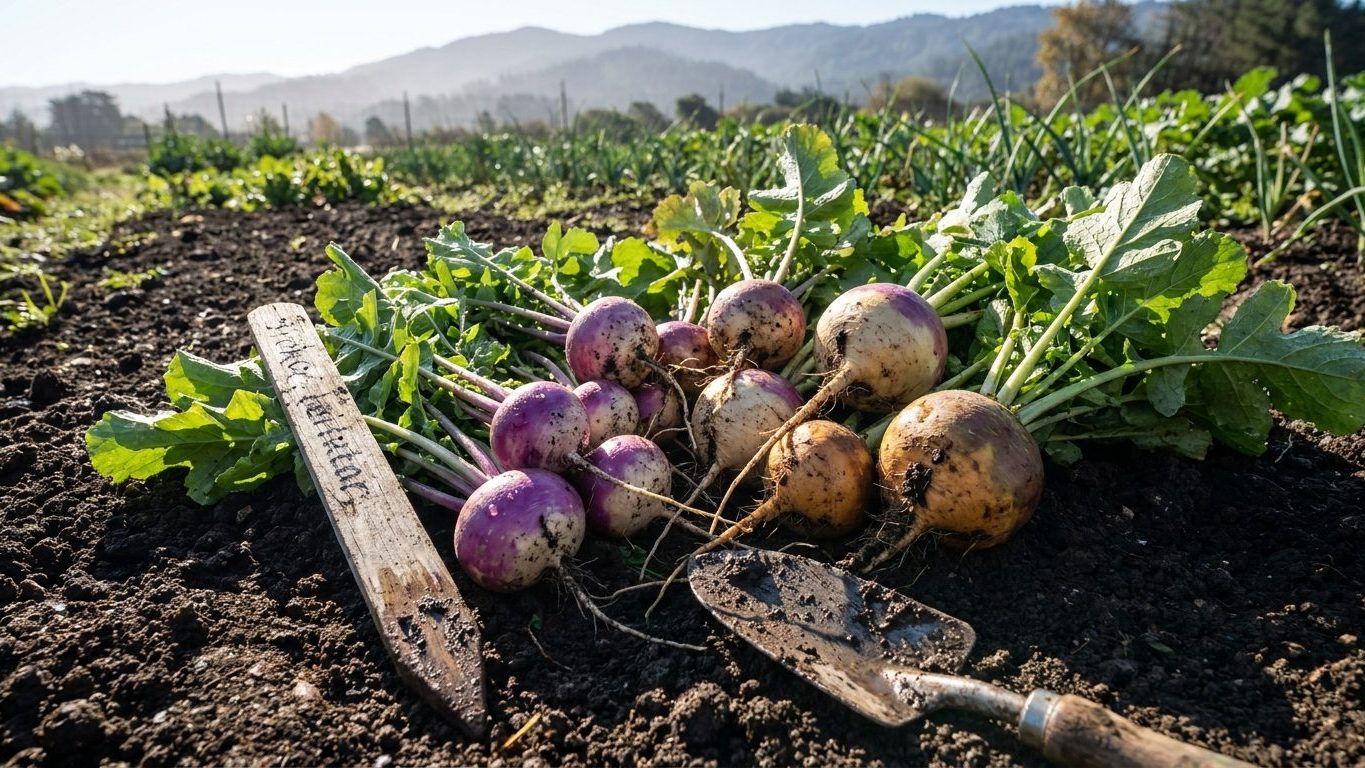

Quick turnips beat rutabaga almost everywhere in Iowa, and the reason comes down to Iowa’s short window between frosts. A 40- to 55-day turnip fits comfortably in either the spring or fall slot; a 90- to 100-day rutabaga only has room for one shot, planted in summer for a fall harvest.
The short answer for Iowa
Iowa’s frost-free season runs from a last spring frost of April 12 to April 24 to a first fall frost of October 14 to October 25, at least at the reference weather station used for these normals. That’s the optimistic end. Iowa State Extension’s own county-level figures, drawn from 1950-2021 records, run about four days later in spring and ten days earlier in fall than that airport number, so the real working season for most counties is shorter than the raw dates suggest.
That squeeze is what decides variety choice. A quick turnip such as Purple Top White Globe or a salad type like Hakurei, both in the 35- to 55-day range, can go in twice: once after the soil thaws in spring, once again in mid to late summer for a fall crop that finishes sweeter after cool nights. Rutabaga, which typically needs 90 to 100 days from seed to a storage-worthy root, doesn’t have that flexibility. It gets one window, and it has to be sown early enough that its long season lands before the first hard freeze.
Counting back from the earlier end of the fall frost window, a rutabaga sown by early July gives the crop its best shot at reaching full size before cold shuts the season down. Wait past that and a county on the shorter side of Iowa’s range may not deliver a rutabaga worth pulling.
| Type | Typical days to maturity | Iowa planting slot |
|---|---|---|
| Salad/quick turnip (Hakurei-type) | 35-45 days | Spring and again in late summer |
| Storage turnip (Purple Top White Globe-type) | 50-60 days | Spring or fall, one crop per slot |
| Rutabaga (Laurentian, American Purple Top-type) | 90-100 days | Single summer sowing for fall harvest |
This page can’t tell you which of those three lands best in your specific county because Iowa’s own extension trial data, not this state-wide page, is where county-level variety performance actually lives. More on that below.
What will not work here

The slowest storage turnips and any rutabaga sown after the early-July cutoff run straight into the wall Iowa’s fall frost date puts up. A 100-day rutabaga started in late July, in a county where the fall frost line sits at the earlier October 14 end rather than the later October 25 end, simply runs out of days. The root stays undersized, and a hard freeze on unprotected foliage stops growth for good.
Leaving roots in the ground over winter, the way some gardeners in milder climates do to stretch a harvest, is the other trap. Iowa’s coldest month brings a mean daily minimum of 13.8°F, and that number, not the record low and not the monthly average, is what actually decides whether roots survive underground. Turnip and rutabaga roots can take a light frost sitting in soil, but a sustained stretch with lows in the mid-teens will freeze and rot even fairly deep roots unless there’s substantial mulch and the ground hasn’t already frozen solid around them. Treat harvest before hard freeze as the plan, not overwintering in place.
On the other end of the calendar, a slow, thick-rooted spring turnip sown right after the last frost runs into Iowa’s early-summer heat before it’s had time to finish. Turnips are cool-season brassicas, and rising day length combined with warm soil pushes them toward bolting, the plant sending up a flower stalk instead of bulking the root, which turns the flesh woody and sharp-tasting. A fast salad type dodges this by finishing before the heat arrives; a slow storage type sown too late in spring often doesn’t.
Close, humid spacing is a smaller but real failure mode too. Turnip and rutabaga leaves crowd fast, and tight rows trap moisture against foliage in Iowa’s humid summers, which invites the leaf spot and downy mildew problems brassicas are prone to. Thinning matters more here than the seed packet spacing suggests, especially for rutabaga, which sits in the ground long enough for humid weeks to add up.
What changes across Iowa
Iowa spans hardiness zones 4b through 6a on the USDA map, built from average annual extreme minimum temperatures, and that spread matters more than it looks on paper. A zone 4b county and a zone 6a county aren’t experiencing the same winter extremes, which means the same fall-frost assumption doesn’t hold everywhere in the state either.
Northern Iowa counties, sitting toward the colder end of that range, tend to see their first fall frost arrive closer to the earlier part of the October 14 to October 25 window, and their growing season overall runs shorter than the state-wide dates imply. A gardener up there is better off treating the rutabaga sowing deadline as earlier, not later, and leaning harder on the quick turnip types for a fall crop that has any margin left.
Southern Iowa counties, closer to the milder end near zone 6a, generally get a few more days of buffer before that first freeze, which is exactly the kind of margin a slower storage turnip or a rutabaga sown a little later can use. Shift the sowing window earlier by roughly a week to ten days if you’re gardening in the northern part of the state rather than following the state-wide date at face value.
None of this tells an individual reader which zone their own yard sits in, and it shouldn’t try to. Zone boundaries follow terrain, elevation, and local features that a state-wide map can’t resolve down to a single property. The right move is checking the current USDA Plant Hardiness Zone Map against your own address, then treating this page’s dates as a starting point to adjust from, not a fixed schedule.
Where to check this for your own county
Iowa State University’s extension service, at https://www.extension.iastate.edu/, is where the state-wide numbers on this page get replaced with something more useful: a calendar and a variety list built around your own county’s conditions. That’s the resource worth bookmarking before the numbers above.
Two things are worth hunting for once there. First, the local planting calendar for cool-season root crops, which will reflect the county-level frost dates rather than the airport-station figures cited earlier, dates that Extension’s own research shows run about four days later in spring and ten days earlier in fall than the national climate normals. Second, any variety trial results specific to Turnips and Rutabaga in Iowa conditions, since county extension offices and university trial gardens test cultivars for disease resistance and yield under the state’s actual soil and weather, not generic seed-catalog claims.
A county-level recommendation will always beat a state-wide one, and this page is deliberately the state-wide one. It’s built to get a reader oriented across all of Iowa’s counties at once, from the colder northern tier to the milder south, which means it necessarily smooths over the exact differences a county office can speak to directly. If your county’s office publishes a specific turnip or rutabaga variety list, or a locally-adjusted sowing date, that document should override the general dates given here.
Extension offices also tend to know about regional quirks that don’t show up in climate data at all, things like a particular county’s tendency toward wet fall soils or an unusually late microclimate along a river valley, the kind of detail that only shows up after years of local trial plots.
Checking this against your own garden
Every date on this page is a starting estimate, and your own garden will tell you more than any calendar once the season is underway. Three signs are worth tracking by hand and eye rather than any tool.
Soil warmth by feel is the first. Turnip seed germinates reliably once soil has warmed past a cool, damp chill to something that feels closer to room temperature a few inches down, and that moment can arrive well before or after the calendar’s average last frost date depending on how your particular bed drains and faces the sun. A south-facing raised bed often warms a week or more ahead of a low, shaded corner of the same yard.
The first flush of flower buds on any spring-sown turnips is the second signal, and it’s a warning rather than a milestone. Once brassica plants start pushing up a flower stalk, root quality starts declining fast, which tells you your particular spot is running hotter or the plants went in later than your soil conditions could handle. Pull roots as soon as buds show rather than waiting for a picture-perfect size.
The third is simpler: watch for the first true leaves to appear, the second set that follows the rounded seed leaves. That’s the cue to thin seedlings to their final spacing, and how fast or slow that stage arrives compared to the seed packet’s estimate is a quiet but reliable readout of how your yard’s particular microclimate compares to the county averages this whole page is built on.