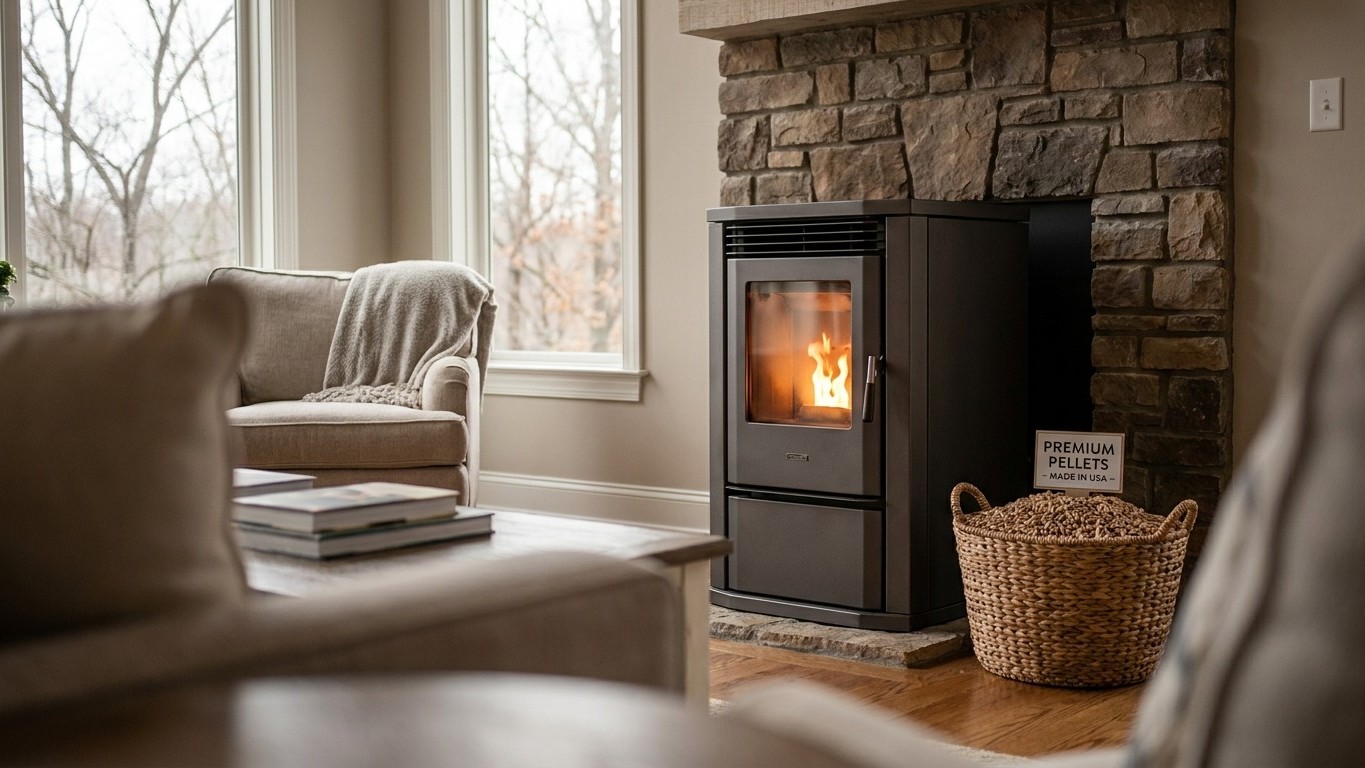

Pennsylvania winters are long rather than extreme, and that shapes everything about running a pellet stove here. At the Philadelphia reference station, the climate averages about 4,510 heating degree days a year across a heating season that runs roughly eight months, October through May. That means a pellet stove works hard for most of the year without facing the brutal single-digit stretches some northern states see. How many tons that takes, how you store them, and what an outage costs you all trace back to that one number and the months it spans.
How hard the winter works here

The figure that anchors this whole page is 4,510 heating degree days a year, recorded at Philadelphia International Airport, the NOAA reference station used for the 1991-2020 U.S. Climate Normals in southeastern Pennsylvania. Heating degree days work by adding up, for every day of the year, how far the daily mean temperature sits below 65 F. A house that needs twice as many degree days to stay comfortable burns roughly twice the fuel, all else equal. At 4,510, Pennsylvania sits in a middle range nationally, not the punishing cold of Minnesota or Maine, but well above the mild coastal Southeast. This is not a climate where a pellet stove is just atmosphere. It’s carrying real heating load.
The same station also logs about 1,358 cooling degree days, a reminder that Pennsylvania summers run genuinely humid and warm, not just mild. That contrast between a real winter and a real summer matters later, when storage comes up.
Depth and length are two different measurements, and the monthly breakdown shows both. The heating season starts in October, the first month whose normal mean temperature (58.2 F) drops below the 65 F base NOAA uses to count degree days. It peaks in January, then tapers into a mean above 65 F by June.
| Month | Heating degree days |
|---|---|
| January | 972 |
| February | 815 |
| December | 818 |
| November | 530 |
| March | 666 |
| October | 236 |
| April | 330 |
| May | 104 |
January alone carries more degree days than April, May, June, and September combined, which is exactly why the coldest six weeks of the year are where a pellet stove either earns its keep or gets exposed as undersized. One more thing worth saying plainly: Philadelphia International Airport is one station in a large, geographically varied state. Erie, the Poconos, and the Allegheny highlands all run colder than this figure. If you’re in one of those areas, treat 4,510 as a floor, not your actual number, and check your own county’s normals before sizing anything.
How many tons a winter takes here
Nobody can hand you a tons-per-winter figure for Pennsylvania that means anything, because two houses on the same street can differ by a factor of two. What you can do is build the estimate yourself, using the same math everyone else uses. A standard bag of wood pellets weighs 40 pounds. Fifty bags make a ton. From there, consumption follows heat demand, which is exactly what the degree-day figure above measures: more heating degree days over the season means more fuel burned to hold the same indoor temperature, in the same house, with the same stove.
Three things move that number more than anything else:
- How well the house holds heat. Attic insulation, air sealing around doors and rim joists, and window quality can swing fuel use by a third or more between two homes of identical square footage.
- Whether the stove is your only heat or a supplement. A stove carrying the whole load through a Pennsylvania winter burns far more than one that just takes the edge off while a furnace or boiler handles the base load.
- The setting it runs at. A stove left on a moderate, steady setting during the coldest stretch, versus one cranked to maximum output every cold snap, produces very different seasonal totals from the same bag count.
Given those swings, the only estimate worth trusting is the one you generate yourself. Count the bags you actually burn through your first full heating season, from that October start through the last cold nights in April or May, and use that number as your baseline going forward. It will be more accurate than any published average, because it already accounts for your house, your habits, and your specific setting choices. For a broader look at how the math scales nationally and what typical ranges look like across different climates, see our guide on how many pellets a winter takes.
Buying and storing them in this climate
Timing matters more than most buyers expect. With heating demand building fast, from 28 degree days in September to 236 in October and then jumping again in November, the smart window to buy is before that ramp starts, not during it. A regional cold snap in December or January can clear dealer shelves fast, and pellets bought in a scramble mid-winter tend to cost more than the same ton purchased in late spring or summer, when demand is flat and suppliers are moving through stock. Buying ahead of the October start isn’t just about price, it’s about availability when you actually need the bags.
Storing pellets against Pennsylvania’s climate
Wood pellets are compressed sawdust, held together by the wood’s own lignin rather than any added glue, which means moisture is their one real enemy. Pennsylvania’s humid summers, reflected in that 1,358 cooling-degree-day figure, push moisture into anything stored in an unconditioned space for months at a stretch. A garage that sweats in July, or a basement corner near a foundation wall, will pull dampness into a pallet of bags long before winter arrives. Once pellets absorb moisture they swell, lose their shape, and can crumble into sawdust that jams a stove’s auger instead of feeding it cleanly.
Pennsylvania winters bring their own moisture risk too, with rain, sleet, and melting snow around any outdoor storage. Bags kept off the ground on pallets, under a tarp or in a dry shed rather than directly against a damp slab, hold up far better through the full stretch from October delivery to spring. When you’re comparing options, compare price per ton rather than per bag, since that’s the only figure that lines up across different package sizes and suppliers. For more on protecting pellets from moisture and reading quality grades before you buy, see our pages on pellet storage and pellet quality standards.
What a winter outage means here
A pellet stove depends on electricity in a way a wood stove never does. The auger that feeds fuel into the firebox and the blower that pushes heated air into the room both run on a standard household circuit. Lose power, and the stove stops working within minutes, regardless of how full the hopper is. That single fact separates pellet heat from wood heat more than any other feature of the appliance.
How much that matters depends entirely on when the outage hits. During January, with 972 degree days of cold pressing on the house, a lost afternoon of power turns into a real heating emergency, especially overnight. During April or May, with degree days down near 330 and 104, the same outage is an inconvenience, not a crisis. The 4,510 annual total spans both ends of that range, so the honest answer is that Pennsylvania’s outage risk is seasonal, not constant.
What most Pennsylvania homes fall back on
According to EIA’s Residential Energy Consumption Survey, 56% of Pennsylvania households use a furnace as their main heating equipment, 19% run a steam or hot-water boiler, and 7% use a central heat pump. By fuel, natural gas leads at 52%, followed by electricity at 26%, fuel oil or kerosene at 13%, and propane at 6%.
| Main heating equipment / fuel | Share of PA households |
|---|---|
| Furnace | 56% |
| Steam or hot-water boiler | 19% |
| Central heat pump | 7% |
| Natural gas | 52% |
| Electricity | 26% |
| Fuel oil or kerosene | 13% |
| Propane | 6% |
Here’s the part worth sitting with: a furnace or boiler running on gas or oil still needs an electric igniter, circulator pump, or blower motor to move heat through the house. So a widespread outage in Pennsylvania often knocks out the primary system right alongside the pellet stove, not just the backup. That’s a different situation than in a state where wood heat can carry a house through a blackout on its own. Rather than guessing at a generator size or battery capacity here, check the wattage draw printed on your stove’s data label and read our national guide on what a pellet stove needs during a power outage before the next storm rolls through.