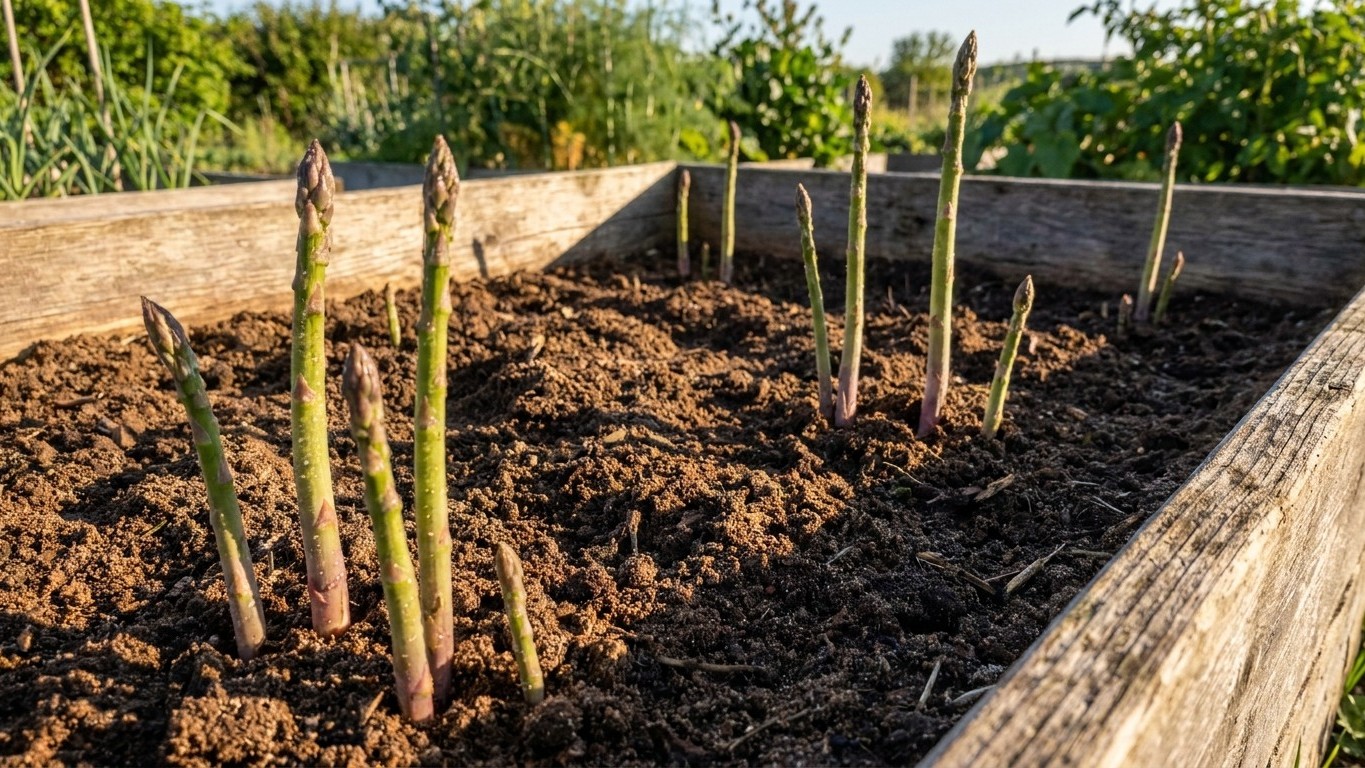

Yes, in most cases. The dominant soil across Iowa is well drained by USDA’s own classification, and that’s the single soil requirement an asparagus bed asks for before you commit a corner of the yard to it for a decade or more. The bigger question isn’t whether the ground will hold the bed. It’s whether your particular patch of ground matches the state’s representative profile.
The short answer
The soil that USDA lists as representative of Iowa is the Tama series, a Mollisol, the deep, dark prairie soil that built the Corn Belt. Its surface horizon runs about 4 percent sand, 26 percent clay and 70 percent silt, with organic matter around 3.5 percent and a surface pH near 6.5. USDA classifies it as well drained. That’s good news for asparagus, because Utah State University Extension is blunt about what the crop needs from the ground beneath it: most soils will work, provided they drain.
What “well drained” means for a silty, clay-heavy soil
A soil that’s 70 percent silt and 26 percent clay sounds like it should hold water and suffocate roots. On paper, that’s the profile of a soil that stays soggy. But “well drained” in USDA’s soil survey language is a field classification based on how water actually moves through and off a site, not just texture on a lab sheet. The Tama series earns that rating because of its structure and its position in the landscape, not despite its clay content. That’s a useful distinction for a gardener staring at a seed catalog: texture alone doesn’t tell you the whole story, and neither does a state-level soil series tell you about the low spot behind your garage where water sits for two days after every storm.
That’s the caution worth repeating here. The Tama series is what USDA records as representative of Iowa’s ground. It is not a diagnosis of your yard. River bottoms drain differently than upland fields. Ground a builder has scraped, filled, or compacted during construction often bears no resemblance to the native profile under it. If your bed sits low, stays wet a day or two after rain, or has visible standing water after a downpour, the fix isn’t a different crop choice so much as a raised bed, added organic matter worked in before planting, or, in stubborn cases, a drainage tile. Asparagus roots that sit in saturated soil rot. A raised bed 8 to 10 inches high solves the problem for most home gardeners without changing anything else about the plan.
The three-year wait and the varieties on record
Once the drainage question is settled, the timeline is the other half of the commitment. Asparagus crowns go into the ground and then you wait. Utah State University Extension is specific: no harvest at all in year one or two. Harvest begins in year three, and even then it’s limited, first to about 4 weeks of cutting, then 6 weeks the following year, then 8 weeks in years after that. The stopping point each season isn’t a date on the calendar. It’s a visual cue: when most of the spears coming up are thinner than a pencil, you stop cutting and let the plant grow into fern for the rest of the season to rebuild its root reserves. Do that faithfully and the bed produces for 10 to 15 years.
On variety, the source names four and stops there:
| Variety | Sex |
|---|---|
| Jersey Giant | All-male |
| Jersey Knight | All-male |
| UC 157 F1 | Male and female |
| Purple Passion | Male and female |
No flavor comparison, no yield figures, no stated reason to prefer one over another appears in the Extension record. What’s published is the sex breakdown and nothing more.
Will the summer here water it for you?
Rain alone won’t reliably do the job, and the numbers explain why. Utah State University Extension calls for 1 to 2 inches of water every other week during the first two years after planting, then eases to every three weeks once the bed matures. NOAA’s 1991-2020 climate normals put summer rainfall across June, July and August at about 13.2 inches total, broken down as 5.26 inches in June, 3.82 in July, and 4.17 in August.
- Do the early math. Over roughly 13 summer weeks, watering every other week at 1 to 2 inches works out to somewhere between about 6.5 and 13 inches of applied water across the season. The seasonal rainfall total, 13.2 inches, sits right at the top of that range on paper.
- Then look at July. July is the driest month on record at 3.82 inches, and it’s also one of the hottest, when evaporation runs highest. A young bed’s every-other-week schedule doesn’t care what month it is, and July’s rainfall alone falls short of what two summer weeks of 1-to-2-inch watering calls for.
- Rain doesn’t fall on a schedule. Climate normals are averages built from decades of data, not a guarantee that any given July delivers its share in gentle, evenly spaced doses. A single thunderstorm can dump an inch in an hour and run straight off a silty surface rather than soaking into the root zone, leaving the bed no better off than before the storm.
- The mature bed has more room to spare. Once the every-three-week schedule kicks in, the seasonal total of 13.2 inches has an easier time covering the gaps, especially in June and August when rainfall is heavier.
- A rain gauge settles it, not a normal. These figures come from one reference station’s 1991-2020 average. A rain shadow, a slope, or simply a dry summer can push any single year well below normal. The only way to know if a bed needs supplemental water in a given week is to measure what actually falls on that plot, not what the region typically gets.
The practical takeaway: budget for supplemental watering during the first two summers, especially in July, and expect the need to ease once the bed matures and the every-three-week schedule takes over.
When to put the crowns in
Crowns go into the ground in early spring, according to Utah State University Extension, planted into furrows about 8 inches deep. That timing has to work around the last frost, and NOAA’s 1991-2020 climate normals put the mean date somewhere around April 12 to April 24 for the reference station used in these figures. That’s an average window, not a hard line, and Iowa State Extension’s own county-level data, built from a longer 1950-2021 record, runs about 4 days later in spring than the airport station figures above. Treat the airport dates as the early, optimistic end of the range rather than a guarantee.
Backfilling the furrow, and the seed alternative
Once the crowns sit in that 8-inch furrow, the covering isn’t a one-time job. Soil gets pulled back in gradually across the year, roughly 2 inches every other month, rather than filling the trench flush at planting time. That staged backfill gives the emerging spears room to push through loose soil as they grow, rather than fighting through a deep, compacted layer from day one.
Growing from seed is the other route into a bed, though the source’s early-spring planting window is specific to crowns, not seed-started plants. Starting from seed adds time to an already patient project, since seedlings need a season of growth before they’re substantial enough to set out, pushing the eventual harvest even further past that already-distant year-three mark. For a gardener weighing the two, crowns are the faster path to an established bed, while seed is the slower, less expensive route for anyone willing to add another year to the wait.
Common questions
Does the state’s representative soil mean my yard will drain well too?
Not necessarily. The Tama series is what USDA lists as representative of Iowa’s ground, based on averaged data from many mapped locations. Your own yard, especially if it sits in a low spot, near a river bottom, or on ground disturbed during construction, can behave completely differently. A simple test is to dig a hole a foot deep, fill it with water, and see how long it takes to drain.
Can I test my own soil’s pH before planting?
The Extension source used for this bed’s requirements is silent on pH, so no specific target is given here. A local soil test through a county extension office is the way to get an actual reading for your plot rather than relying on a regional average.
What happens if I harvest before year three?
Cutting spears before the plant has built up its root reserves weakens the crown and can shorten the life and productivity of the whole bed. The three-year wait, followed by the graduated 4-week, 6-week, then 8-week harvest windows, exists specifically to let the root system establish itself first.
How do I know when to stop cutting each season?
Watch the spears, not the calendar. When most of what’s coming up is thinner than a pencil, that’s the signal to stop harvesting for the year and let the remaining growth fern out to recharge the roots for next season.