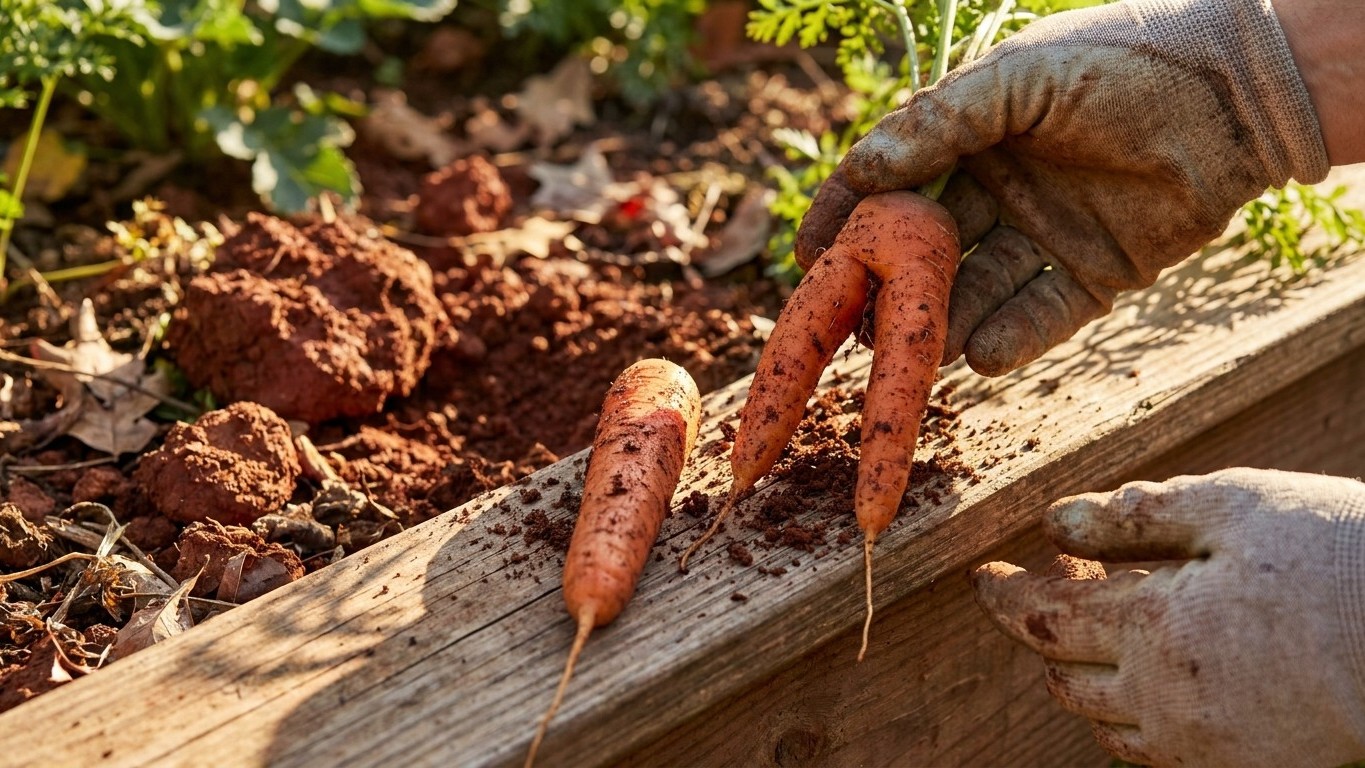

Indiana’s representative soil, the Miami series, is a loam to silt mix rather than heavy clay, and it drains moderately well, so the odds of a forked carrot are lower than in a clay-heavy garden but far from zero. Compost worked deep and loose, or a raised bed where the ground stays packed or wet, settles the question in most yards.
The short answer
The soil that USDA lists as representative of Indiana is the Miami series, an Alfisol, which is the technical name for a forest soil of moderate fertility that holds onto nutrients reasonably well once they’re applied. The surface horizon runs about 30 percent sand, 20 percent clay and 49 percent silt, which puts it closer to a loam or silt loam than to the sticky clay that causes the worst forking. Surface pH sits around 6.5, slightly on the acid side, and organic matter averages about 2.0 percent. Drainage is rated moderately well, meaning water moves through it without pooling for long, but not as freely as it would in a sandy garden bed.
That combination matters because a carrot root doesn’t fork out of stubbornness. It forks when the growing tip meets something it can’t push through cleanly, whether that’s a rock, a hardpan layer, or soil compacted enough to resist the root the way a closed fist resists a finger. Utah State University Extension puts it plainly: carrots want deep, sandy, well-drained soil rich in organic matter, and heavy or rocky ground makes the root fork. The Miami series isn’t the worst-case heavy clay that guarantees trouble, but at 49 percent silt and 20 percent clay it isn’t the sandy loam carrots prefer either. Silt in particular has a habit of sealing itself into a crust when it dries after a hard rain, and that crust can be enough to split a young root or send it hunting sideways.
So the honest answer for a garden that matches this profile is: some forking, especially in spots where the soil has been walked on or left uncompacted, but not the guaranteed mess you’d get in dense clay. The fix USDA’s own numbers point toward is the same one Utah State recommends for any heavy or rocky ground: work in plenty of compost and double dig the bed to break up compaction below the top few inches, since a carrot root needs open ground for its full length, not just at the surface. Where drainage is genuinely poor or the ground has been compacted by construction or heavy foot traffic, building a raised bed with loosened, blended soil skips the problem instead of fighting it season after season.
None of this is a verdict on any one backyard. A state this size carries hundreds of distinct soil series, and the Miami series is simply the one USDA singles out as broadly representative. River bottoms run sandier, hill country runs rockier, and any lot a builder has graded or filled can be nothing like the native ground nearby. Treat the numbers above as a starting point for what the region’s soil tends to do, not a diagnosis of the dirt under your own carrots.
The test that settles it in your own garden
State averages can’t tell you what’s six inches under your own carrot bed. A short dig-and-feel check will.
- Dig a hole about a foot deep in the spot you plan to plant, and note where the shovel starts meeting real resistance. Carrots need that top foot loose and open; if you hit a hard, compacted layer or a shelf of rock well before a foot down, that’s exactly the kind of obstruction that forks a root.
- Sift through the soil you pulled out and count the stones. A few pebbles won’t bother a carrot much, but a soil full of gravel-sized rock is going to deflect roots no matter how much compost you add on top.
- Grab a handful of moist soil and squeeze it, then roll it between your fingers. Soil that forms a slick, sticky ribbon is clay-heavy and prone to compacting; soil that falls apart and feels grainy is sandier and drains faster; something in between that holds a loose clump but crumbles easily is closer to the loam carrots actually want.
- Fill the hole with water and watch how fast it disappears. Water that’s still sitting there after several hours points to poor drainage, which sets up the wet-then-dry cycles that crack and split carrot roots later in the season.
- Repeat the dig in two or three other spots in the same bed. Soil can change character within a few feet, especially near a foundation, a driveway, or an old fill area, so one hole doesn’t speak for the whole garden.
What goes wrong here
Even with a carrot-friendly plan, this soil and climate combination tends to produce the same handful of problems every season.
- Forking in heavy or compacted ground. Wherever the loam runs closer to clay, or wherever foot traffic or machinery has packed the bed down, roots hit resistance and split into two or more legs. Double digging the bed a full spade’s depth and mixing in compost before seeding opens the ground enough for a straight root to grow through.
- Poor germination during a hot, dry stretch. Carrot seed is slow to sprout under the best conditions, and a silt-heavy surface that crusts over after watering or a hard rain can seal moisture away from the seed right when it needs it most. Keeping the top inch of soil consistently damp with light, frequent watering until seedlings appear, rather than one heavy soak, keeps that crust from forming in the first place.
- Splitting from uneven watering. A carrot that goes dry for a stretch and then gets soaked, whether from a missed watering or a sudden storm, tends to crack along the root as it swells back up too fast. A steady watering schedule, backed up by a couple inches of mulch to even out soil moisture between waterings, keeps the root growing at one pace instead of stopping and starting.
- Shallow rooting from a hard subsoil layer. Even where the topsoil looks fine, a compacted layer a few inches down can stop a carrot’s taproot cold, forcing it to fork sideways or stay stubby. This is the specific problem double digging solves, since it breaks up that hidden layer rather than just improving the surface inch.
Common questions
Does the Miami series mean my carrots will definitely fork?
No. It means the representative surface soil for the state runs loam to silt with moderate drainage, which is a middling risk for forking, not a guarantee. Your own garden could be sandier, rockier, or better drained than that average, and the dig test is the only way to know.
Is double digging really necessary, or can I just add compost on top?
Utah State University Extension recommends both together for heavy or rocky soil: compost improves fertility and texture, but double digging is what actually breaks up compaction below the surface where a carrot’s root needs open ground to grow straight.
How long should I expect to wait before I know if the fix worked?
Carrots are sown directly in place, with no transplanting step, and typically need somewhere between 70 and 100 days from seeding to reach harvest size. You won’t see whether forking has improved until you pull a full crop at the end of that window.
What if my soil test shows heavy clay and I don’t want to double dig?
A raised bed filled with loosened, compost-blended soil sidesteps the problem entirely, since the carrot never has to push through the native ground below. It’s more setup work up front but it’s the more reliable long-term fix where drainage is genuinely poor.