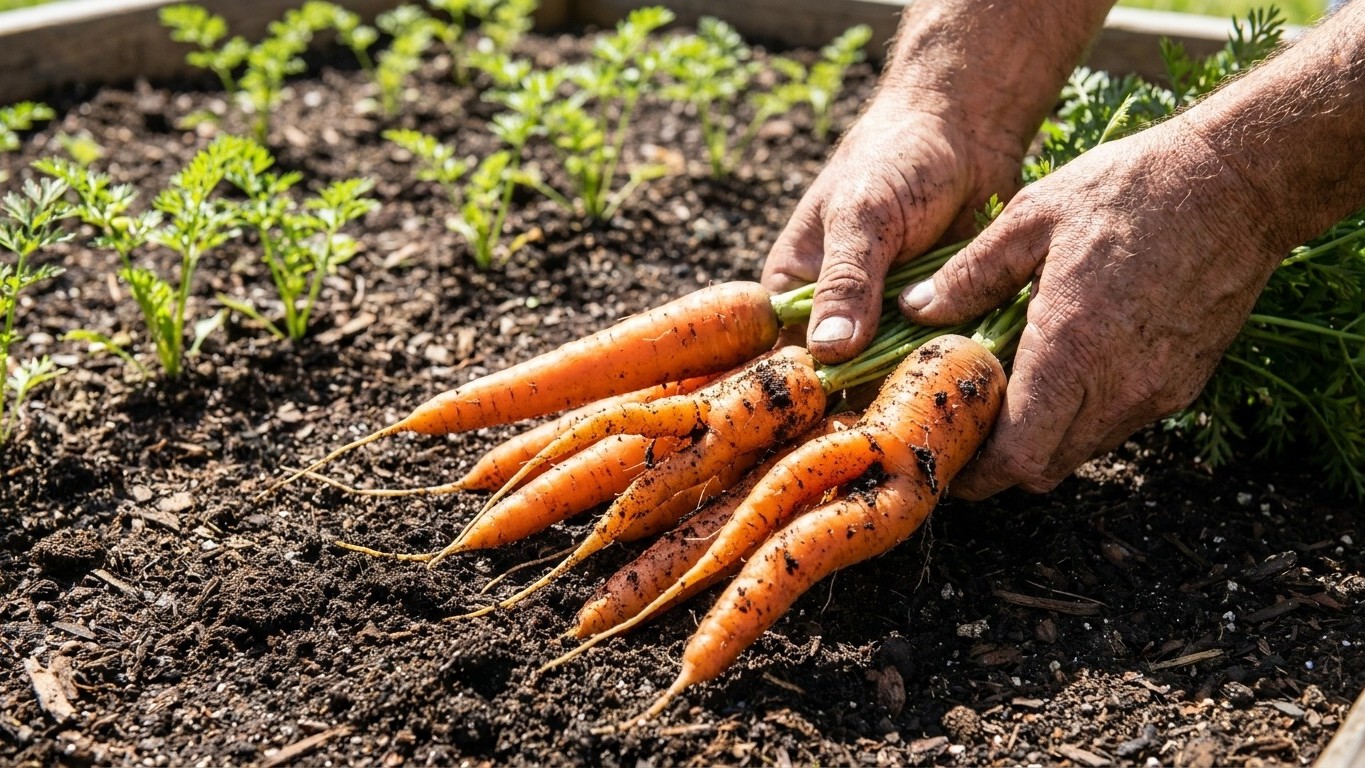

Indiana carrot growers don’t get one universal sowing date, since the state’s last-frost timing shifts from county to county and isn’t a single fixed number. What holds everywhere: carrots are seeded directly into the row, never transplanted, and harvest is figured 70 to 100 days forward from that seeding date, per Utah State University Extension. But the date on the calendar matters less than what’s waiting underground, because Indiana’s default soil is exactly the kind that makes a carrot root fork instead of running straight.
The short answer
The soil USDA lists as representative of Indiana is the Miami series, an Alfisol, a forest soil of moderate fertility that holds onto nutrients reasonably well. Its surface horizon runs about 30 percent sand, 20 percent clay and 49 percent silt, putting it solidly in loam-to-silt-loam territory, with a surface pH near 6.5 (slightly acid) and organic matter around 2.0 percent. Drainage is rated moderately well drained, meaning water moves through, but not fast.
| Component | Share of surface soil |
|---|---|
| Sand | 30% |
| Clay | 20% |
| Silt | 49% |
Carrots, according to Utah State University Extension, want deep, sandy, well-drained soil that’s rich in organic matter. Heavy or rocky soil makes the root fork instead of pushing straight down. Set that guidance next to the Miami series numbers and the mismatch is obvious: a soil that’s roughly half silt and one-fifth clay, sitting at “moderately” rather than “well” or “excessively” drained, with organic matter under the level carrots prefer, is not the loose sandy bed a carrot root wants to muscle through. It will grow a carrot. It just won’t necessarily grow a straight one, and it won’t shed water as fast as a lighter soil would after a heavy rain.
The fix Utah State University Extension gives for heavy ground is not a different carrot variety. It’s working in plenty of compost and double digging the bed, breaking up the profile well below where the root will travel, so the taproot meets loosened, organically enriched soil instead of a compacted silty layer. Gardeners who don’t want to double dig every spring often build a raised bed instead, filling it with a lighter mix from the start and sidestepping the native profile entirely.
None of this is a diagnosis of your specific yard. Indiana spans hundreds of mapped soil series, and the Miami series is simply the one USDA names as representative of the state as a whole under its State Soils program. River bottoms drain differently than upland fields. Anywhere a builder scraped topsoil and regraded a lot will behave like nothing on a soil survey map. Treat the Miami numbers as a starting point for what the region’s ground tends to do, not a stand-in for the dirt under your own carrots.
The test that settles it in your own garden
State-level soil data can only tell you the odds. Your own bed tells you the truth, and it takes about fifteen minutes to find out.
- Dig down as far as your spade will go in the spot you plan to plant, and look at what comes up. A carrot root needs a long, open run; if you hit a hardpan, a gravel layer, or dense clay a shovel barely bites into, that’s the depth where forking starts, no matter what the state average says.
- Check for stones and rubble in the soil you just turned. Carrots fork around obstructions the way a river forks around a boulder, so a handful of pea gravel scattered through the bed matters more here than almost any other factor.
- Rub a moist handful between your fingers. Gritty and loose suggests sand-leaning soil that drains fast and won’t hold a carrot’s shape as well without organic matter. Sticky, slick, and able to hold a ribbon shape when you press it between thumb and finger points toward clay, which is the forking risk Utah State University Extension warns about directly.
- Pour water into the hole you dug and watch it. Water that disappears steadily and evenly suggests reasonable drainage. Water that sits and pools, hours after a rain has stopped elsewhere in the yard, is telling you this particular spot behaves more poorly than “moderately well drained,” and a raised bed will outperform any amount of digging.
- Note where the water came from and where it goes after a real storm, not just your hose. Low corners of a lot, areas near downspouts, and anywhere snowmelt pools in late winter often run wetter than the rest of the yard even when the soil type is identical.
Run through those five checks before you invest in compost, a tiller pass, or lumber for a raised bed. The answer is usually obvious well before you finish digging the first hole.
What goes wrong here
- Forking in heavy ground. Indiana’s representative soil carries meaningful clay and silt content and only moderate drainage, the exact profile Utah State University Extension flags for producing forked, twisted roots instead of the single straight taproot growers want. The remedy is working in generous compost and double digging the bed deeply before sowing, or skipping the native soil altogether with a raised bed filled with a lighter mix.
- Poor germination during a hot stretch. Carrot seed is small and sits shallow, so it dries out fast once the soil surface heats up, and a dry crust can keep seedlings from ever pushing through. Keeping the seed row consistently moist with light, frequent watering until seedlings appear solves most of this, and a thin layer of light mulch or fine compost over the row helps the surface hold moisture longer between waterings.
- Splitting from uneven watering. A root that grows steadily through a dry spell and then gets soaked all at once tends to split down the middle, because the interior swells faster than the outer layer can stretch. Watering on a steady schedule instead of letting the bed dry out completely between soakings keeps growth even and reduces the splits that show up right around harvest.
Common questions
Is Indiana’s soil naturally good for carrots?
The state’s representative soil, the Miami series, runs closer to loam and silt loam than to the deep sandy ground carrots prefer, with only moderate drainage and organic matter below what Utah State University Extension recommends for carrots. It’s workable, but most beds benefit from compost and loosening before carrot seed goes in.
What’s the fastest fix for heavy clay before sowing?
Utah State University Extension points to working in plenty of compost and double digging the bed, which loosens the soil well below root depth and adds the organic matter carrots need to grow straight instead of forking around compaction.
Do carrots need transplanting in Indiana gardens?
No. Carrots are sown directly into the row where they’ll grow and are never transplanted. Any timeline for germination or harvest counts forward from that seeding date, not from a transplant date, because there isn’t one.
How many days should I count before expecting a harvest?
Utah State University Extension puts the window at 70 to 100 days, counted from the day the seed goes into the ground. Where your soil falls between fast-draining and heavy will influence how evenly and quickly the roots size up within that window, which is one more reason to test your own bed rather than rely on the state average alone.