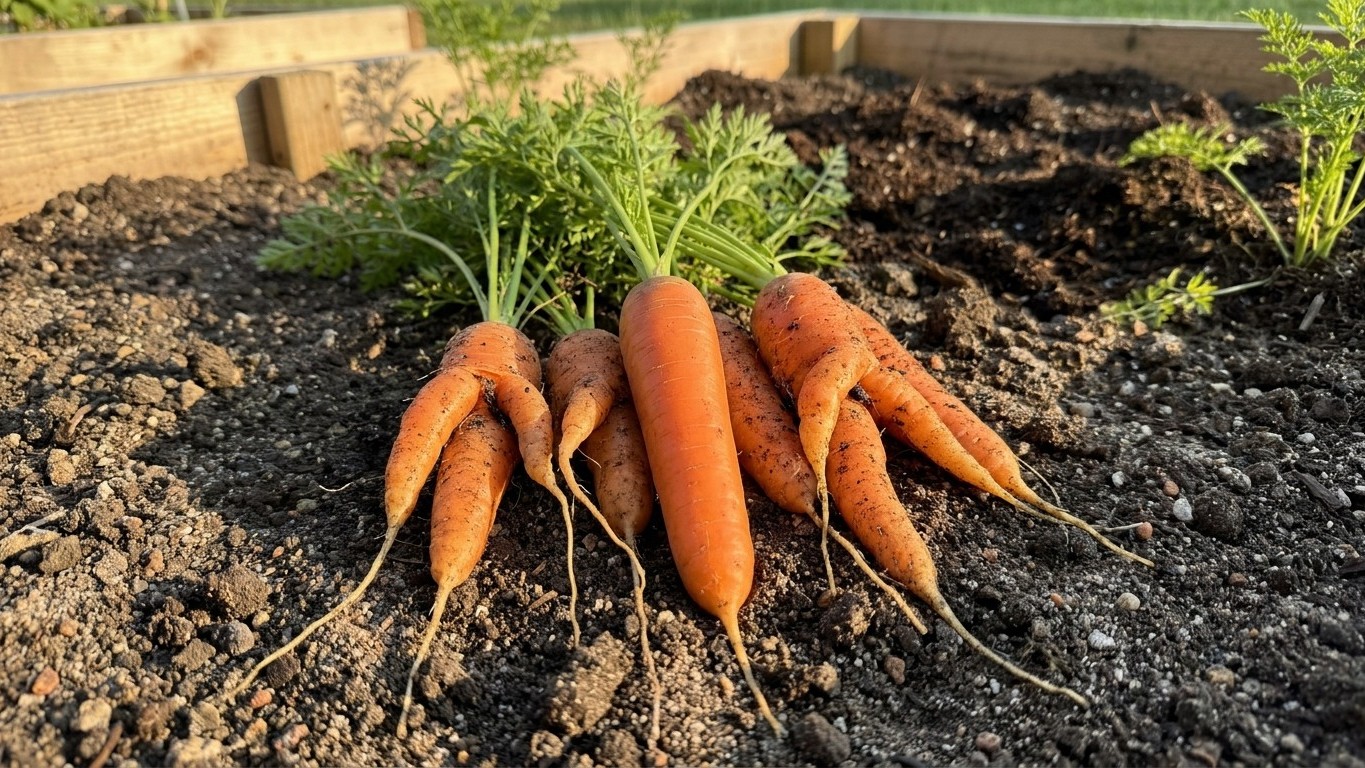

Indiana’s representative soil, the Miami series, runs 30 percent sand, 20 percent clay and 49 percent silt: a silt loam with enough clay to compact and enough silt to crust over. In ground like that, a straight carrot is not guaranteed. Compost worked in deep, or a raised bed with looser fill, is what turns that soil into something a carrot root can push through without splitting into forks.
The short answer
The soil USDA lists as representative of Indiana is the Miami series, an Alfisol, which is a forest soil of moderate fertility that holds nutrients reasonably well. Its surface horizon runs about pH 6.5, slightly acid, with a texture of 30 percent sand, 20 percent clay and 49 percent silt, organic matter around 2.0 percent, and a drainage class of moderately well drained. That comes from USDA NRCS Soil Data Access, averaged across 627 mapped components of the series.
Read those numbers the way a carrot would. Utah State University Extension is blunt about what the crop wants: deep, sandy, well-drained soil rich in organic matter. Heavy or rocky soil makes the root fork, splitting into two or three legs instead of growing down as one clean taproot. So Will Carrots Fork in Indiana Soil? A silt loam with one-fifth clay and moderately well drained (not well drained, not excessively drained) sits closer to the “heavy” end of that scale than the “sandy” end. It will hold water longer than a sandy loam, which is good for germination and bad for a taproot trying to force its way straight down through compacted layers.
None of that means carrots are a lost cause in Indiana ground. It means the fix Utah State names directly applies: plenty of compost worked into the bed, and double digging to break up the compaction a silt loam is prone to below the surface inch or two. Loosening the soil to a full spade’s depth, twice over, gives the taproot a path of least resistance instead of a wall of packed silt to push against. Where the ground stays heavy no matter how much is dug in, particularly in a yard with clay fill from construction, a raised bed filled with a loose, sandy mix sidesteps the problem outright rather than fighting it season after season. Getting the soil right matters less if the timing is off, so it’s worth knowing When to Sow Carrots in Indiana before putting seed in the ground.
Here is the caution worth sitting with before reaching for a shovel. The Miami series is what USDA names as representative of Indiana as a whole. It is not a diagnosis of any one garden. Indiana spans hundreds of mapped soil series, from sandy outwash in the north to heavier till plains and river-bottom silt elsewhere in the state. A yard three miles from where the Miami series is mapped can sit on something entirely different, especially anywhere a builder has scraped topsoil or brought in fill. The state figure is a starting point for what the region’s ground tends to do, not a number to plug into a planting plan without checking.
The test that settles it in your own garden
State averages tell you what to expect in general. They do not tell you what is actually under your own carrot bed. That takes a short, hands-on check before seed goes in the ground.
- Dig a hole at least a foot deep where the carrot row will go. Carrots need depth to grow straight, so this is the first thing worth confirming rather than assuming.
- Look at what comes out. Note where the soil color or texture changes with depth, and pull out any stones, gravel, or chunks of hard clay you hit along the way. A layer of rock or dense clay a few inches down is exactly what forces a root to fork around it.
- Feel the texture between your fingers. Rub a moist handful of soil. Gritty and loose means more sand; slick and sticky, holding its shape when squeezed, means more clay. This rough feel test won’t give you exact percentages, but it tells you which end of the sandy-to-heavy scale your bed leans toward.
- Watch how water drains. Fill the hole with water and time how long it takes to disappear. Water that sits for hours points to a heavier, slower-draining soil similar to or worse than the moderately well drained Miami series. Water that vanishes quickly suggests a sandier, faster-draining bed, closer to what carrots actually prefer.
- Decide from what you saw, not from the state average. Stones and slow drainage call for compost, double digging, or a raised bed. Loose, quick-draining soil with no obstructions means the ground is already doing most of the work for you.
When to sow here
Carrots are sown as seed directly in the row. There is no transplanting stage to work around, so every count below runs from the day seed goes into the ground.
- Start with the frost window. NOAA’s 1991-2020 climate normals put the last spring frost for the Indianapolis area between April 9 and April 21. That is the state’s central reference point; southern Indiana tends to clear frost earlier in spring, and northern Indiana later, often by two weeks or more in either direction.
- Sow two to three weeks before that date, not after. Carrot seed tolerates cool soil far better than most garden vegetables, so gardeners aiming for the April 9 to April 21 window would typically be sowing in late March, and those planning around a later local frost date later still. The exact calendar date depends on where in the state you are relative to Indianapolis.
- Check the soil temperature before trusting the calendar. Soil needs to reach a minimum of 40 F for carrot seed to germinate at all. A thermometer pushed a couple of inches into the bed on a dry morning is a more honest signal than the date on a seed packet, especially in a cold, wet spring that lags behind the average.
- Know that germination speeds up in warmer soil, up to a point. Germination is best between 55 F and 65 F. Seed sown right at the 40 F minimum will still sprout, just slower and less evenly, while soil already in that 55 to 65 F range gives the most uniform stand.
- Watch for the roughly 10 percent risk that lingers past the average date. Even after the published spring frost window closes, there remains a real chance of a freeze event. Carrot seedlings tolerate a light frost far better than most vegetables, but it is worth having row cover on hand for anything sown at the early edge of that window.
What goes wrong here
- Forking in heavy ground. A silt loam with real clay content, like the Miami series’ 20 percent, gives roots something to split around instead of pushing through. The remedy is the one Utah State University Extension gives directly: work in generous compost and double dig the bed before sowing, or switch to a raised bed filled with a looser mix if the native soil never loosens enough.
- Poor germination during a hot, dry stretch. Carrot seed is small and sits near the surface, which means it dries out fast once soil temperatures climb well past the 55-65 F ideal range and rain is scarce. Keeping the row lightly and evenly moist with a fine spray, rather than one heavy soak, gets far more of the seed to sprout.
- Splitting from uneven watering. A bed that dries out hard and then gets a heavy soaking pushes the root to swell suddenly, cracking it along its length. Watering on a steady schedule instead of catching up after a dry stretch keeps growth even and the root intact.
- Slow, patchy stands in cool soil. Sowing before the soil has reached even the 40 F minimum stalls germination for days or weeks, and by the time it warms up, weeds have often gotten a head start on the row. Checking soil temperature directly, rather than relying on the calendar alone, avoids the wasted seed.
Checking this against your own county
Everything above is a regional starting point, built from a statewide soil series and a single climate station’s frost data. Your own county’s soil map, frost timing and local growing conditions can differ from both in ways worth confirming before you commit a season’s seed to a bed.
Purdue Extension (extension.purdue.edu) is the land-grant university extension service for Indiana, and its county offices are the practical next step: local soil testing, county-specific frost guidance, and staff who know how the ground behaves a few miles from where you are actually digging, rather than at a weather station in Indianapolis.
Common questions
Why do carrots fork in Indiana clay soil?
Forking happens when a taproot meets resistance underground, whether from compacted clay, rocks, or a hardpan layer, and splits into two or more legs to get around it. The Miami series’ 20 percent clay content gives roots exactly that kind of obstacle unless the bed is loosened well beyond the surface inch or two.
How early can I sow carrot seed in Indiana?
Sowing can begin once soil temperature reaches at least 40 F, which for most of the state falls in the two to three weeks before the local last frost date. Around Indianapolis, where NOAA records the last spring frost between April 9 and April 21, that generally means sowing in late March, with southern counties often earlier and northern counties later.
Do I need a raised bed to grow straight carrots in Indiana?
Not always. A raised bed filled with loose, sandy soil is the surest fix where native ground is heavy clay or full of stones, but many gardens do fine with in-ground beds that have been double dug and amended with compost, following Utah State University Extension’s guidance for heavy soil.
What soil temperature gives the best carrot germination?
Germination is best between 55 F and 65 F. Seed sown at the 40 F minimum will still sprout, just more slowly and less evenly than seed sown once soil has warmed into that ideal range.