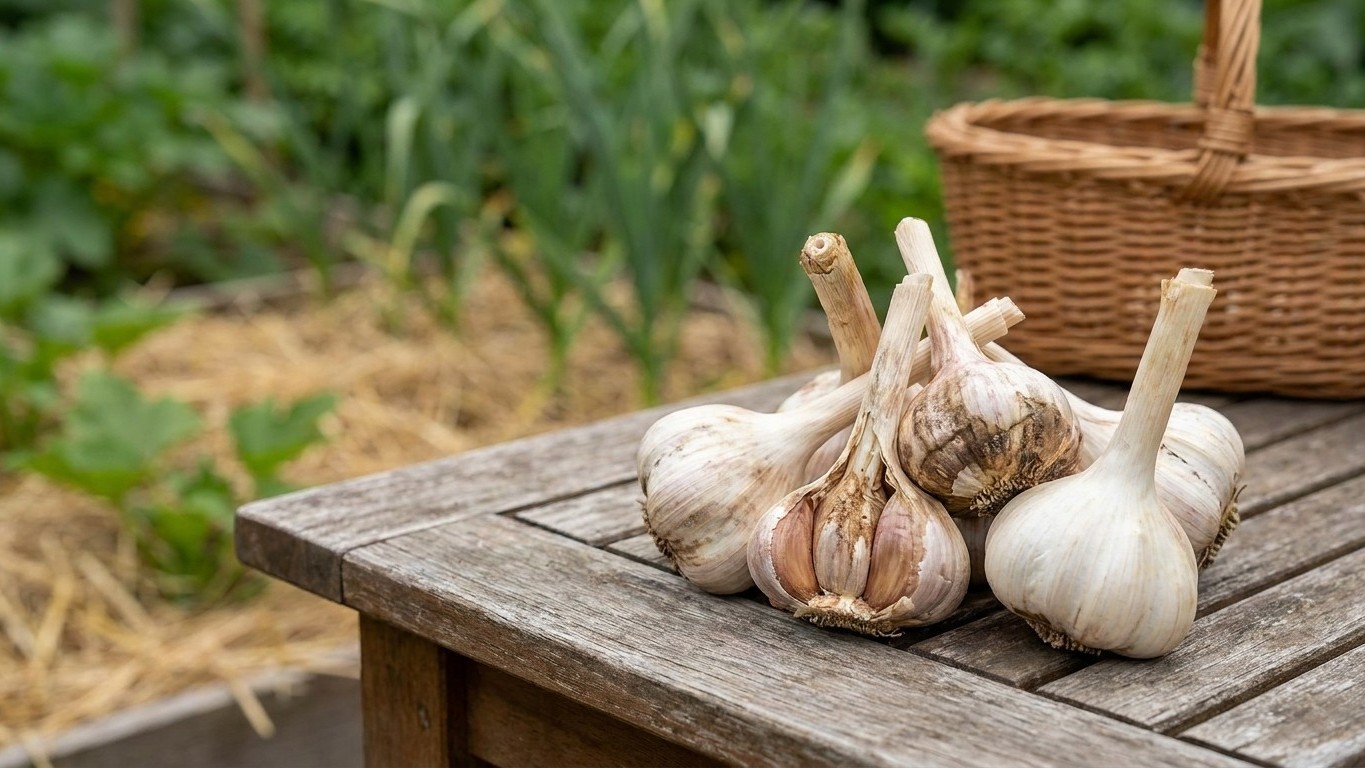

In Indiana, garlic planted the previous fall is ready to lift when roughly the bottom half of its leaves have browned while five or six leaves up top stay green. That balance point usually lands in the back half of summer. Curing then takes several weeks of airflow and shade before the bulbs get trimmed, sorted, and moved into cool, dark storage for the winter ahead.
When garlic is ready to lift in Indiana
Garlic grown in Indiana runs on a long clock. Cloves go into the ground in autumn, root through the cooling soil, sit dormant over winter, then push up new growth once the ground warms in spring. That fall planting window matters because it sets the whole calendar that follows: growers here generally aim to get cloves in the ground well ahead of the season’s first hard freeze, so roots have time to establish before the soil locks up. Around the Indianapolis area, the first fall freeze at 32°F typically falls somewhere between October 21 and October 30, based on 1991-2020 climate normals from NOAA NCEI. That’s a midpoint, not a guarantee. In roughly half the years on record, the freeze arrives later than that window, sometimes well into November. Southern Indiana tends to run later in autumn than that Indianapolis reference point, often by two weeks or more, while the northern part of the state trends earlier.
None of that changes the actual harvest signal the following summer, but it explains why bulb size and vigor vary from one Indiana garden to the next. A crop that went in early, with several extra weeks of root development before frost, tends to bulk up bulbs more evenly than one rushed into the ground late.
Reading the leaves instead of the calendar
Leaf count is a more reliable guide than any date on a wall calendar, because a warm spring or a cool, wet stretch in June can shift maturity by a couple of weeks in either direction. Watch the lower leaves turn from green to yellow to brown, working their way up the stalk. When that browning has claimed roughly the bottom half of the plant and five to six leaves remain green above it, it’s time to check.
Pull one test bulb from the row and brush off the soil. A mature bulb shows plump, distinct cloves under intact papery wrappers. If the wrapper is already splitting or the cloves look loose and separated, that bulb sat in the ground too long. If the cloves are barely differentiated and the wrapper feels thick and undivided, give the rest of the row another week and check again. Garlic left in the ground too long after maturity loses its storage wrappers layer by layer, and once those protective skins are gone, the bulb won’t keep through an Indiana winter no matter how well it’s cured.
Curing it, and where to hang it here
Curing is the step that turns a freshly dug, moisture-heavy bulb into something that will actually last in storage. Skip it or rush it, and even a perfectly timed harvest rots by December. The process itself is simple: get the whole plant, roots, stalk, and bulb together, into a shaded space with steady airflow and leave it there until the outer wrappers dry papery and tight and the neck above the bulb shrinks down hard.
What makes this trickier in Indiana than in a drier climate is the timing overlap with the state’s humid summer stretch. Bulbs typically come out of the ground in the same window when afternoon humidity runs high across most of the state, which is exactly the wrong condition for drying anything. Damp air slows the cure and raises the odds of mold setting in on the wrappers or, worse, inside the neck where you can’t see it until you cut into a bulb months later.
Finding the right spot
The goal is shade, not darkness, plus air movement, not stagnant air. A few options that tend to work in Indiana:
- An open garage or carport with the doors cracked for cross-breeze, out of direct sun
- A covered porch or breezeway, away from rain
- A barn or shed with a box fan running on low, aimed across the bulbs rather than directly at them
- A basement only if it stays dry; a damp basement will slow curing and invite mold
Hang bulbs in small bunches of six to eight, tied loosely by the stalks, or lay them in a single uncrowded layer on a screen or slatted rack so air reaches all sides. Crowding is the most common mistake at this stage. Bulbs piled together or bunches tied too thick trap moisture right where you can’t see it, and that’s where rot starts. Give the cure three to four weeks minimum before you trim anything, and check a few bulbs partway through; if the necks still feel soft or spongy, they need more time regardless of how the calendar looks. Anyone unsure whether a particular growing season’s humidity calls for extra drying time can check with Purdue Extension, which fields exactly these kinds of local growing-condition questions through its county offices.
Storing it through a Indiana winter
Once the cure is done, trim the roots close and cut the stalks down to an inch or two above the bulb, unless you’re braiding softneck types, in which case leave the stalks long and braid before they dry too stiff to bend. Brush off loose soil, but don’t wash the bulbs; water at this stage undoes weeks of drying work fast.
Sort as you go. Set aside your biggest, cleanest bulbs as next fall’s planting stock, since Indiana’s fall-planting cycle means this year’s harvest supplies the cloves that go back in the ground a few months later. Anything with a soft spot, a bruised wrapper, or a leaning stalk that suggests early splitting should get used first, not stored long term.
What “cool and dark” actually means
Cured garlic keeps best somewhere in the range most sources describe as cool, dry, and dark, with steady airflow, roughly a basement corner, an unheated but insulated closet, or a pantry that doesn’t swing wildly in temperature. Mesh bags, loosely woven baskets, or old pantyhose knotted between bulbs all work because they let air circulate around each bulb rather than sealing in moisture like a plastic bag would.
The refrigerator is not the answer, despite being the instinctive place to put fresh produce. Cold, humid refrigerator conditions push garlic toward early sprouting, which shortens storage life rather than extending it.
Indiana winters bring their own wrinkle here. An unheated garage or an uninsulated shed that feels like a fine storage spot in October can drop well below freezing by January, especially once nightly lows settle in after that October 21 to October 30 freeze window passes and cold becomes the norm rather than the exception. Garlic that freezes solid in storage often turns soft and unusable once it thaws. A spot that stays cool but doesn’t swing into hard freeze territory, an insulated closet against an interior wall, a basement stairwell, a mudroom that shares some heat with the rest of the house, tends to outperform anything fully exposed to outdoor temperature swings.
What goes wrong here
Most storage failures trace back to one of two points: an incomplete cure or a storage spot with the wrong humidity. Bulbs that go into storage before the neck has fully dried carry moisture inward, and that moisture shows up weeks later as a soft, sometimes discolored spot that spreads to the rest of the bulb. There’s no fixing this after the fact. It has to be caught by testing a bulb or two before committing the whole harvest to storage.
The other common issue is a storage space that’s either too humid, which invites mold on the wrappers, or too dry and warm, which speeds up sprouting and shrivels the cloves from the inside out. A garage that bakes in leftover summer heat through September, or a kitchen pantry near a stove, both run warmer than ideal for long-term keeping.
On the pest side, Purdue Extension Entomology documents seedcorn maggot as a pest that can attack bulb and seed crops in cool, wet spring soil, feeding on germinating tissue before plants get established. It’s worth keeping in mind at planting and again in early spring growth, since damaged cloves that limp through spring rarely bulk up into bulbs worth curing at all. Beyond that specific pest, Purdue’s entomology program documents a range of other insects across Indiana vegetable crops, including asparagus beetle, brown marmorated stink bug, cabbage looper, Colorado potato beetle, Mexican bean beetle, spotted cucumber beetle, squash bug, squash vine borer, and striped cucumber beetle, though these are associated with other garden crops rather than garlic specifically.
Finally, using grocery store garlic as planting stock is a quieter source of trouble. It’s often treated to resist sprouting and may carry disease not adapted to overwintering in Indiana’s clay-heavy soils, which shows up as poor stands or weak bulbs the following summer rather than any dramatic failure.
Common questions
How long does cured garlic actually keep in Indiana storage?
It depends heavily on variety and how well the cure and storage conditions held up, but a properly cured bulb kept cool, dry, and dark generally outlasts one that was rushed through curing or stored somewhere with temperature swings, by a wide margin. There’s no single published number for Indiana conditions specifically, so the safest approach is checking bulbs periodically through winter rather than assuming a fixed shelf life.
Can I plant garlic bulbs I saved from this year’s harvest?
Yes, and it’s the standard approach for the fall-to-summer cycle Indiana growers follow. Set aside the largest, healthiest bulbs at harvest, keep them in the same cool, dark storage as the rest of the crop, and break them into cloves just before fall planting.
Does the exact fall frost date matter for when I plant garlic?
It matters as a general marker more than a hard deadline. The October 21 to October 30 window around Indianapolis is a midpoint from historical data, meaning the actual freeze lands later than that in roughly half of all years. Many growers plant several weeks ahead of that window regardless, since the goal is root establishment before hard freeze, not a race against the frost itself.
Why did some of my bulbs split apart in storage instead of staying whole?
Splitting wrappers usually trace back to bulbs left in the ground past maturity, where the protective outer layers start to shed even before harvest, or to a cure that didn’t fully dry the neck. Once a bulb’s wrapper is compromised, it’s more exposed to moisture and mold and won’t store as long as an intact one.