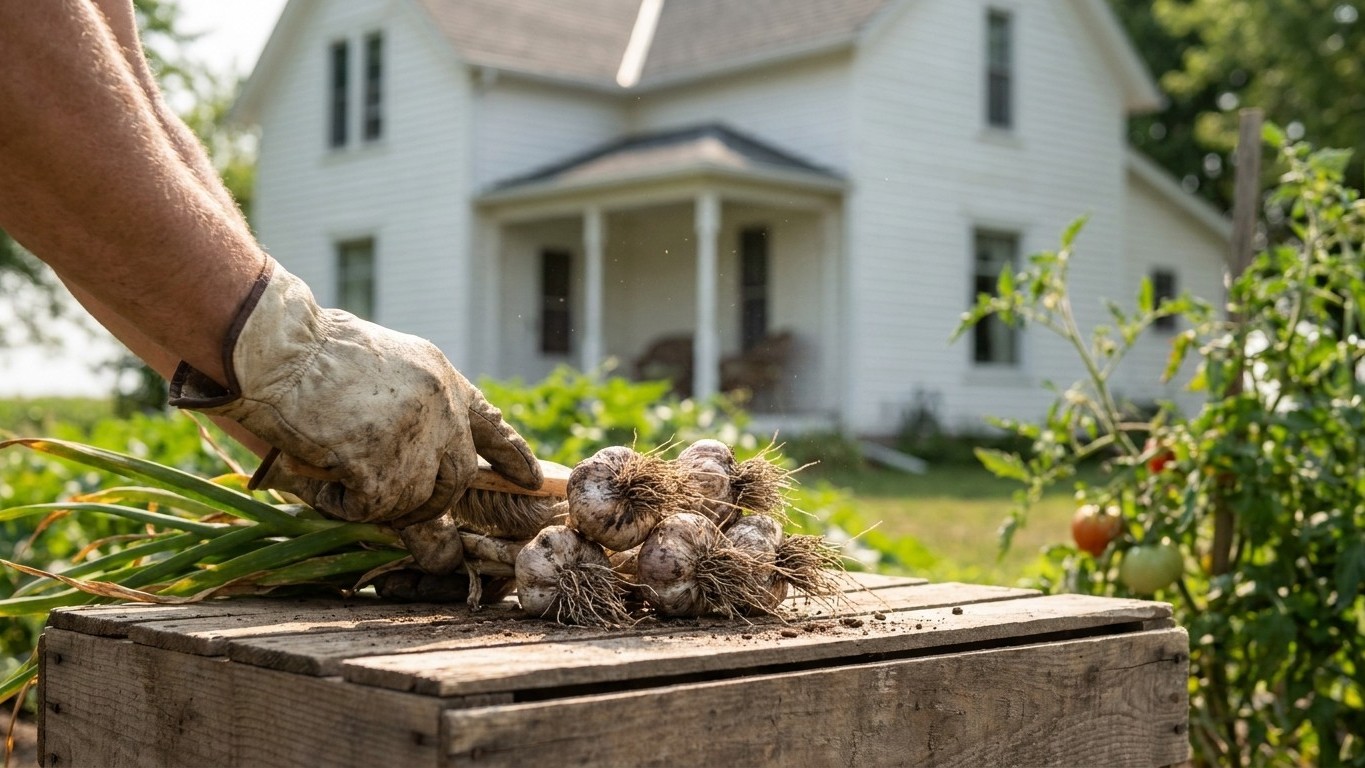

Iowa’s cold winters actually work in garlic’s favor. Hardneck varieties need that sustained freeze to trigger bulb division, which makes them the steadier bet here, though softneck types can succeed too if they’re planted with enough time to root before the ground locks up. The set-out window that fits both is late September to early October — early enough to give cloves close to a month of rooting time before the season’s first hard freeze arrives.
The short answer for Iowa

Yes, Iowa’s cold winters work in garlic’s favor. Both hardneck and softneck types can be grown across the state, but hardneck varieties are the steadier choice because they need a sustained stretch of freezing weather to trigger bulb division. Softneck garlic tolerates Iowa winters too, provided it goes into the ground with time to root and gets a mulch blanket before the soil locks up.
Every variety listed here calls for the same set-out window: late September to early October, timed against NOAA’s 1991-2020 climate normals, which put the first fall freeze at Des Moines between October 14 and October 25. Planted at the early end of that window, cloves get close to a month of rooting time before the earliest normal freeze date. Planted at the tail end, in early October, they might get less than two weeks if the freeze lands on the early side of NOAA’s range that year.
Varieties that fit this window
| Variety | Neck type | Set-out window |
|---|---|---|
| Early Red Italian | Softneck | Late Sept to early Oct |
| Inchelium Red | Softneck | Late Sept to early Oct |
| Italian Late | Softneck | Late Sept to early Oct |
| Lorz Italian | Softneck | Late Sept to early Oct |
| Bavarian Purple | Hardneck | Late Sept to early Oct |
| Blue Music | Hardneck | Late Sept to early Oct |
| Chesnok Red | Hardneck | Late Sept to early Oct |
| Duganski | Hardneck | Late Sept to early Oct |
| Fall Festival | Hardneck | Late Sept to early Oct |
| Georgian Crystal | Hardneck | Late Sept to early Oct |
| Georgian Fire | Hardneck | Late Sept to early Oct |
| German Red | Hardneck | Late Sept to early Oct |
| German White | Hardneck | Late Sept to early Oct |
| Ivan | Hardneck | Late Sept to early Oct |
A frost date is a midpoint, never a guarantee. In roughly one year out of two, the season’s first freeze at Des Moines arrives after October 25, and in the other half it arrives before October 14. Lean toward the early side of the set-out window if you garden north of the metro or on low ground where cold settles first.
Working it out for your own garden
The October 14 to October 25 window above comes from a single weather station, the Des Moines airport, inside NOAA’s 1991-2020 climate normals. Your county is almost certainly not Des Moines, and Iowa State University Extension‘s own county-level frost figures, built from a longer 1950-2021 record, run about ten days earlier in fall than that airport station. Treat the NOAA window above as the late, optimistic end of the range for most of the state, not the middle of it.
Redo the count with your own numbers
Pull your county’s first-freeze figure from Iowa State University Extension rather than relying on the Des Moines number if a closer station is listed there. Shift the catalogue’s late-September to early-October set-out window back by roughly the same margin your county’s freeze date runs ahead of Des Moines. If your county’s normal freeze lands ten days earlier than the October 14 to October 25 range used above, plan to have cloves in the ground correspondingly earlier, not on the same calendar days given here.
Do this arithmetic in ranges, never in single days. NOAA’s own normal spans eleven days at Des Moines. Shifting an eleven-day range ten days earlier for a different county still leaves you with a span of dates to work inside, not one afternoon to circle on the calendar. If a wet week or an early cold snap eats into that window, plant on the early side of whatever range you land on rather than waiting for the date you first picked out.
What else moves the number
Iowa has no coastline and no single lake large enough to run its own microclimate, so terrain does most of the local work here. Cold air drains downhill and pools in low ground, creek bottoms, and frost pockets behind windbreaks, so gardens in those spots see their first freeze before the surrounding uplands do. A garden on a hillside or high bench often stays a few degrees warmer on a clear, calm night than low ground half a mile away. Neither effect shows up in one airport reading, which is one more reason to lean on your county’s Extension figures and your own memory of which mornings bring frost first in your yard. If you haven’t worked out a planting date from the frost window at all yet, the planting calendar for Iowa garlic walks through that count from scratch.
What changes across Iowa
Iowa runs roughly 200 miles north to south, and the counties along the Minnesota border cool off before the counties along the Missouri border in most autumns. The Des Moines figure sits in the middle of the state, not at either extreme, so a gardener near the northern border should expect the first freeze earlier than the NOAA window above, and a gardener near the southern border should expect it later.
Terrain does the rest
Northeast Iowa’s driftless region, the hilly, unglaciated corner of the state around the Upper Iowa and Turkey rivers, has more local relief than most of the state. Valley bottoms there collect cold air on clear nights while the ridges above stay warmer, so two gardens a mile apart can see their first frost on different mornings. The Loess Hills along the western edge, running roughly from Sioux City down to Council Bluffs, add a similar kind of elevation change, with bluff-top gardens often lagging behind the low ground along the Missouri River in when the first freeze shows up.
The Mississippi River corridor on Iowa’s eastern edge behaves a little differently again. Large moving water moderates the immediate riverbank compared to the uplands a few miles inland, so river-bottom gardens in counties like Dubuque or Clinton can run milder on a given autumn night than fields set back from the water. None of this shows up in a single airport reading. Iowa State University Extension’s county normals are built to capture exactly this kind of local variation, which is why they’re worth checking even after you already know the statewide picture from NOAA’s normals.
The mistakes this climate punishes
Iowa’s climate does not forgive certain shortcuts, and most of them show up at harvest rather than at planting. If you haven’t yet covered bed prep and clove spacing, Growing Garlic in Iowa walks through that groundwork; the mistakes below assume you already have a bed ready and cloves in hand.
Skipping mulch on softneck varieties
Softnecks such as Inchelium Red, Lorz Italian, Italian Late, and Early Red Italian can be grown in Iowa, but they carry less natural cold tolerance than hardneck types. Skip the mulch, or let a thin layer blow off during a snowless stretch, and a hard freeze can damage exposed cloves before they’ve rooted deeply. Hardneck types built around a stiff central stalk, from German White and German Red to Chesnok Red and Duganski, generally shrug off Iowa’s freeze-thaw cycles with less protection, but none of them are immune to a bare, wind-scoured bed.
Planting too late in the window
The late-September to early-October set-out window exists because it lands ahead of NOAA’s October 14 to October 25 freeze range at Des Moines. Planting cloves at the very end of that window, in early October, leaves almost no cushion if the freeze arrives on the early side of the range that particular year, and a clove that hasn’t rooted before the ground locks up heads into winter with a poor anchor.
Planting infected stock
The bigger long-term risk isn’t the freeze at all. White rot, caused by the fungus Sclerotium cepivorum, and Fusarium basal rot, caused by Fusarium oxysporum f. sp. cepae, both spread mainly through infected planting stock rather than through the climate itself. UC IPM’s Pest Management Guidelines for Onion and Garlic, UC ANR Publication 3453, list white rot’s active range as 50 to 75°F and Fusarium basal rot’s as 59 to 90°F, both measured in soil rather than air. Iowa’s monthly air temperatures fall inside white rot’s range in five months of the growing season, September, October, April, May and June, and inside Fusarium’s range in four, September, May, June and July. A monthly average sitting inside those ranges doesn’t mean the whole month is at risk, since a month can average in range while still holding days well outside it, and neither pathogen is limited to counties near Des Moines. Buying certified or known-clean seed garlic, rather than planting cloves from a grocery bulb of unknown origin, does more to keep both diseases out of a bed than any choice of variety.
- Buy from a seed garlic supplier that names the growing region, not a bulk bin of unlabeled bulbs.
- Skip any clove with soft spots, a moldy smell, or a wrapper that looks water-stained.
- Keep new stock in its own bed the first year rather than mixing it into an established planting.
The same UC IPM guidelines list pink root‘s optimum as 75 to 85°F, a range Iowa’s air temperature averages only reach in July, well into curing rather than planting season, and southern blight‘s optimum as 86 to 95°F, warmer than any monthly air average during Iowa’s growing season. Neither figure means those diseases can’t occur here. It means the climate favors them less than it favors white rot and Fusarium, and infected stock can still bring either one into a bed regardless of the weather.
Checking this against your county
Everything above uses NOAA’s climate normals for one station near Des Moines, a reasonable starting point but not a substitute for county-level data. Iowa State University Extension keeps its own frost and freeze records by county, built from a longer 1950-2021 period, and that record is the one to check before you finalize a planting date. Search the Iowa State University Extension site for your county’s horticulture office or frost date guidance, and use whatever local figure you find there in place of the Des Moines window.
Common questions
Can I Plant Garlic in spring instead of fall in Iowa?
You can, but you’ll get smaller bulbs. Garlic needs a sustained cold period to divide into cloves properly, and a spring-planted clove misses most of that chilling, so bulbs tend to stay small and sometimes fail to split into cloves at all. Fall planting into the late-September to early-October window is the more reliable route for every variety listed above.
What happens if I miss the late September to early October window?
Planting into mid-October can still work in a year when the freeze runs late, but you’re gambling against NOAA’s October 14 to October 25 range rather than working with it. The later you plant, the less rooting time a clove gets before the ground locks up, and a poorly rooted clove is more likely to heave out of the soil during winter freeze-thaw cycles.
Should I save my own garlic cloves as seed stock next year?
Yes, once you’ve grown a clean crop, saving your largest, healthiest cloves is standard practice and it’s how most garlic growers build up stock adapted to their own ground. Skip any bulb that showed yellowing, stunted growth, or soft rot at harvest, and don’t replant into the same bed two years running if you saw any disease symptoms at all.
Is hardneck or softneck garlic better for Iowa’s climate?
Hardneck varieties like German White, German Red, and Chesnok Red are generally the steadier choice because they’re built for a real winter chill and tend to shrug off Iowa’s freeze-thaw cycles with less mulch. Softnecks such as Inchelium Red and Lorz Italian will grow here too and typically store longer in the pantry once cured, but they need a heavier, more reliable mulch layer to get through winter without damage.