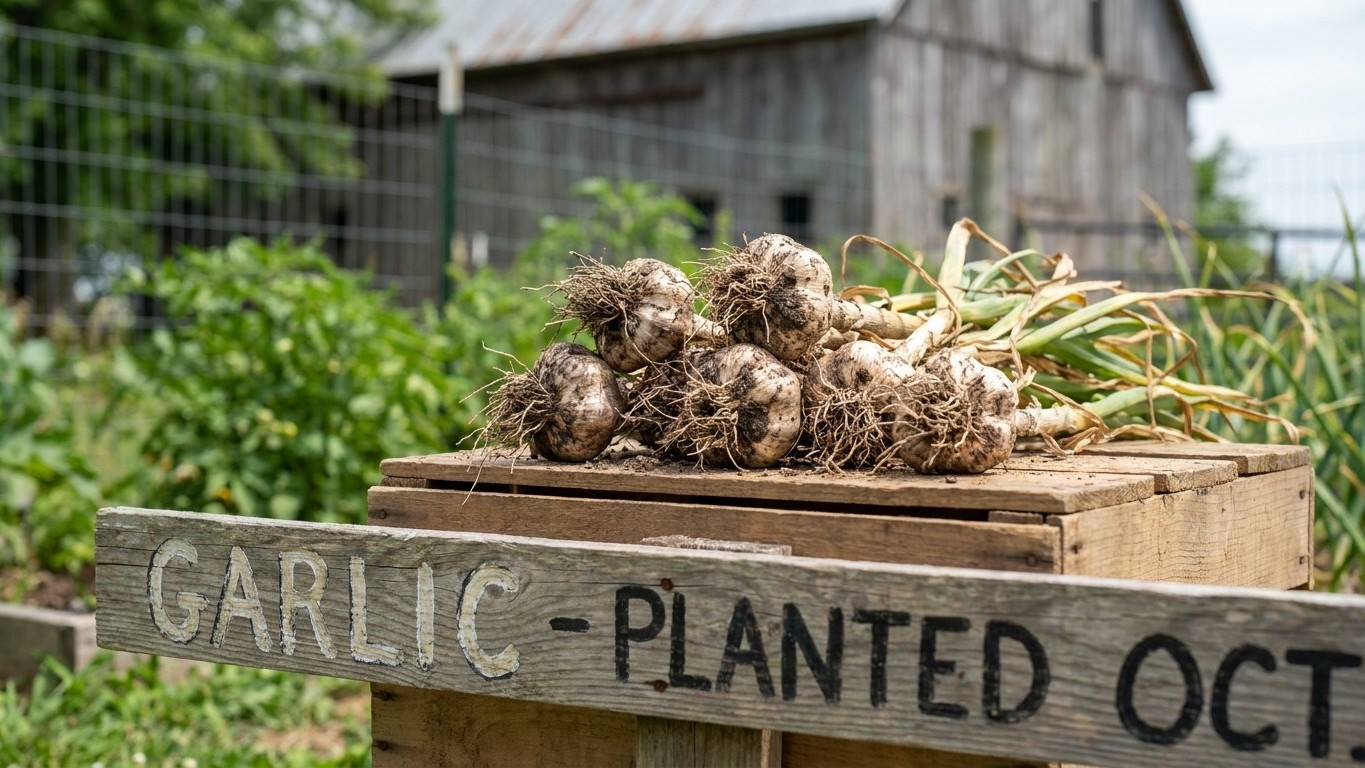

Garlic goes into Iowa soil in fall, and the window most seed catalogs point to is late September to early October. That range is built by counting back from NOAA’s 1991-2020 climate normals, which put the Des Moines area’s first fall frost between October 14 and October 25, a midpoint that arrives later than that in half of all years and earlier in the rest. The one thing to do now: pick a cultivar, order it, and get cloves in the ground before the soil turns cold and wet, not after a freeze warning shows up in the forecast.
The short answer for Iowa

For most of Iowa, the safe planting window for garlic is late September to early October, and that holds whether you’re growing a hardneck or a softneck type. The catalogue figures for days to maturity that come with each variety matter for next summer’s harvest, not for when you set cloves out this fall, because garlic planting dates are counted backward From the First Frost, not forward from a spring sowing date. For a full comparison of the cultivars below by flavor and storage life, see Garlic Varieties That Suit Iowa Winters before you order.
That window is anchored to NOAA’s National Centers for Environmental Information (NCEI) 1991-2020 climate normals for the Des Moines airport station, which place the area’s first fall freeze between October 14 and October 25. Garlic cloves need several weeks of active root growth while the soil is still workable, but they need to go in before that soil turns cold enough to stall rooting. Plant too early into warm September ground and a hardneck can push visible green top growth that then gets killed back by the first hard freeze. Plant too late, once the ground has started to firm up, and the cloves won’t root well before winter, which leaves them prone to heaving out of the soil during freeze-thaw cycles.
| Variety | Type | Set-out window (Des Moines area, calculated from NOAA’s Oct 14-25 frost date) |
|---|---|---|
| Early Red Italian | Softneck | Late September to early October |
| Inchelium Red | Softneck | Late September to early October |
| Italian Late | Softneck | Late September to early October |
| Lorz Italian | Softneck | Late September to early October |
| Bavarian Purple | Hardneck | Late September to early October |
| Blue Music | Hardneck | Late September to early October |
| Chesnok Red | Hardneck | Late September to early October |
| Duganski | Hardneck | Late September to early October |
| Fall Festival | Hardneck | Late September to early October |
| Georgian Crystal | Hardneck | Late September to early October |
| Georgian Fire | Hardneck | Late September to early October |
| German Red | Hardneck | Late September to early October |
| German White | Hardneck | Late September to early October |
| Ivan | Hardneck | Late September to early October |
Working it out for your own garden
Counting back from frost
The late-September-to-early-October window isn’t an arbitrary catalog date, it’s the result of counting back from NOAA’s October 14-25 frost range for Des Moines. The tail end of September sits roughly three weeks ahead of the early edge of that range, and the first week of October sits roughly two and a half weeks ahead of the late edge. That gap, somewhere in the two-to-four-week range, is what lets a clove build roots in soil that’s still workable without pushing top growth that a hard freeze will only kill back. If your own frost date runs earlier or later than the Des Moines figures, shift the planting window by the same number of weeks in the same direction.
Local terrain shifts the count
NOAA’s figures come from a single airport station, and Iowa State University Extension and Outreach’s own county-level compilation, which covers 1950 to 2021, runs about 4 days later in spring and about 10 days earlier in fall than that airport station. That fall gap matters more than the spring one for this decision: if your county’s actual first frost lands roughly 10 days ahead of the October 14-25 window, the whole planting window should shift earlier too, toward mid-to-late September rather than early October. Treat the Des Moines dates as the late, mild end of what’s possible in the state, not the norm everywhere in it.
Elevation and water also move the local number in ways a single weather station can’t capture. A garlic bed on a low, flat field with no windbreak cools faster on a clear night than one on a gentle slope where cold air can drain away. None of this is a fixed correction you can apply with confidence statewide, since it depends on the specific piece of ground, but it’s worth watching your own thermometer for a season or two before committing to the earliest or latest edge of the window.
What changes across Iowa
Iowa runs roughly 200 miles from its northern border with Minnesota to its southern border with Missouri, and that distance alone is enough to shift the average frost date by more than a week in either direction. The northern tier of counties, closest to the Minnesota line, typically sees its first fall freeze earlier than the Des Moines figures used above, while the southern tier near the Missouri border tends to hold on to warm weather a little longer into October.
Terrain matters within a single county too. The Loess Hills along the state’s western edge and the bluffs above the Mississippi River in the east create pockets of higher ground that stay a few degrees warmer on a still, clear night than the bottomland below them. Cold air is heavier than warm air, and on calm nights it drains downhill and pools in the lowest fields and river valleys, so a garlic bed set in creek-bottom soil can see its first hard frost well before a bed on a ridge fifteen minutes away.
Open water changes the local pattern as well. Around the Iowa Great Lakes in the northwest corner, natural lakes such as West Okoboji hold summer heat into autumn and can delay the first freeze in their immediate vicinity, the same moderating effect that larger lakes produce elsewhere in the Midwest.
None of this changes the underlying logic behind the late-September-to-early-October window, only where inside it, or slightly ahead of it, a given garden should plant. A grower in a river-bottom field and one on a nearby ridge are effectively working from two different local frost dates, even though both fall inside the same county.
The mistakes this climate punishes
Iowa’s autumn planting window is short, and the failure modes sit on either side of it depending on how the winter turns out.
- Planting a hardneck too early into warm September soil, which pushes visible green growth before the first freeze and weakens the clove heading into winter.
- Planting too late or too shallow, so roots haven’t established before the ground firms up, leaving cloves prone to frost heave through winter’s freeze-thaw cycles.
- Skipping mulch in an open, wind-exposed field where snow cover is unreliable, leaving cloves without the insulation a thick layer of straw would provide.
- Planting cloves saved from a grocery-store bulb instead of certified seed stock, which is how soil-borne pathogens get introduced to a bed that was previously clean.
Why seed source matters more here than the calendar does
According to the University of California’s Statewide IPM Program (UC ANR Publication 3453, Pest Management Guidelines for Onion and Garlic), white rot, caused by the fungus Sclerotium cepivorum, develops across a 50 to 75°F soil temperature range. Mean air temperatures around Des Moines fall inside that band in five months of the growing season, September, October, April, May, and June, including one month at the pathogen’s published optimum. Fusarium basal rot, caused by Fusarium oxysporum f. sp. cepae, has a wider 59 to 90°F range that overlaps four months: September, May, June, and July. Those are air-temperature averages, not the soil readings the published thresholds were built on, and soil lags air by weeks and swings less than a monthly mean suggests, so the overlap tells you conditions are plausible, never that infection is certain, and a lower overlap doesn’t mean a disease can’t occur either. Pink root‘s 75 to 85°F optimum lines up with a Des Moines-area monthly mean only in July, and southern blight‘s 86 to 95°F optimum isn’t reached by any month’s average here, but both pathogens can still turn up wherever infected stock or contaminated soil brings them in. None of these four diseases appears in a garden that wasn’t carrying them already. The real safeguard is starting with clean, certified cloves, not trying to time planting around a temperature range Iowa’s climate sits inside for most of the growing season regardless.
Checking this against your county
The Des Moines airport figures used throughout this article are a starting point, not a county-specific forecast, and the actual date at a farm sixty miles away can run meaningfully earlier or later. For a planting date closer to your own ground, check with Iowa State University Extension and Outreach, which keeps county-level climate and planting guidance through its local offices. Treat the figures here as the reference point, not the county forecast, and adjust by the direction and rough scale the extension data suggest for your area. If you still need to work out bed prep, clove separation, or spacing before this window arrives, that groundwork is covered in Growing Garlic in Iowa.
Common questions
Can I still plant garlic in spring in Iowa if I miss the fall window?
You can, but expect smaller bulbs. Garlic relies on a period of cold to trigger bulb division, and cloves that go in during spring miss most of that chilling, so heads tend to come up smaller and sometimes fail to divide into cloves at all. If you miss the fall window, it’s usually better to hold the cloves in cold storage and plant the following fall rather than force a spring planting.
What happens if I plant too early and get green growth before winter?
Top growth that appears before a hard freeze usually gets killed back, and the plant has to regrow it from the same clove reserves in spring. It’s rarely fatal on its own, but it draws down the energy the clove needed for root and bulb development, which tends to show up as a smaller harvest the following summer.
Do I need to mulch garlic every winter in Iowa, or only in a bad one?
Mulch every year rather than gambling on snow cover. Snowfall is unpredictable from one winter to the next, and a straw mulch that fully hides the soil surface protects cloves from temperature swings and heaving whether or not snow shows up to do the same job.
Is hardneck or softneck garlic the better bet for Iowa winters?
Hardneck types are generally the more cold-tolerant of the two, which is why most of the varieties suited to this climate, including Chesnok Red, Duganski, and German White, are hardnecks. Softnecks such as Inchelium Red and Lorz Italian can still do well here with reliable mulch, but they have less built-in cold tolerance to fall back on if a winter turns out harsher than usual.
If you follow the almanac, here is when to plant garlic by the moon. It is a tradition, not a proven method.