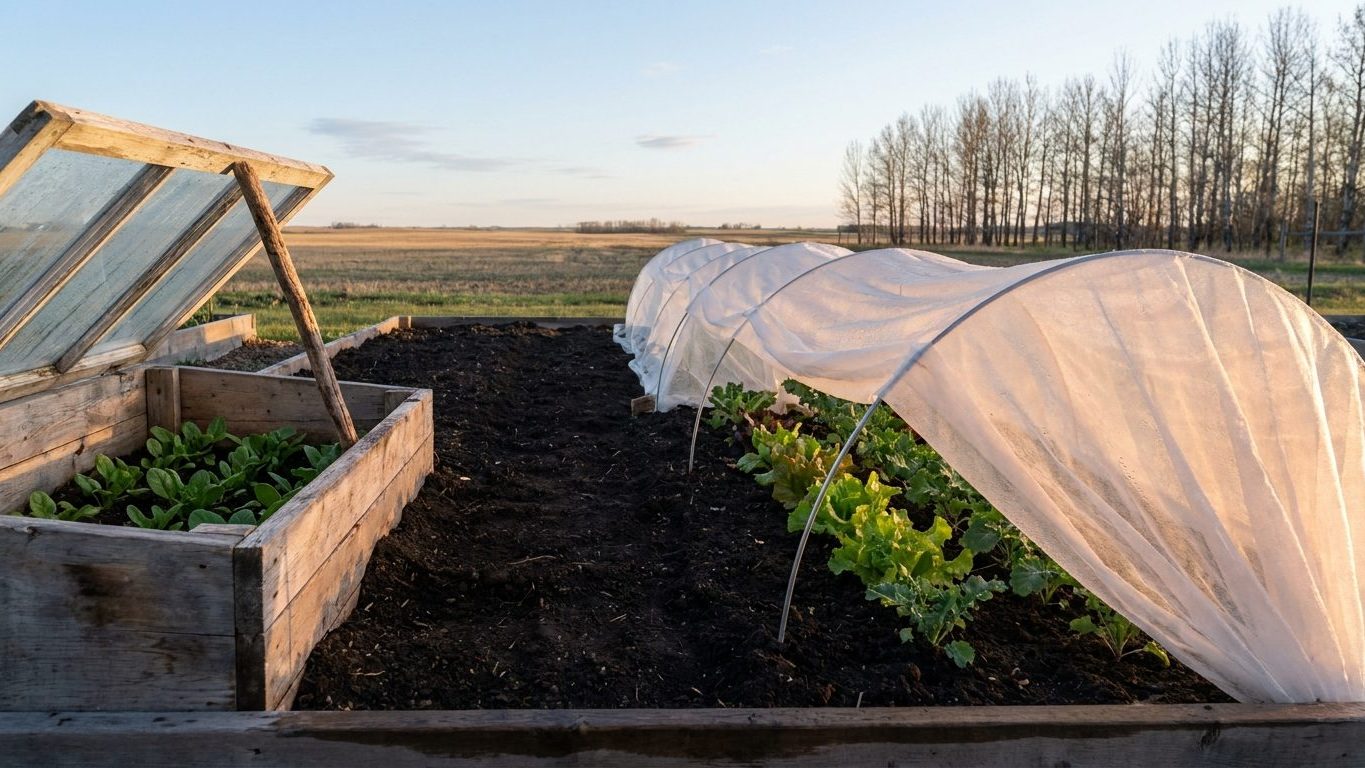

In Indiana, the extenders that earn their keep are floating row cover, low tunnels and cold frames, with an unheated high tunnel for gardeners ready to build one. They stretch spring and fall by weeks, not months. Indianapolis, the reference point for the dates on this page, sees its first fall freeze between October 21 and October 30. That is about a week from now, so this is a good moment to decide what to buy.
The short answer for Indiana
Row cover and low tunnels do the most work for the least money. Hoops and a sheet of fabric or plastic can go over a bed in an afternoon, and they cover the two jobs Indiana gardeners need most: getting tomatoes, peppers and squash out early, and keeping lettuce, spinach and carrots going past the first freeze. A cold frame handles hardy greens through the dark months. A high tunnel makes sense only if you want to garden seriously in winter.
Spring and fall
The frost dates are probabilities, not promises. NOAA’s 1991-2020 Climate Normals for the Indianapolis station put the last spring freeze at April 9 to April 21. That range is the band where the chance of a 32F freeze sits between 30 and 70 percent. Purdue adds a caution worth taping to the shed door: roughly a 10% chance of a 32F event remains after the published spring date. A tomato set out on the early edge of that range needs its cover ready to go on.
The fall window runs October 21 to October 30 on the same basis. A cover does not cancel the freeze. It moves your own effective date later, and on a cold night it can be the difference between salvaging a pepper crop and losing it.
Winter
The mean daily minimum of Indianapolis’s coldest month is 20.9F. That is cold enough that an unheated structure protects hardy crops without growing much of anything. Think of a cold frame as a refrigerator with a window, not a greenhouse.
| Extender | Best job in Indiana | Main limit |
|---|---|---|
| Floating row cover | Light frost insurance in spring and fall | Not enough for a hard freeze on its own |
| Low tunnel | Early warm-season crops, late greens and root crops | Needs venting on sunny days |
| Cold frame | Hardy greens in late fall and winter | Small footprint, little winter growth |
| Unheated high tunnel | Longest stretch, spring through winter | Cost, snow load, wind |
Timing the cover is its own skill, and When to Cover Your Garden in Indiana walks through it.
What will not work here
Timing mistakes
Setting tender transplants out on April 9 and hoping. The date sits at the early edge of a 30-70% band, and Purdue’s roughly 10% chance of a later 32F event is not small when you have a flat of tomato plants in the ground. Without a cover standing by, that bet loses often enough to matter.
Starting warm-season crops late and expecting a cover to rescue them is another loser. Indianapolis’s first fall freeze arrives October 21 to October 30. A cover buys a short stretch beyond that, not a whole extra month, so a pepper that needs another six weeks to ripen will not finish under fabric. Count backward from the fall date to see whether a variety has the time.
Expecting an extender to turn a northern garden into a southern one fails too. Southern Indiana runs earlier in spring and later in autumn than the north by a fortnight or more. A cover closes part of that gap, but it does not erase it.
Structure and moisture mistakes
Sealed plastic, left closed. Indiana springs swing from freezing mornings to sunny afternoons, and a closed tunnel or frame on a bright day cooks seedlings. Humid summers and damp falls add disease pressure when the air inside never moves. Vent early, and use breathable fabric rather than plastic when you only need frost protection.
Winter tomatoes, peppers or basil in an unheated structure. With the coldest month averaging a daily low of 20.9F, and with winter days short at about 39.7 degrees north, tender crops will not grow and will not survive. Stick to spinach, kale, mache, carrots and similar hardy crops.
Lightly built hoop houses facing Indiana winters. Wet snow and wind will flatten flimsy frames, so anything meant to stay up through winter should be built for it, and snow should be cleared from low tunnels before it piles up.
What changes across Indiana
There is no single Indiana answer. The USDA Plant Hardiness Zone Map (2023 edition, built on 1991-2020 normals) places the state in a range from 5b to 7a. That system rests on one variable, the average annual extreme minimum temperature, so it tells you what survives a winter, not when to plant. Four zone steps within one state is a wide spread, and it means a perennial or overwintering crop that is safe in one county can be a gamble in another.
Every date on this page belongs to Indianapolis, a station at 39.71 degrees north. A reader near Lake Michigan or along the Ohio River is not at that latitude, and should check their own. Latitude matters because day length, not warmth, tells an onion to stop making leaves and start making a bulb. Move north or south and the onion’s timing moves with you.
A gardener in the north should shift spring covers later and think about fall covers earlier, since the north’s freeze-free stretch is shorter by a fortnight or more than the south’s. A gardener in the south gets more room at both ends, but a long, warm autumn also means pests and disease linger, and a cold frame can overheat quickly. Winter is milder there too, though the zone range runs up to 7a, not beyond.
To find your own zone, use the USDA map and enter your ZIP code. This page will not guess it for you, and neither should anyone who has not seen your yard. For a wider view of the options, see Extending the Growing Season in Indiana.
Where to check this for your own county
The best next stop is Purdue Extension, Indiana’s land-grant extension service, with an office in every county. Once there, look for two things: the local planting calendar and the varieties that have been trialled in your county.
The calendar gives you dates tied to your region’s frost patterns rather than to Indianapolis. Check which frost probability it uses. A date built on a 50 percent chance of a freeze behaves very differently from one built on 10 percent, and the difference decides whether you need a cover on a given night.
Trial results tell you what actually grew well nearby, including which varieties handled cold springs, wet falls and the heat in between. That is the information no state page can supply, and this one does not have it.
A county recommendation beats a state one, and this page is the state one. Treat the dates here as a starting range, then narrow them with what your county office says. Staff and local Master Gardener volunteers can also tell you about frost pockets, soil types and common pest timing in your area, details that rarely make it into a statewide summary.
Checking this against your own garden
Your garden’s own signals outrank every date on this page. Three are worth watching, and none needs an instrument.
- Soil warmth by feel. Push your hand into a bed on a morning in April. If it feels cold and clammy while the bed next to a south-facing wall feels noticeably milder, you have found your warm microclimate. Plant tender crops there first, and under cover in the cold beds.
- The first male flowers. On squash and cucumbers, male flowers open before female ones. When they appear, the plant is telling you conditions have warmed enough to settle in. A bed that flowers days ahead of another is the one to trust for early planting.
- First true leaves. The seed leaves come first, and true leaves signal that a seedling has rooted and is growing. If seedlings under a cover stall before true leaves appear, the soil is still too cold, or the cover is holding too little warmth.
Keep notes for a season: the date each signal shows up, and where in the yard. By next year you will have a calendar more accurate than any regional table, built on your own beds.
Common questions
Is row cover enough to protect plants from a freeze?
It helps against light frosts. A hard freeze can still get through a single layer, so add a second layer or a tunnel over it on the coldest nights. Check the forecast, because the roughly 10% chance Purdue flags after the published spring date is exactly when a cover on standby pays off.
Can I grow vegetables all winter in Indiana?
Hardy greens, yes, under a cold frame or tunnel, though growth is slow. With the coldest month at a mean daily minimum of 20.9F in Indianapolis, tender crops such as tomatoes and peppers will not make it through.
Which frost dates should I use?
Indianapolis’s April 9 to April 21 (last spring) and October 21 to October 30 (first fall) are the reference. Southern Indiana runs earlier in spring and later in autumn than the north by a fortnight or more, so adjust for where you live and confirm with your county extension office.
Do I need a high tunnel?
Most home gardeners do not. Row covers, low tunnels and a cold frame handle spring and fall well. A high tunnel starts to make sense when you want to harvest through the winter, and then the frame has to be built for Indiana snow.