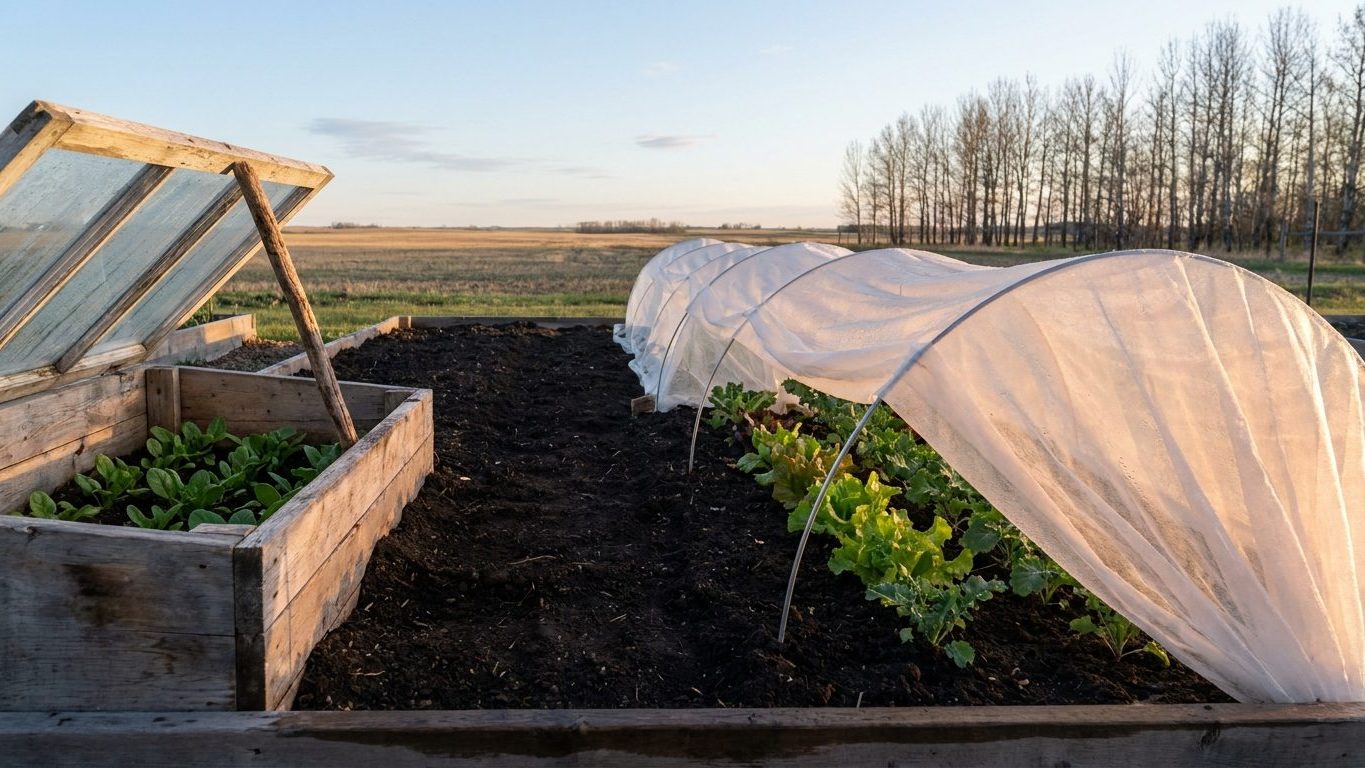

In Iowa, start with floating row covers and low tunnels, add a cold frame for hardy greens and seedlings, and treat a walk-in hoop house as the step up for serious growers. Each tool buys a few weeks at either end of the season, not a new climate. Iowa’s cold is the limit: the coldest-month readings are low enough that these tools stretch autumn and spring but cannot run a winter garden.
The short answer for Iowa
Light row cover over low hoops is the best first purchase for most Iowa gardens, and a cold frame is the best second. Walk-in hoop houses extend the season further but cost more and need anchoring. Black plastic and mulch fill a different job: warming soil before planting.
The numbers explain why the margins are narrow. NOAA’s 1991-2020 Climate Normals for the Des Moines airport station put the last spring 32°F freeze between April 12 and April 24. The first fall one lands between October 14 and October 25. Those dates are the band where the chance of a 32°F freeze runs between 30 and 70 percent. They are probabilities, not promises, and a freeze after the window’s end is entirely possible.
There is a catch. Iowa State Extension county figures (1950-2021) run about four days later in spring and ten days earlier in fall than this airport station. Treat the Des Moines numbers as the optimistic end. A garden outside the city’s warmth could plausibly lose a week or two of the window the airport suggests. Season extenders earn their keep in exactly that gap, protecting plants from the frosts that arrive just outside the average. For a deeper look at the general approach, see Extending the Growing Season in Iowa.
| Extender | Best job in Iowa | Main limit |
|---|---|---|
| Floating row cover | Light spring and fall frosts, plus insect screening | Modest protection; a hard freeze can still get through |
| Low tunnel | Early greens, brassicas and fall lettuce | Needs venting on sunny days |
| Cold frame | Hardening seedlings, holding hardy greens late | Small footprint; must be opened and closed |
| Walk-in hoop house | Earlier tomatoes, later salad crops | Wind anchoring and snow load |
| Black plastic or mulch | Warming soil before warm-season transplants | Does nothing for air frost |
What will not work here
Winter growing under a simple cover will not work. The mean daily minimum of Iowa’s coldest month at Des Moines is 13.8°F, and a sheet of fabric or thin plastic cannot hold a garden against that, night after night. Hardy crops such as spinach can sit under protection and survive for a while, but they mostly hold rather than grow once the short days arrive. Anyone planning fresh salad in January from an unheated tunnel will be disappointed.
Planting tender crops weeks early under cover is the second failure. Tomatoes, peppers and squash dislike cold soil as much as cold air. A row cover does little for soil that is still chilly in mid-April, and the Des Moines last-freeze band runs through April 24, with county figures about four days later. A cover may save a plant from a frost, but a stunted transplant sitting in cold ground gains nothing from it. Black plastic laid ahead of planting helps with the soil side, but it has no effect on a hard freeze overhead.
Unvented plastic is another trap. A clear low tunnel closed on a sunny spring afternoon can cook seedlings, even when nights are still frosty. Iowa’s spring swings between cold nights and warm days, so a tunnel that needs no attention rarely exists here. If you cannot be home to open it, fabric row cover forgives more than plastic does.
Wind and snow defeat poorly built structures. Iowa’s open farmland gives wind plenty of room to run, and a loosely anchored hoop house can be tipped or shredded. Wet spring snow will flatten a light hoop frame that has no support, so a tunnel left up through winter needs to be sturdy or be cleared of snow by hand.
Finally, slow crops can’t be rescued by cover at the back end. Sweet potatoes, long-season melons and late-sown corn need heat and time, and the first fall freeze arrives between October 14 and October 25 at the Des Moines station, ten days earlier by Extension county figures. Covering a plant that has not finished its crop adds a few days, not the month it needs. Choose shorter-season varieties first, then use covers on top. The timing questions around fall protection are covered in When to Cover Your Garden in Iowa.
What changes across Iowa
Iowa does not have one garden climate. The USDA Plant Hardiness Zone Map (2023, built on 1991-2020 normals) places the state across zones 4b to 6a, so there is no single answer to how hard winter hits. That map rests on one variable, the average annual extreme minimum temperature, which tells you whether a perennial survives winter. It does not tell you when spring frost ends.
Shifting north
The reference figures on this page belong to Des Moines, at 41.53 degrees north latitude. A gardener in the far north of the state is farther from the equator and should expect a colder winter and a later spring than the numbers here. Day length shifts too, and day length, not warmth, tells an onion when to stop making leaves and start making a bulb. No cover changes that. If you live near the state’s northern or southern edge, check your own latitude before leaning on the Des Moines dates.
Shifting south
The southern tier of the state generally leans toward the milder end of the zone range, which gives a little more breathing room in spring and fall. Even there, the Extension caution applies: county records can show later spring and earlier fall freezes than an airport does. Cities hold heat, so a rural garden often sits colder than the nearest airport station. Low spots collect cold air on still nights, and a garden at the bottom of a slope may see frost when a neighbor uphill does not.
To find your own zone, use the USDA map rather than guessing from the county name. It lets you enter a ZIP code. Use the zone for plant survival and the county frost dates for timing.
Where to check this for your own county
The best next stop is Iowa State University Extension, the state’s land-grant extension service. Its horticulture resources are the place to look for two things: the local planting calendar and the varieties trialled in your county.
The planting calendar matters because extension calendars are often organized by crop, not by state, so look for the crop you actually grow. A cool-season crop like spinach and a warm-season crop like tomato are worked in opposite halves of the year, and the recommended covers and dates differ for each. This page does not have a crop-by-crop Iowa calendar, so do not treat its dates as one.
Varieties trialled in your county tell you something a state page can’t: what actually finished before frost in soils like yours. A variety that does well in a university trial plot a few counties away is a much better bet than one picked by a seed catalog photo.
A county recommendation beats a state one. This page is the state one, built from a single reference station (Des Moines), a statewide hardiness range, and the Extension caution that county frost figures run four days later in spring and ten days earlier in fall. Use it to decide what kind of extender fits your goals, then use your county’s figures to set actual dates. Local Extension staff and Master Gardener programs can also tell you how local wind, soil and frost pockets change the picture.
Checking this against your own garden
Your own observations outrank every date on this page. Three are worth watching, and none needs an instrument.
- Soil warmth by feel. Push a hand a few inches into bare soil in the morning. If it feels cold and damp, warm-season transplants will sulk, covered or not. Compare a spot under black plastic with an uncovered patch, and a sunny bed with a shaded one. The gap shows how much your extender is really helping.
- The first male flowers on squash and cucumbers. Male blooms usually open before female ones. When they show up, the plants have enough warmth to start flowering. If they arrive late in one bed and early in another, you have found a warm corner and a cool one.
- The first true leaves. Seedlings first show rounded seed leaves, then the true leaves that look like the mature plant. Once they appear, plants can generally handle hardening off in a cold frame. If one tray gets them days before another, that location holds more heat.
Write the dates in a notebook for a couple of seasons. Patterns appear quickly: the bed along a south wall that thaws first, the low corner that frosts last, the row that always gets hit by wind. After two years, your own notes will tell you more about your garden than any state average can.
Common questions
Will a row cover protect plants from a hard freeze in Iowa?
Light fabric helps in light frosts and modest dips, but it is not a reliable guard against a hard freeze. Hardy greens tolerate more than tomatoes or peppers do. For tender crops, add a second layer or bring them in.
Can I grow vegetables through an Iowa winter without heat?
Only hardy crops, and mostly they hold rather than grow. The mean daily minimum of the coldest month at Des Moines is 13.8°F, and days are short. Plan to plant in early fall and harvest from what is already established.
Is plastic or fabric better for low tunnels?
Plastic holds more heat but needs venting on sunny days or it can overheat plants. Fabric is more forgiving if you can’t be there to open it. Many Iowa gardeners use fabric in fall and plastic in early spring.
Should I trust the Des Moines frost dates for my garden?
Treat them as the optimistic end. Iowa State Extension county figures (1950-2021) run about four days later in spring and ten days earlier in fall than the airport station. Plan for a shorter season unless your county data says otherwise.