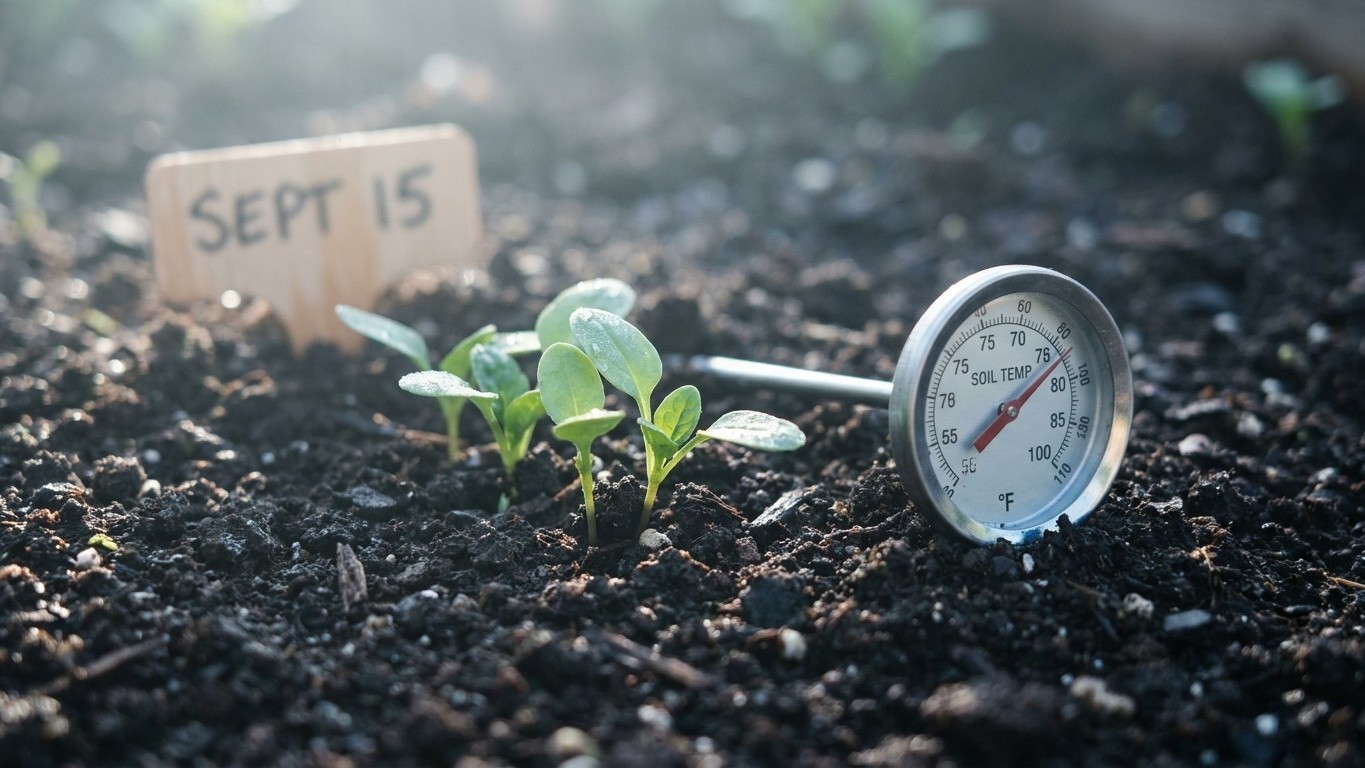

In central Iowa, spring spinach goes into the ground from late March through the first days of April, two to three weeks ahead of the April 12-24 last-frost window. The fall crop follows a different clock entirely: sow from early August into early September, timed backward from the first fall frost of October 14-25, and only once the soil itself has cooled enough to let seed germinate.
The short answer
Des Moines gets 15 hours and 1 minute of daylight on the longest day of the year. For spinach, that number is not a bonus, it’s a countdown. Flowering in spinach is triggered by day length as much as by temperature, so as the days stretch past 14 hours in late spring, the plant starts pushing toward seed whether or not the thermometer cooperates. A mild June in Iowa does nothing to slow that clock down. This matters because it means the limiting factor here isn’t purely heat.
It’s both, and they arrive in a particular order. Day length climbs first, forcing the plant toward bolting as early as late May in some years, well before the hottest weeks of summer even start. Heat compounds the problem rather than causing it outright. Des Moines averages 18.4 days a year at 90F or above, almost all of them clustered in June, July, and August, and spinach growth quality falls apart above 75F long before the thermometer gets anywhere near 90. So by the time day length alone would be enough to end the spring crop, the heat has usually already made the leaves bitter and the plant unpleasant to eat.
That combination is why Iowa gardeners get two narrow windows rather than one long season. Spring spinach has to be sown, grown, and harvested before day length and temperature converge into bolting conditions, which in practice means a window measured in weeks, not months. Fall spinach flips the equation: day length is shortening by August, which works in the plant’s favor, but the soil is still holding onto summer heat, and spinach seed struggles to germinate once soil temperatures climb above 80F.
None of this makes spinach a bad fit for Iowa gardens. It just means the crop rewards precise timing over improvisation. Missing the spring window by even ten days can mean bolted, bitter leaves instead of a harvest. Missing the fall window by sowing too early can mean seed that simply sits in hot soil and rots before it ever germinates.
How long the spring window really is
- Start counting from the last frost. NOAA climate normals put the last spring frost in central Iowa between April 12 and April 24. Spinach seed is cold-tolerant enough to go in two to three weeks before that date, which lands the sowing window somewhere between late March and the first days of April.
- Germination begins even in cool soil. Unlike the fall crop, spring sowing doesn’t have to wait for warm soil, spinach seed germinates fine in the cool ground of early spring, which is exactly why this window opens so much earlier than most garden vegetables.
- Growth is good until the 75F ceiling closes in. Spinach performs best where temperatures stay below 75F. Iowa’s spring typically holds under that mark through April and much of May, giving the plant several weeks of favorable growing weather before either heat or day length becomes a problem.
- Day length starts working against the plant by late May. As the calendar moves toward the June solstice and daylight climbs toward that 15-hour-1-minute peak, spinach shifts from leafy growth toward bolting, regardless of how mild the actual temperature happens to be.
- The realistic harvest window runs about eight to ten weeks. Sown in late March or early April, spinach in central Iowa needs to be harvested before late May or the first half of June, when day length and rising heat close in from both directions at once.
That’s a tighter window than gardeners moving from warmer states often expect. It also means succession sowing, planting a new short row every week or two through the open window, tends to work better than one large single sowing, since it spreads the harvest across the weeks the plant actually tolerates.
The autumn crop, and when the soil lets you sow
Soil still too warm to germinate
The obstacle in late summer isn’t heat stress on growing plants, it’s the seed itself refusing to sprout. Utah State University Extension notes that spinach germination drops off once soil temperature climbs above 80F, and Iowa soil in late July and early August is still holding onto the summer’s accumulated warmth, especially after a stretch that averages 18.4 days a year at 90F or hotter. Sowing too early, straight through the hottest part of August, often means seed sitting inert in ground that’s simply too warm for it to do anything. The practical fix is patience: wait until the soil has visibly cooled from its midsummer peak, which in most years means holding off until mid-to-late August rather than sowing the moment the calendar turns.
The frost that ends the season
The other end of the window is fixed by the first fall frost, which NOAA climate normals place between October 14 and October 25 for this station. The only guidance available for fall spinach timing is to sow 50 to 75 days before the date you want to harvest, since no source publishes a specific days-to-maturity figure for the crop. Counting back 50 to 75 days from an October 14 harvest lands sowing between July 31 and August 25. Counting back the same range from October 25 lands sowing between August 11 and September 5. Put those two ranges together and the workable fall sowing window for central Iowa sits roughly from early August through early September, narrower on the early end by the soil-temperature problem, narrower on the late end by the approaching frost.
Four spinach varieties come up repeatedly in Extension guidance for gardeners: Bloomsdale, Melody, Teton, and Olympia. None of them come with published data on days to maturity or bolt resistance from the sources behind this guidance, so there’s no accurate way to say one performs better than another for an Iowa fall planting without inventing numbers that don’t exist. Choosing among them comes down to what’s available from a given seed source rather than any documented performance edge.
Common questions
Can spinach survive a light frost in Iowa?
Spinach is a cold-tolerant leaf crop, and gardeners commonly harvest it after light frost has touched the leaves. The specific frost thresholds published for this region come from NOAA climate normals and cover the general 32F freeze date, not a separate light-frost or hard-freeze figure, so treat the October 14-25 window as the point where the season is ending rather than a hard cutoff for every leaf on the plant.
Why does a mild Iowa summer not extend the spring spinach harvest?
Because bolting in spinach is triggered by day length as well as heat. Even in a cooler-than-average June, the days themselves are still stretching toward that 15-hour-1-minute peak, and that alone is enough to push the plant toward flowering regardless of temperature.
Is there a way to sow fall spinach earlier than August?
The limit isn’t the calendar, it’s the soil. Once soil temperature climbs above 80F, germination drops off sharply, according to Utah State University Extension. Sowing earlier only works if the soil itself has actually cooled, which in most years in central Iowa doesn’t happen until later in August regardless of what the date on the calendar says.
Does succession sowing help with either the spring or fall crop?
Yes, particularly in spring, where the usable window runs only about eight to ten weeks. Sowing a short row every week or two through that window spreads the harvest out and reduces the risk of losing an entire crop at once to a sudden warm spell or a jump in day length.