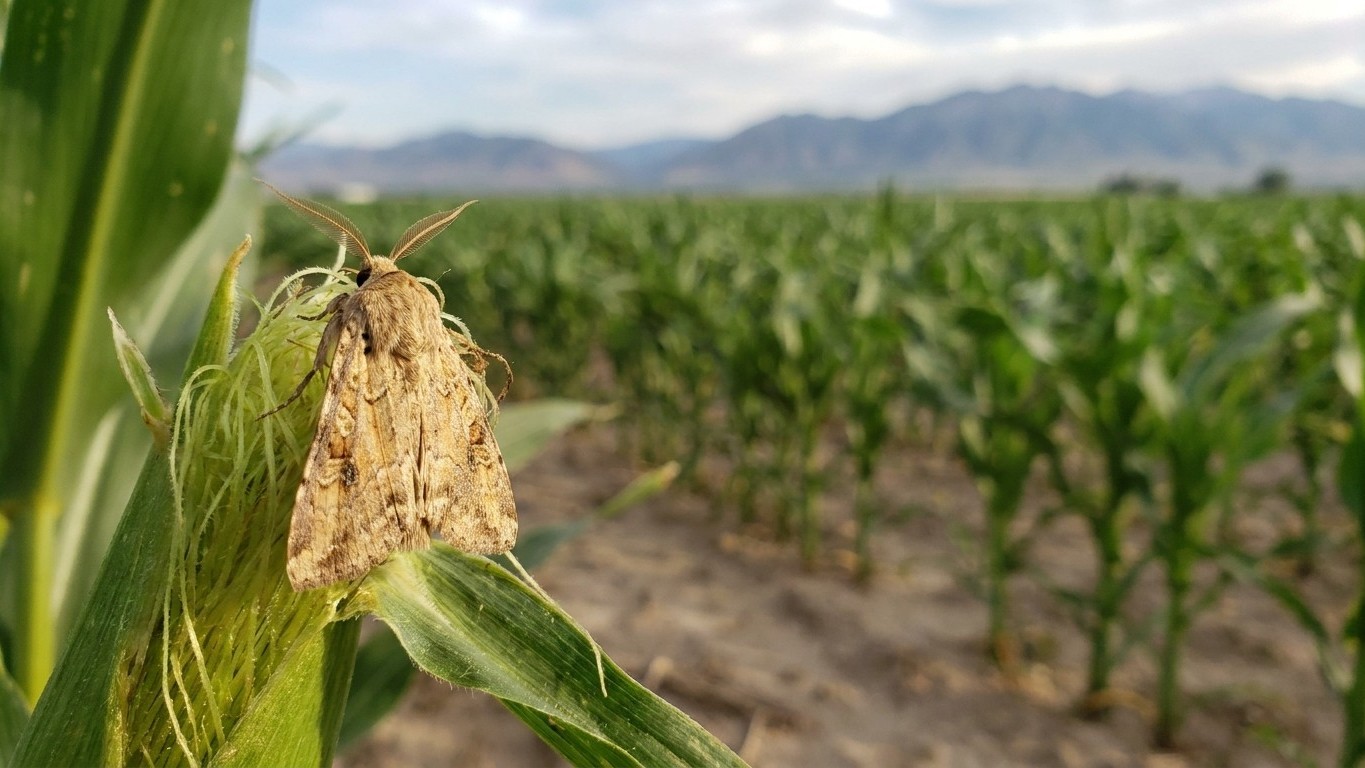

Purdue Extension Entomology documents ten garden pests active in Indiana, and only three of them have any real business in a cornfield. Seedcorn maggot attacks the seed itself right at planting. Spotted cucumber beetle feeds on leaves as an adult and on roots as a larva. Brown marmorated stink bug punctures ripening ears once silks appear.
Which pests attack corn in Indiana
Purdue Extension Entomology’s list for this territory runs to ten names: Asparagus beetle, Brown marmorated stink bug, Cabbage looper, Colorado potato beetle, Mexican bean beetle, Seedcorn maggot, Spotted cucumber beetle, Squash bug, Squash vine borer, and Striped cucumber beetle. That’s the full documented set for Indiana gardens, not a longer tally borrowed from a national database.
Most of that list has no reason to be near a corn stalk. Asparagus beetle stays on asparagus spears and ferns. Cabbage looper works brassica leaves, cabbage, broccoli, kale, and skips grasses like corn entirely. Colorado potato beetle needs a plant in the potato family (potato, eggplant, tomato), which corn isn’t. Mexican bean beetle feeds only on bean foliage. Squash bug and squash vine borer both depend on a cucurbit vine to survive, and a corn stalk offers neither the tissue nor the shelter they need. Striped cucumber beetle sticks to cucurbit blossoms and vines too, despite looking like a generalist.
Three species remain with an actual food source in a corn patch. Seedcorn maggot tunnels into the planted seed underground, before a seedling ever reaches daylight. Spotted cucumber beetle does double duty: the adult chews young corn leaves, while its larva is the same insect known separately as the southern corn rootworm, working on roots later in the season. Brown marmorated stink bug feeds on dozens of unrelated crops, but it does pierce the husk to reach kernels once an ear forms.
What decides which of the three matters most in any given garden is timing, not identity — a seed left in cold soil an extra week is exposed to the maggot for that whole extra week, while a stink bug has nothing to puncture until an ear exists.
When each one shows up, and what it does first
The Indianapolis reference station places the last spring frost between April 9 and April 21, but that date alone doesn’t say when to plant. Sweet corn seed needs soil above 60°F to germinate reliably, and that threshold arrives well after the frost window closes, not on the same day. The stretch in between, soil clear of frost but still short of 60°F, is exactly where seedcorn maggot does its worst work.
Seed sitting in soil that’s still cold and wet is slow to sprout, and every extra day underground is another day exposed to a maggot already tunneling into it. The first sign isn’t a damaged plant at all. It’s an empty gap in the row where nothing came up, or a seedling that emerges pale and collapses within days.
Spotted cucumber beetle adults appear as soon as seedlings break ground, feeding on the first true leaves. That’s the visible stage. The damage that matters more shows up later, once the larvae, working underground as corn rootworm, chew into roots during the weeks the plant is putting on height. First sign above ground: small chewed patches on young leaves. First sign of the root stage: a plant that leans or develops a gooseneck curve at the base after a summer storm, once weakened roots can’t hold it upright anymore.
Brown marmorated stink bug shows up last, once ears are forming and silk has emerged. Sweet corn needs 60 to 90 days from planting to reach harvest, and that window pushes ear formation into the hottest stretch of the season, the same stretch that accounts for Indiana’s average of 14.6 days a year above 90°F. The first sign here is on the kernel itself: a small puncture mark on an otherwise normal ear, with a shrunken or discolored kernel underneath once the husk is pulled back, all of it arriving before the first fall frost settles in between October 21 and October 30.
Telling the damage apart from everything else
Not every ragged leaf or empty row means an insect did it. Cold soil rot, hail, drought, and simple nutrient shortages produce symptoms that look close enough to insect feeding to send a gardener chasing the wrong problem. Dig up or pull apart the damaged tissue before assuming a pest is responsible — the physical evidence, not the symptom alone, is what tells the two apart.
| Symptom | Likely cause | What tells them apart |
|---|---|---|
| Gaps in the row, no seedlings emerged | Seedcorn maggot, or seed simply rotted in cold soil | Dig up the seed: maggot damage leaves a hollow, tunneled kernel; rot leaves a mushy kernel with no insect inside |
| Small ragged holes in young leaves | Cucumber beetle feeding, or wind and hail | Beetle feeding is scattered, with chewed margins and beetles visible nearby at dawn; hail damage is uniform across the whole planting |
| Plant leaning or curved at the base after a storm | Rootworm larvae, or simple wind lodging | Pull the plant: larval damage leaves stubby, scarred roots; lodging leaves roots intact with soil pushed up on one side |
| Puncture mark and discolored kernel under the husk | Stink bug feeding, or poor pollination from hot, dry silking weather | A visible puncture point on the kernel skin points to the stink bug; unfilled kernels with no puncture mark point to pollination failure |
| Yellowing lower leaves | Nitrogen deficiency, drought stress, or insect feeding | Deficiency moves in a V-shape from the tip inward on older leaves; drought curls leaves inward at midday; insect feeding leaves visible bite marks or frass |
None of this replaces a look from someone trained to make the call. A county extension office can tell a nutrient streak from a beetle scar in a way a photo online can’t always settle.
What actually works here, and what is a waste of time
Waiting until soil is reliably above 60°F before planting does more to limit seedcorn maggot damage than anything applied after the fact — fast germination simply gives the maggot less time to work. Planting extra early to get a head start backfires for this exact reason: slow germination in cold soil means longer exposure, not less.
For spotted cucumber beetle and its rootworm larvae, rotating corn to a different bed each season breaks the cycle, since larvae overwinter in the soil where corn grew the year before. Handpicking adult beetles during the cool of early morning, when they’re sluggish, works fine on a small home planting. Treating for adult leaf feeding alone rarely pays off, since a few chewed patches on young leaves don’t reliably predict how much root damage follows.
Brown marmorated stink bug is the hardest of the three to manage directly, because by the time it’s feeding, ears are already formed and stalks are too tall and dense for a physical barrier to matter. The one thing that helps is checking ears as they near ripeness and harvesting promptly rather than letting them sit on the stalk longer than needed. Treating a whole planting because “the corn looks off” wastes effort, since most of the damage that looks like insect feeding, as the table above shows, has nothing to do with this bug at all.
This site doesn’t name a product, an active ingredient, or a dose for any of these three, because what’s labeled for use on corn in Indiana is a question for the people who track state pesticide registration, not a garden content page.
Where to check this for your own county
Purdue Extension Entomology is the source for the pest list used on this page, and it’s also the right first stop for anything more specific than what’s covered here. A pest documented at the state level doesn’t mean it’s present in any one garden — presence shifts county to county and even yard to yard, depending on soil, nearby crops, and what was planted in that same bed the year before.
A county extension office can look at an actual sample, not just a description of one, and that difference matters more than it sounds. Two gardeners describing “holes in the leaves” over the phone might be dealing with two completely different problems.
The next useful step for anyone seeing damage right now isn’t a broader search. It’s a call or a sample drop-off at the local county extension office, with the damaged plant part in hand if possible.
Common questions
Does field corn attract the same pests as sweet corn in Indiana?
Field corn and sweet corn share the same three documented pests, seedcorn maggot, spotted cucumber beetle, and brown marmorated stink bug, since all three respond to the plant’s growth stage rather than to sweetness.
What time of year is corn most at risk from insects in Indiana?
Risk shifts through the season: seedcorn maggot is a planting-time problem tied to soil still short of 60°F, cucumber beetle and its larvae run through the early leaf and root stages, and stink bug pressure builds once ears form, closer to the season’s hottest stretch.
Can row covers protect corn the way they protect squash or cucumbers?
Covers can shield very young corn seedlings from early beetle feeding, but corn relies on wind for pollination once it tassels, so covers need to come off well before that stage, unlike squash or cucumbers where insect pollination changes the timing question.
Why do I see cucumber beetles on my corn if they’re a squash pest?
Striped cucumber beetle is a cucurbit specialist and isn’t documented as a corn feeder here, but spotted cucumber beetle is different: it feeds on both cucurbits and corn leaves, which is why the two get confused in the same garden.