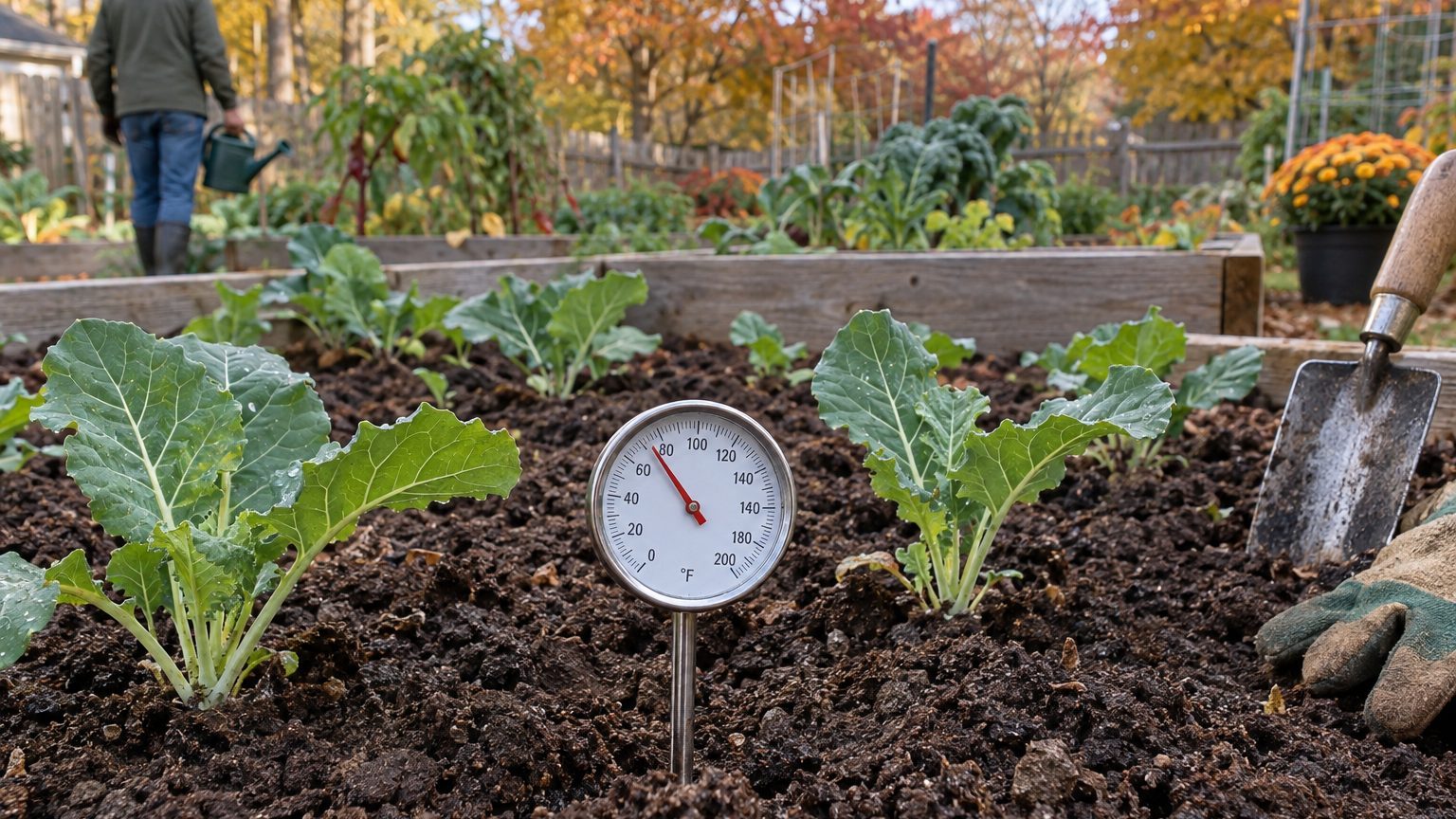

Collards can go into Iowa gardens once the soil itself has warmed, not the moment the calendar says frost risk has passed. That distinction matters more here than almost anywhere else, because Iowa’s frost dates and its soil temperatures don’t move in lockstep, and a gardener who plants by frost date alone often ends up with stalled, yellow seedlings sitting in cold ground.
When the soil is warm enough in Iowa

The last spring frost across this territory falls somewhere between April 12 and April 24, according to NOAA’s 1991-2020 Climate Normals for the 30-70% freeze probability band at the Des Moines reference station. That’s a probability window, not a promise: some years the risk clears earlier, some years a late cold snap pushes past it. Iowa State University Extension’s own county-level data, built from a longer 1950-2021 record, tends to run about four days later in spring than this airport figure, so treat the NOAA date as the optimistic end and your own county’s extension figure as the safer one to plan around.
Frost is only a stand-in for the number that actually matters to collards: soil temperature. A morning with no frost risk can still sit over ground in the low 40s, and collard transplants set into cold soil simply sulk there until the ground catches up. The practical move is to let the soil warm for a week or two past the local frost date before setting out transplants, and to hold off on direct seeding a little longer still, since germination slows sharply in cold soil.
Direct seeding versus transplanting is worth thinking through here rather than defaulting to habit. Transplants give a head start on a season that, as the next section shows, isn’t unlimited in this territory. Either way, cover young plants with floating row cover for the first few weeks, both for a few degrees of frost buffer and to keep early flea beetles off tender leaves, a common early-season nuisance on brassicas across the Midwest. Skip naming a specific spray and stick to the practice: row cover first, targeted treatment only if damage crosses a threshold you can see on the leaves themselves.
Collards belong to the same brassica family as cabbage, kale, mustard, turnip and rutabaga, and they share the same soil-borne troubles: clubroot, blackleg, and a shared appetite from cabbage worms and flea beetles. A bed that grew any of those crops last year hasn’t been rotated just because it now holds collards instead. If you’re planning rotation across a mixed brassica bed, the rotation guide on this site is the place to work that out before you plant, not after the first disease shows up.
How long the season lasts here
Stack the two frost dates together and Iowa’s frost-free window runs roughly from April 12-24 in spring to October 14-25 in fall, both figures from the same NOAA 1991-2020 Climate Normals record. Do the subtraction at the two extremes and you get a season somewhere between about 173 and 196 days, depending on which end of each range your particular year and county land on. That’s a wide band, and it’s wide on purpose: a single point figure would pretend to a precision the underlying data doesn’t have.
What that length allows is the real question. A window past roughly six months gives Iowa gardeners room for two collard plantings in a single year: an early spring sowing timed to the soil-warming window above, and a second sowing in mid-to-late summer aimed at a fall harvest that finishes before the first hard freeze. That second sowing is where succession planting earns its keep, since collards actually sweeten with a light fall frost, and timing a crop to mature right as the weather turns cool is one of the better payoffs of gardening in this climate.
Whether that second sowing is worth transplanting rather than direct seeding comes down to how much of the season you have left when you plant it. Given the range above, a gardener working from the later end of the spring frost window and the earlier end of the fall one has a noticeably tighter fall slot than someone at the other extremes, which is exactly why the county-level, four-days-later spring figure from Iowa State Extension is worth checking before committing to a second round. For the mechanics of staggering sowings so you’re not harvesting everything in one frantic week, the succession sowing guide on this site walks through spacing plantings two to three weeks apart across a season like this one.
Heat and water in Iowa

This is where Iowa’s winter, not its summer, ends up deciding how a collard bed gets planned. The mean daily minimum temperature of the coldest month here runs 13.8°F, per NOAA’s 1991-2020 Climate Normals for the Des Moines reference station, which sits inside a broader USDA hardiness zone range of 4b-6a across the territory. That figure, the average low of the coldest month rather than a rare record low, is cold enough that collards left standing through a full Iowa winter won’t make it. This is not a territory where you pick leaves off a standing plant in January the way a gardener in the coastal Southeast might.
That makes Iowa an autumn-crop territory for collards, not a standing-crop one. The plant’s job here is to grow through summer and finish strong in the weeks around the first fall frost, October 14-25 in the NOAA data, with the plant likely tolerating a few light frosts afterward but not the hard, sustained freeze that follows once the coldest month sets in. Plan the fall sowing so maturity lands in that October window, and treat anything still in the ground once nightly lows start dropping into the 20s as finished business, not a crop to nurse through winter.
On the summer side, this territory’s specific count of days above 90°F and its summer rainfall total aren’t part of the verified data available for this page, so no number gets invented here. What can be said generally about Midwest summers, drawing on the humid continental pattern this hardiness zone range sits within, is that warm, muggy stretches favor fungal and bacterial leaf problems on brassicas more than they favor pest pressure alone. Spacing plants for airflow, watering at the soil line rather than overhead, and avoiding a dense, shaded canopy all reduce the odds of the leaf spot and downy mildew that humid air tends to invite. A gardener who’s watched leaves go from healthy to spotted almost overnight during a sticky August week knows exactly what that humidity does to a crowded bed.
Which collards suit Iowa
Reasoning from this territory’s own numbers points toward a type, not a name. A season running roughly 173 to 196 days end to end, split into two plantings, favors collard types bred to mature quickly enough to fit a spring sowing before summer heat sets in and a fall sowing that still has time to finish before the October frost window closes. Types marketed as slower to bolt and quicker to reach usable leaf size both have a place here, one for the spring slot and one for the tighter fall one.
The humid stretch of Iowa summer covered above makes disease resistance the next filter worth applying, ahead of leaf color or texture preferences. Collard types selected for resistance to common leaf diseases hold up better through a muggy August than those chosen purely for flavor or leaf size, and that resistance matters more in a state sitting in this hardiness zone range than it would in a drier western territory.
None of that adds up to a variety name worth printing here, and that’s deliberate rather than an oversight. The specific collard types trialled and recommended for Iowa conditions change as breeding programs release new selections, and a name picked for this page today could be outdated or simply wrong for a given county’s microclimate by the time it’s read. Iowa State University Extension runs exactly these variety trials for the state and publishes results specific to Iowa’s growing conditions, which makes it the one source worth checking before buying seed, rather than any general gardening page.
One more rotation note belongs here rather than only in the pest sections: collards are brassicas, in the same family as cabbage, kale, mustard, turnip and rutabaga, and whichever type you choose will carry the same soil-borne risks those crops do. Working a chosen collard type into a rotation plan that already accounts for those relatives, rather than treating collards as a stand-alone crop, is part of picking the right type for this territory, not a separate step to handle later.