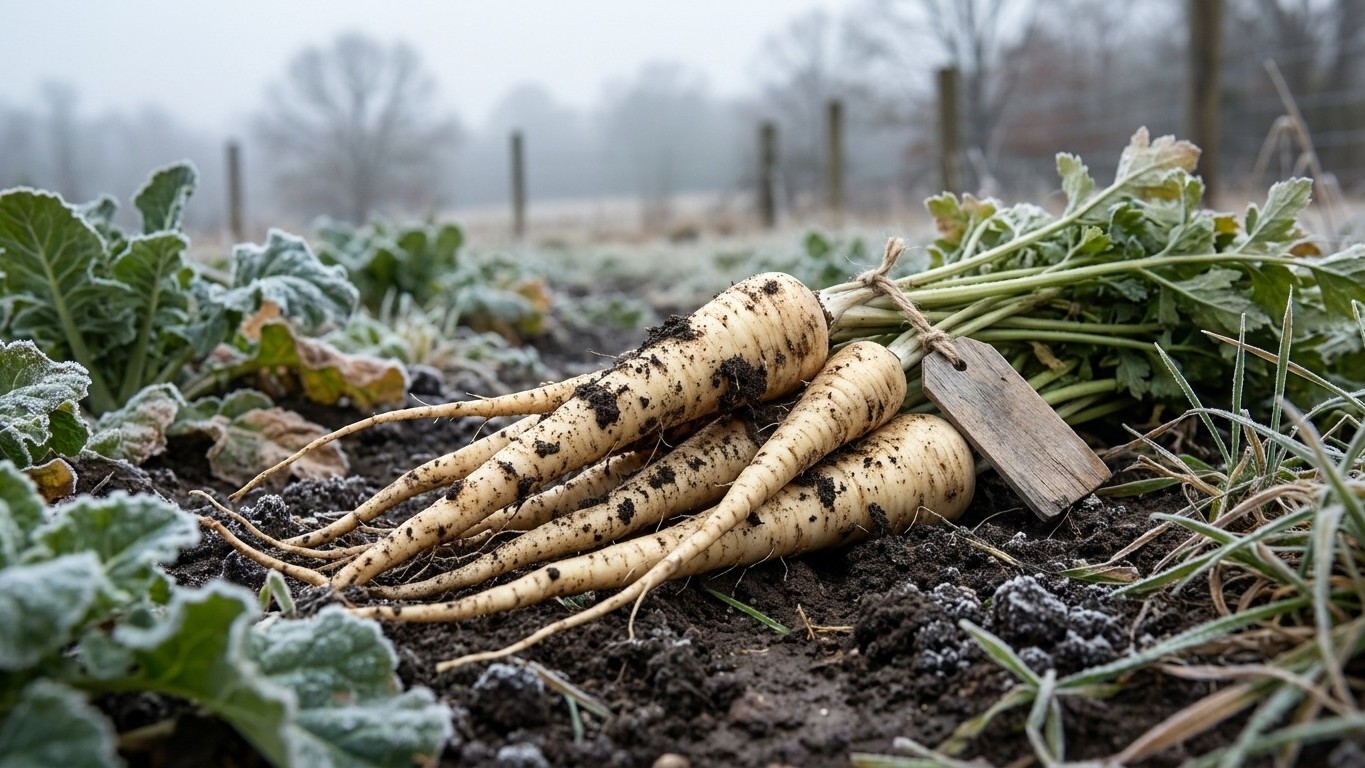

Yes. Iowa’s winters run cold enough, and long enough, to give parsnips the frost exposure that converts starch to sugar in the root. The mean daily minimum in the coldest month sits at 13.8°F at the Des Moines reference station, and the spring-to-fall window leaves comfortable room for a full 100 to 120 day crop. The rest of this page walks through why that number matters, whether the calendar actually lines up, and where local soil and rainfall still trip up an otherwise favorable climate.
The short answer
The question that decides this for a root vegetable grower isn’t “how cold does it get once,” it’s whether the cold season delivers several straight weeks of hard frost. A single freeze does almost nothing to a parsnip’s sugar content. Weeks of sustained cold, working on roots left in the ground, is what pulls off the conversion.
At the Des Moines reference station, the NOAA NCEI Climate Normals for 1991-2020 put the mean daily minimum for the coldest month at 13.8°F. That’s not a record low or a single overnight dip. It’s the average low across the coldest month of the year, which means most nights in that stretch are dropping well into the teens as a matter of routine, not as an exception.
Frost exposure, not the zone number
A hardiness zone rating tells you whether a perennial plant survives the winter where you live. It says nothing about how many frosty weeks pass through a garden bed, and it’s the wrong number to reach for here. What sweetens a parsnip is sustained exposure to cold soil temperatures over an extended stretch, not a single classification tier. Two locations can share a hardiness zone and differ sharply in how many frosty weeks they actually deliver each year. In this case, the 13.8°F coldest-month minimum is the number that matters, and it describes a winter with real staying power, not a marginal one that hovers near freezing and backs off.
A mild-winter climate can grow a perfectly respectable-looking parsnip: full-sized, well-shaped, harvestable on schedule. It just never gets sweet, because the starch-to-sugar conversion depends on cold exposure the plant never receives. That’s not the situation here. A coldest-month average minimum in the teens is squarely in the range where a parsnip left in the ground through autumn cold gets the weeks of frost it needs. The climate does its part. What’s left is making sure the calendar and the soil cooperate too.
Does the season fit?
Parsnips are sown directly in the garden bed where they’ll grow, not started indoors and transplanted, and the clock for maturity starts at seeding, not at germination. That distinction matters because germination itself is slow: 14 to 21 days before the first true leaves show, according to Utah State University Extension. A gardener who doesn’t account for that stretch will dig up bare soil, assume the seed failed, and re-sow on top of a bed that was already working. Here’s how the full season stacks up against Iowa’s frost dates.
- Set the sowing window. Parsnip seed goes in the ground 2 to 3 weeks before the last spring frost. The last spring frost at the Des Moines reference station falls between April 12 and April 24, which puts sowing somewhere around late March to early April.
- Add the germination lag. Seedlings take 14 to 21 days to emerge in cool spring soil, so visible growth won’t appear until roughly mid to late April, even though the seed has been doing its work underground the entire time.
- Add the maturity window. From seeding, a parsnip needs 100 to 120 days to reach full size. Counting from a late-March to early-April sowing, that maturity date lands somewhere between early July and early August.
- Compare against the first fall frost. The first fall frost at the reference station arrives between October 14 and October 25. That leaves roughly ten to twelve weeks between a parsnip reaching maturity and the first hard frost of autumn, weeks the gardener can use to keep roots in the ground for continued cold exposure rather than pulling them the moment they’re grown.
- Read the fit. A season stretching from late March sowing to late October frost gives well over 200 days of growing room, against a crop that needs 100 to 120 days plus a three-week germination lag. That’s a comfortable fit, not a tight one, with enough slack to absorb a late sowing or a slow, cool spring without pushing the harvest past the first freeze.
One caution worth carrying into fall planning: Iowa State Extension’s county-level frost data, drawn from records spanning 1950 to 2021, runs about 4 days later in spring and 10 days earlier in fall than the airport-station figures above. Treat the dates in this section as the optimistic end of the range, and give a parsnip crop a little extra buffer on both ends if working from local county records instead.
What goes wrong here
A climate that fits doesn’t guarantee a clean harvest. Most parsnip failures trace back to the soil bed or to how the crop is watered, not to the calendar.
- Forked roots from heavy or stony ground. Parsnips send a single taproot straight down, and anything that blocks that path, compacted clay, buried rock, an old root system, splits the root into two or three forks. Utah State University Extension recommends deep sandy soil, and where the bed runs heavy, double digging to at least a foot or more before sowing so the taproot has a clear, loose channel to follow.
- Forked roots from overwatering. This is a separate cause from heavy soil, not the same problem wearing a different name. Excess moisture, especially early in the season, encourages the root to branch rather than drive down as one clean taproot. A bed that’s consistently soggy needs less frequent, deeper watering rather than daily light sprinkling.
- A season that runs out before harvest. Given how much slack Iowa’s frost window leaves, this is the least likely failure here, but it still happens when sowing gets pushed late by a wet spring or when germination takes the full 21 days and then some. Sowing at the early end of the 2-to-3-week pre-frost window, rather than waiting until the last possible date, builds in a margin against a slow start.
- A winter too mild to sweeten. This is the failure mode that defines growing parsnips in warm-winter climates, and it’s not the risk here. A coldest-month mean minimum of 13.8°F describes a winter with real sustained cold, the kind that delivers the several frosty weeks a parsnip needs to convert stored starch into sugar. Where this problem does show up, it’s a climate issue no amount of soil preparation can fix.
Common questions
How long should parsnips stay in the ground after they mature?
Utah State University Extension’s guidance ties the crop’s best flavor to several weeks of cool, frosty weather after the roots have sized up, so leaving mature parsnips in place through at least part of the fall frost window, rather than pulling them the day they hit full size, is what produces the sweeter root.
Can parsnip seed be started indoors and transplanted?
No. Parsnips are a direct-sow crop, seeded in place in the garden bed. The taproot doesn’t tolerate the disturbance of transplanting well, which is part of why soil preparation before sowing matters more than it does for crops that get moved as seedlings.
Why hasn’t anything come up three weeks after sowing?
That’s within the normal range. Utah State University Extension puts parsnip germination at 14 to 21 days, slower than most root vegetables, so bare-looking soil at the two-week mark isn’t a sign of failure on its own.
Does soil type matter as much as the frost schedule?
Both matter, for different reasons. The frost schedule determines whether the crop has time to mature and whether it gets cold enough afterward to sweeten. Soil structure determines whether the root grows as one clean taproot or forks. A favorable climate paired with heavy, unamended ground still produces a misshapen harvest.