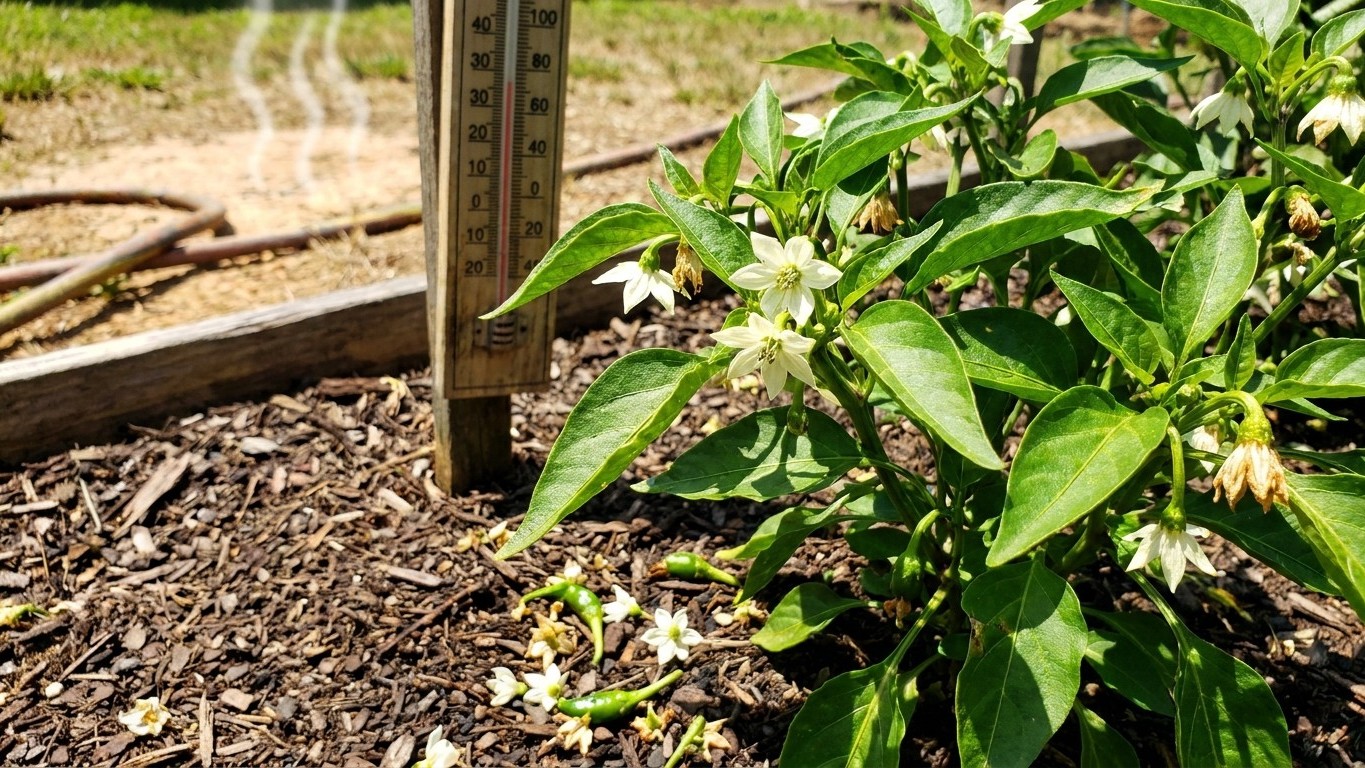

Iowa Peppers Fail to Set Fruit mainly because summer days push past pollen’s heat limit, and because nights on either edge of the season drop below the temperature pollen needs to work. Des Moines averages 18.4 days a year at or above 90 F, enough heat load to stall blossoms during the hottest stretch of summer. The cool end matters just as much, but this site doesn’t track summer night lows for Iowa, so the grower has to watch a thermometer at dusk rather than rely on a published number.
The short answer
Eighteen days doesn’t sound like much spread across a whole growing season, but that’s the average: Des Moines logs 18.4 days a year at or above 90 F, based on NOAA’s 1991-2020 climate normals. Those days rarely land evenly across the calendar. Most of them bunch into a two- to three-week stretch in July or August, and that’s exactly when pepper plants are trying to push out their heaviest flush of fruit. Pollen turns unreliable once daytime temperatures push past that mark for several days running, so blossoms open, look perfectly healthy, and drop anyway. No hail, no disease, no pest damage. Just heat arriving at the wrong week.
The flip side gets less attention because gardeners assume that once the heat breaks, fruit set follows automatically. It doesn’t. Pepper flowers also stall when nights drop below 55 F, according to Utah State University Extension, because pollen won’t germinate properly in cold air even if the plant itself looks fine. That threshold hits Iowa gardens twice: once in the cooler stretch right after transplanting in spring, and again as nights lengthen going into fall. This site carries the heat side of Iowa’s climate, the days above 90 F, but it does not carry summer night minimum data for this territory. There’s no published county-level night-low average to point to here, so the reliable move is to keep a min-max thermometer in the pepper bed and read it yourself, especially through late summer when a single cold night can shut down the last flush of blossoms before the plant runs out of season.
Both thresholds squeeze the same window from opposite ends. Peppers need a run of days and nights that stay inside that 55 to 90 F band to actually convert flowers into fruit, and Iowa’s growing season doesn’t guarantee that band holds for the whole summer. Early and late in the year, the risk sits at the cold end. In the thick of July and August, it flips to heat. Either way, the plant looks the same from the porch: flowers open, then fall, and never become a pepper.
When to start seed here
Work the calendar backward from transplant day rather than forward from a seed packet date, and the math gets a lot more forgiving to redo for any specific county.
- Start with frost. NOAA’s 1991-2020 climate normals put the last spring freeze (the 32 F mark, in the 30 to 70 percent probability band) between April 12 and April 24 at the reference station. Treat that window as the earliest realistic transplant date, not a guarantee.
- Add soil temperature on top of frost. Utah State University Extension recommends waiting until soil reaches 60 F before setting peppers outside, no matter what the air feels like or what the calendar says. Cold soil stalls root growth even when daytime highs feel warm enough.
- Widen the window for anywhere outside the metro. Iowa State University Extension’s county-level frost data, gathered from 1950 to 2021, runs about 4 days later in spring than the airport figures above (and about 10 days earlier in fall). That makes April 12 to April 24 the optimistic end of the range, not the rule for the whole state.
- Count back 8 to 10 weeks from that transplant date. Peppers need that much time indoors under grow lights before they’re sturdy enough to go in the ground, per Utah State University Extension. Working from a transplant target in the back half of April into early May, that lands indoor seed-starting somewhere in late February to early March for most of Iowa.
- Shift the whole schedule later for a colder county. If local frost records run closer to the later end of that spring window, push both the transplant date and the seed-starting date back by the same number of days. The 8-to-10-week gap between the two stays fixed either way.
What goes wrong here
- Blossom drop during a hot spell. Once daytime highs stack up near or above 90 F for several days, pollen loses viability and flowers fall without setting fruit. There’s no fix for the heat itself, but shade cloth over the row during the worst afternoon hours, and consistent watering so the plant isn’t fighting drought stress on top of heat stress, keeps the next flush of blossoms from failing the same way.
- Blossom drop after a cool night. Nights below 55 F stop pollen from working just as effectively as heat does, and this typically shows up right after transplanting or again as nights start cooling toward the end of the season. Row cover pulled over the plants on nights that dip that low buys a few degrees of protection and can save a late flush of flowers that would otherwise drop.
- Sunscald on developing fruit. Where Iowa’s summer sun is strong and a plant has lost leaf cover from wind, pruning, or disease, the exposed pepper skin bleaches and blisters on the sun-facing side. Keeping the plant’s natural leaf canopy intact, rather than pruning it hard, is the simplest prevention; a light shade cloth over exposed fruit works after the fact.
- Blossom-end rot on the fruit tip. A dark, sunken patch on the bottom of the pepper usually points to inconsistent watering rather than a soil nutrient shortage, since uneven moisture interrupts calcium uptake even when calcium is present in the soil. Even watering on a regular schedule, with mulch to hold soil moisture steady between waterings, is the standard remedy.
Common questions
Can a pepper plant recover after blossom drop?
Yes, the plant itself isn’t damaged. Once conditions move back inside the range where pollen works, the plant sends out new flowers and resumes setting fruit. The lost blossoms simply don’t turn into peppers; nothing about the drop event permanently reduces the plant’s ability to flower again.
Do certain pepper varieties handle Iowa’s summer heat better than others?
Utah State University Extension names several varieties commonly grown in home gardens, but its guidance doesn’t attach a heat rating, a days-to-maturity figure, or a size to any of them. There’s no published data here tying a specific variety name to better fruit set in Iowa’s climate, so variety choice shouldn’t be treated as a fix for heat-driven blossom drop.
How do I check if my soil is actually at 60 F before transplanting?
A simple soil thermometer pushed a few inches into the bed, checked in the morning before the sun has warmed the surface, gives an accurate reading. Air temperature and calendar dates are not reliable substitutes, since soil warms more slowly than air in spring.
What if nights stay below 55 F into June?
Since this site doesn’t track summer night minimums for Iowa, the only way to know is to watch a min-max thermometer in the garden itself rather than assume based on the date or the region. If cool nights are running that low into June, row cover overnight can hold enough warmth to keep blossoms from dropping until the pattern breaks.