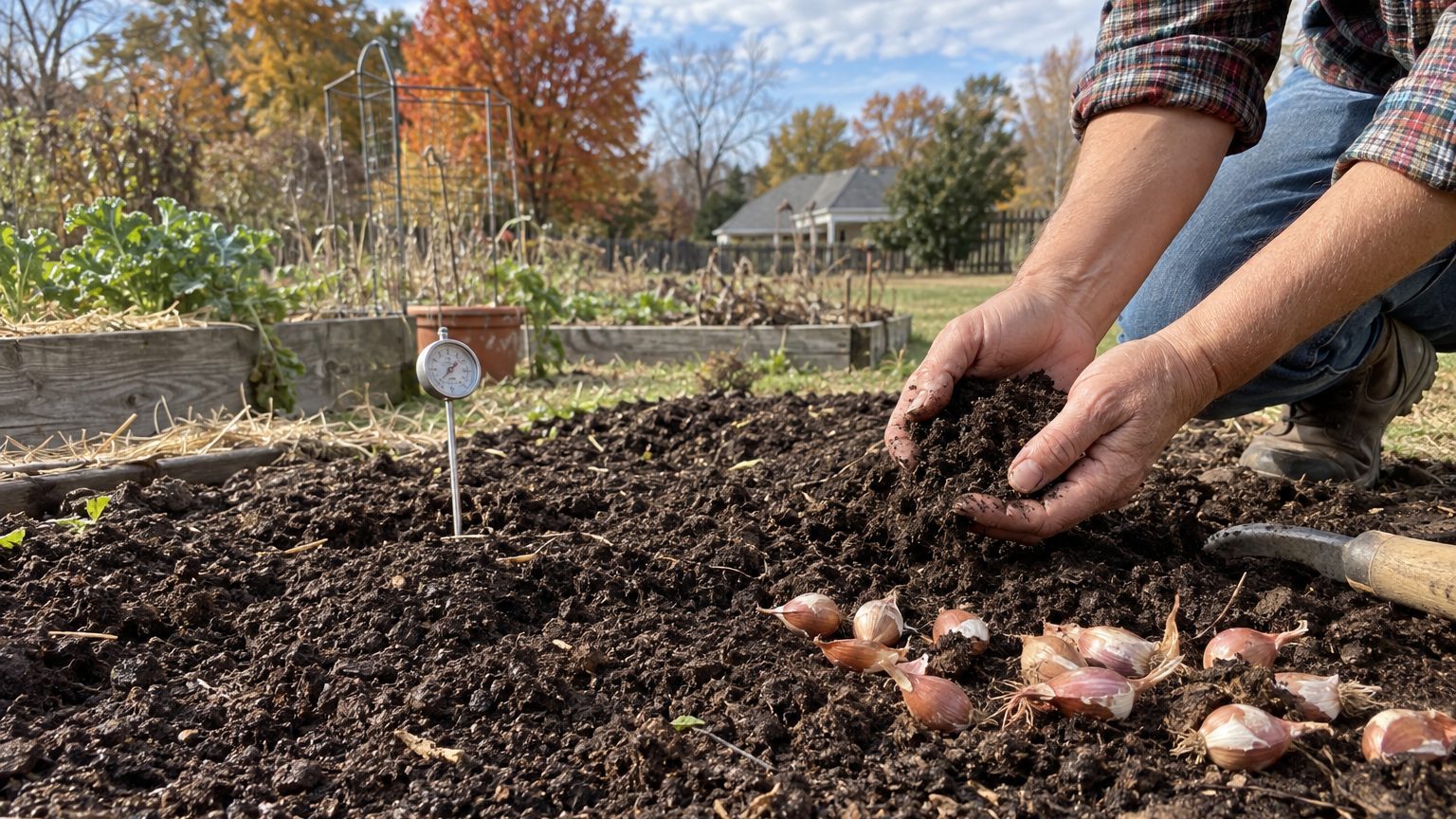

In Iowa, plant shallots in spring as soon as the ground is workable and no longer sodden. The last 32 F freeze falls between April 12 and April 24 in NOAA’s 1991-2020 normals for an airport station, and planting follows that window by days or weeks, not the other way around. Autumn planting can work in milder corners of the state, but a hard, wet winter makes spring the safer default.
When the soil is warm enough in Iowa
The date most Iowa gardeners want is the last spring frost. NOAA’s 1991-2020 Climate Normals put it between April 12 and April 24, a band covering the dates when the odds of a 32 F freeze sit between 30 and 70 percent. That is a probability, not a promise, and a late freeze in early May would not break any rule of nature. One caution goes with those numbers: the source is an airport station, and Iowa State Extension county figures (1950-2021) run about 4 days later in spring. Treat April 12 as the optimistic end, not the starting gun.
Frost is a proxy, soil is the real signal
Shallots do not read the calendar, and they do not read the frost forecast either. They respond to the ground. Soil warms after the frost risk ends, not with it, so a gardener who plants the day the last freeze passes is often putting sets into cold, wet earth that has barely begun to stir. Sets sitting in saturated soil do nothing useful and can start to rot before they root.
The practical test is cheap. Squeeze a handful from planting depth: if it crumbles, you can plant, and if it smears into a ribbon or sheds water, wait. A soil thermometer pushed a few inches down tells you whether the bed is trending warmer or still holding winter. Raised beds and sandy or well-amended ground usually reach that point days ahead of heavy, low-lying plots, so one yard can have two planting dates.
What carries over from garlic, and what does not
Shallots belong to the same family as garlic, and several practices overlap: autumn planting, mulching over winter, curing, storage and allium rotation. This site has a full garlic section with national pages on each of those, so they are not repeated here. What changes for shallots is mostly scale. Sets are smaller and sit shallower, and each one multiplies into a cluster, so crowding and drainage matter more than depth. For the crop itself, start with Growing Shallots: One Bulb In, a Handful Out.
Curing and storage touch food safety, so a few firm rules apply. After harvest, tops and outer skins need to dry fully in a shaded, airy spot. Before putting anything away, inspect every bulb: press the neck and check the base. A soft neck or a moldy base ends the question for that bulb, and it should go in the trash, not the pantry. A bulb that looks fine from the outside is not proof that it is sound, and no page can promise how long yours will keep.
On varieties, this page names none. Types are enough for planning, and the cultivars trialled in Iowa are for Iowa State University Extension to say.
How long the season lasts here
The same NOAA normals give a first fall frost between October 14 and October 25. Put the two bands together and the growing window runs from roughly 173 days to 196 days, depending on which dates you pair.
| Pairing | Last spring frost | First fall frost | Days between |
|---|---|---|---|
| Early dates in both seasons | April 12 | October 14 | 185 |
| Late dates in both seasons | April 24 | October 25 | 184 |
| Shortest case | April 24 | October 14 | 173 |
| Longest case | April 12 | October 25 | 196 |
Those figures come from the airport station. Iowa State Extension county records (1950-2021) run about 4 days later in spring and 10 days earlier in fall, which takes roughly two weeks off every row. For a farm out in the countryside, the lower end of the table is the realistic one.
What roughly half a year allows
A window near 170 to 185 days is long enough for one full shallot crop with room to spare, which is the point. Shallots do not need the whole season. They size up as days lengthen and cure in summer heat, so the frost-free stretch after harvest is slack you can use. A second planting is possible for an earlier-maturing type, staggered a few weeks apart so the harvest does not land all at once. The main shallot guide covers the basics, and the succession sowing guide on this site explains how to space the plantings and when a second round stops paying off.
Transplanting is the other decision the window changes. Starting shallots from seed indoors and setting out seedlings makes sense where the season has slack, because the seedling has to recover from the move before it can size a bulb. Iowa’s window can absorb that, though a gardener on the short end of the table has less margin. The root check matters here: lift a seedling from its cell and look for white, branching roots that hold the plug together. A pot-bound mat or a plug that falls apart both signal trouble. In a shorter season, losing two weeks to transplant shock costs more, so sets go in first and seedlings second.
For comparison, Growing Shallots in Rhode Island and Growing Shallots in Prince Edward Island show how the same crop plays out under maritime influence, where winter and summer are both moderated by water. Iowa has no such buffer.
Heat and water in Iowa
This page does not carry a verified count of days above 90 F or a figure for summer rainfall, and it will not guess at either. What it can say is that Iowa summers are warm and often humid, which matters in two ways: shallots finish and cure in that heat, and humidity favors leaf diseases and slows drying. Ask Iowa State Extension for the numbers for your county, since a reference station describes one place, not the whole state.
The figure that does decide the main question here is the winter low. In the NOAA 1991-2020 normals for Des Moines, the mean daily minimum of the coldest month is 13.8 F. That is an average of nightly lows, not the record cold, and the worst nights run well below it. The USDA Plant Hardiness Zone Map (2023 edition, built on the average annual extreme minimum) places Iowa between zones 4b and 6a, so the north and south of the state are not in the same position. A garden in the north is in a different winter than one near the Missouri line.
Autumn against spring
Autumn-planted sets are grown for a reason: they root before winter, restart early and make larger, earlier bulbs. In a mild-winter climate that payoff is reliable. In Iowa, where the ground freezes hard and tends to stay wet through thaws, sets can rot in saturated soil or get pushed up by repeated freezing and thawing. Heaved sets expose their roots and often fail. Spring planting skips that risk entirely, which is why it is the safer call for most of the state.
Autumn planting is not off the table. In the milder south, on well-drained ground, with a thick mulch of straw laid after the soil freezes, it can work, and the earlier crop is real. The honest way to try it is on a small scale: plant a handful in fall and the main crop in spring, and watch which does better in your soil. Shallow, loose sets are more exposed than deeply rooted garlic, so do not assume garlic habits transfer, and check the garlic pages for the shared mulching and timing practices.
Water management is simpler than the climate questions. Shallots have shallow roots, so steady moisture while bulbs size up matters, and drainage matters more than quantity. Once the tops start to yellow and fall, stop watering so the necks can dry. A wet late summer is the practical enemy: it slows ripening, invites mildew and rot, and turns curing into a gamble. Raised beds, spacing wide enough for airflow and mulch kept away from the bulb shoulders all help the crop dry out.
Which shallots suit Iowa
The choice comes down to type, because Iowa’s facts point at three criteria in a fixed order. This page names no cultivars, and that is deliberate: a variety name is only worth repeating if it has been trialled where you garden, and this page does not have those trials. Inventing one would send you to buy something that may not perform in your county.
| Type | Why it fits Iowa | What to watch |
|---|---|---|
| Sets (small bulbs) planted in spring | Quickest route to a crop; fit a window of roughly 170 to 196 days easily | Wet, cold ground right after planting |
| Transplants from seed | Use the season’s slack; seedlings avoid some set-borne disease | Root check and shock from the move |
| Sets planted in autumn | Earlier, larger bulbs where winters are milder | Rot and heaving in wet, hard-freezing ground |
Reasoning from the facts
A season of this length does not force the earliest types, but a gardener at the short end of the table, or one hoping to fit a second planting, should lean toward early-maturing ones. A warm, humid summer makes disease resistance the first criterion, ahead of size or flavor. Sets from a reliable source, planted with airflow between clusters and a little shade or mulch over the root zone, do better than bargain bags of unknown origin. Rotation counts too: avoid putting shallots where onions, garlic or leeks grew recently, since they share diseases.
The place to find names is your state extension service. Iowa State University Extension and its county offices know which types have been trialled locally and what they did in a wet season, and that is the only recommendation that carries weight. Ask which types resist the diseases common in Iowa and where to buy certified stock.
Common questions
Can I plant shallots in fall in Iowa?
You can, but spring is safer. With a coldest-month mean minimum of 13.8 F in Des Moines and a hardiness range of 4b to 6a (USDA, 2023), sets planted in fall face heaving and rot, especially in wet, heavy soil. Try a small test patch with deep mulch before committing a whole bed.
Is April 12 the date to plant?
No. April 12 to 24 is the NOAA airport-station window for the last 32 F freeze, and soil warms after that, not with it. Extension county records run about 4 days later in spring. Plant when the soil crumbles in your hand.
How do I know if a cured shallot is safe to store?
Inspect each one. Check that the neck is dry and tight, the skins are papery and the base is firm and clean. A soft neck or a moldy base ends the question, and that bulb should be discarded. No keeping time can be promised, so check stored bulbs regularly.
Where do I find varieties that suit my county?
Start with Iowa State University Extension or your county extension office. They know which types have been trialled where you garden. Many county offices also run Master Gardener programs that can answer sourcing questions for your area.