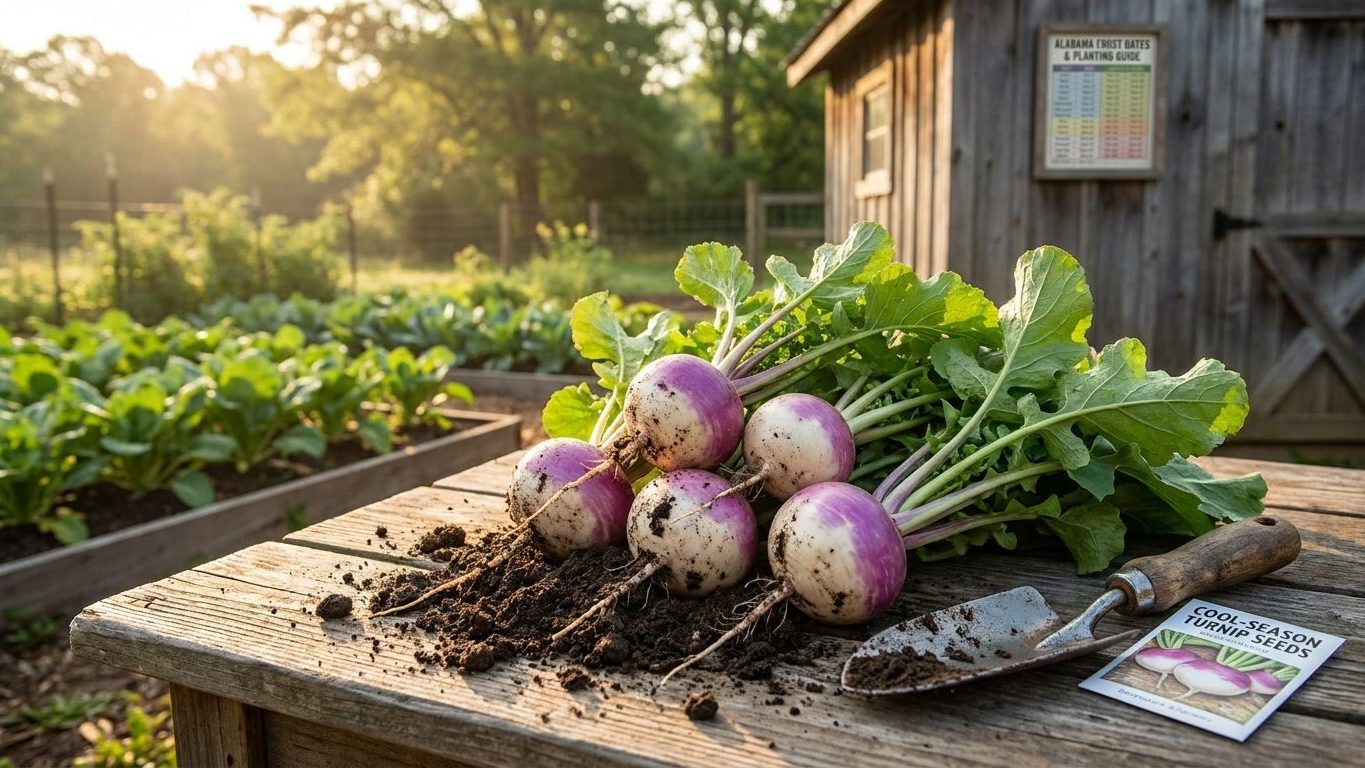

Iowa gardeners get two shots at turnips: a spring sowing timed to the state’s last frost window of April 12 to April 24, and a fall sowing that runs from roughly August 19 through September 13, counting back from first fall frost. Between those two windows sits a stretch of summer heat that turnips generally don’t tolerate well.
The short answer for Iowa
Turnips are a cool-season root crop, and Iowa’s climate data gives two workable sowing periods rather than one long season. The first runs in early spring, timed off the state’s last spring frost window of April 12 to April 24 (NOAA’s 1991-2020 normals, the 30-70% probability band for a 32°F freeze). Turnips tolerate a light frost once they’re up, so gardeners typically sow two to three weeks ahead of that window, roughly late March into early April, rather than waiting for the frost-free date itself.
The second window is the one Iowa growers rely on more heavily, because turnip roots hold their flavor better when they mature in cooling fall weather instead of rising early-summer heat. Working backward from the state’s first fall frost window of October 14 to October 25, and allowing the 40 to 60 days most turnip varieties need to size up, the sowing period lands between August 19 and September 13.
Both of those frost dates come from a single airport weather station (Des Moines), and the Iowa State Extension caution attached to them matters here: county-level data collected between 1950 and 2021 runs about four days later in spring and ten days earlier in fall than the airport figures. That means the airport dates are the optimistic end of the range. A gardener planning a fall crop should treat September 13 as a soft deadline, not a firm one, and lean toward sowing in the first half of the window if their county tends to cool off early.
This page can’t tell you whether your particular county frosts on the early or late side of that spread. That’s a local extension question, covered further down. What the state-level data does establish is the shape of the calendar: a short spring window before heat arrives, a longer and more forgiving fall window, and a summer gap in between where sowing turnips is fighting the climate rather than working with it.
What will not work here

Sowing turnips in June or early July is the most common mistake in Iowa gardens, and the frost data explains why. The gap between the end of the spring window (early April) and the start of the fall window (mid-August) covers roughly four months of Iowa’s hottest, most humid stretch. Turnip roots sown into that heat tend to bolt to flower, turn woody, and develop the sharp, bitter flavor that gives the vegetable its bad reputation at the dinner table. The plant isn’t dying, it’s just responding to day length and heat stress exactly as it’s built to.
Rutabaga is the other crop this data rules out for most Iowa gardens, at least as a fall planting. Rutabaga needs closer to 90 days to bulk up, nearly double a fast turnip variety. Counting back 90 days from the earlier end of the fall frost window (October 14) lands the required sowing date around July 16, squarely inside the hottest part of an Iowa summer. Getting rutabaga seed to germinate reliably in mid-July soil, then keeping seedlings alive through weeks of high heat before fall cooling even begins, is a much harder ask than starting turnips in late August. Gardeners who want rutabaga in Iowa are generally better off treating it as a spring-sown, early-summer-harvested crop, or accepting the extra irrigation work a July sowing demands.
Watering habits fail here too, in a way that’s easy to miss. Iowa summers swing between humid stretches and dry spells, and a once-a-week watering schedule that might carry a turnip patch through in a milder, wetter state leaves Iowa’s clay-heavy soils cracking at the surface while staying dry a few inches down, right where the developing root needs even moisture. Uneven watering during root sizing is what produces the split, woody turnips gardeners often blame on the variety instead of the schedule.
On the cold side, the region’s coldest-month average minimum of 13.8°F rules out any attempt to overwinter turnip roots in the ground the way a milder climate might allow. Roots left unharvested past a hard freeze in most Iowa counties won’t survive to a later harvest.
What changes across Iowa
Iowa is not one growing zone, and the USDA Plant Hardiness Zone Map makes that explicit: the state spans 4b to 6a, built from the average annual extreme minimum temperature recorded across 1991-2020 normals. That’s a meaningful spread for a state this size, and it means the frost dates cited above, drawn from a single Des Moines-area station, describe the central part of the state better than its edges.
A gardener in a colder pocket of northern Iowa, closer to zone 4b, should expect both a later last spring frost and an earlier first fall frost than the state-level window given here, which compresses the already-short window for a fall turnip crop. In practice, that means sowing at the earlier edge of the August 19 to September 13 range, not the later edge, and watching more closely for an early cold snap that arrives ahead of the general county forecast.
A gardener in the milder river-bottom areas closer to zone 6a can generally push both directions: an earlier spring sowing and a later fall one, stretching the usable turnip season by a couple of weeks on each end compared to the state average built into this page.
This page isn’t built to tell an individual reader which of those zones their own yard falls into, since hardiness zones can shift within a few miles depending on elevation, tree cover, and proximity to a river valley. The USDA’s interactive hardiness zone map lets any Iowa gardener check their zip code directly, and that single lookup does more to fine-tune a sowing date than any statewide average can.
Where to check this for your own county
Everything above comes from statewide and single-station data, useful for a general calendar but not a substitute for county-specific numbers. Iowa State University Extension and Outreach publishes county-level planting guidance that accounts for local frost timing rather than one Des Moines-area station.
Two things are worth hunting for once there. First, a county or regional planting calendar, if the local office publishes one, will reflect the four-days-later-spring, ten-days-earlier-fall adjustment mentioned earlier, rather than the more optimistic airport figures used on this page. Second, look for variety trial results or recommended cultivar lists specific to Iowa growing conditions. Extension trials often flag which turnip varieties held up best against the state’s flea beetle pressure and summer humidity, information a national seed catalog won’t have.
A county recommendation will always outrank a state-level one, for a simple reason: it’s built from data closer to the actual garden. This page draws its frost dates from a single weather station and a statewide hardiness zone range spanning two full zones. A county extension office works from decades of local observations specific to that stretch of Iowa. When the two disagree, on a sowing date, a variety choice, or a frost risk, the county source is the one to follow.
Some gardeners also time this by the Moon: when to plant turnips by the moon, as almanac tradition rather than fact.
Checking this against your own garden
No calendar, state or county, replaces what’s happening in the actual soil of a particular yard, and turnips give a few clear signals worth checking by hand.
Soil warmth by feel is the first and most direct check. Turnip seed germinates poorly in cold, wet soil regardless of what the calendar says. Working a handful of soil at planting depth, roughly an inch down, should feel cool but not cold and should crumble rather than clump. Soil that still feels raw and heavy in early April, even after a warm stretch of days, is a sign that a particular yard is running behind the regional average, whether from shade, low ground, or heavy clay.
The appearance of the first true leaves is the second checkpoint. Turnip seedlings send up rounded seed leaves first, then a set of true, slightly fuzzy leaves that follow within 10 to 14 days under normal conditions. A longer gap than that suggests the soil was cooler or the seed was planted deeper than ideal, information useful for adjusting the next sowing.
The third signal is early bolting: a turnip that sends up a flower stalk well before the root has sized up is responding to stress, usually a sudden heat spike or a late cold snap right after germination. A gardener who sees this happening consistently, sowing after sowing, is getting a clearer read on their own microclimate than any regional frost date can provide, and that’s the point where local observation starts to matter more than the calendar.