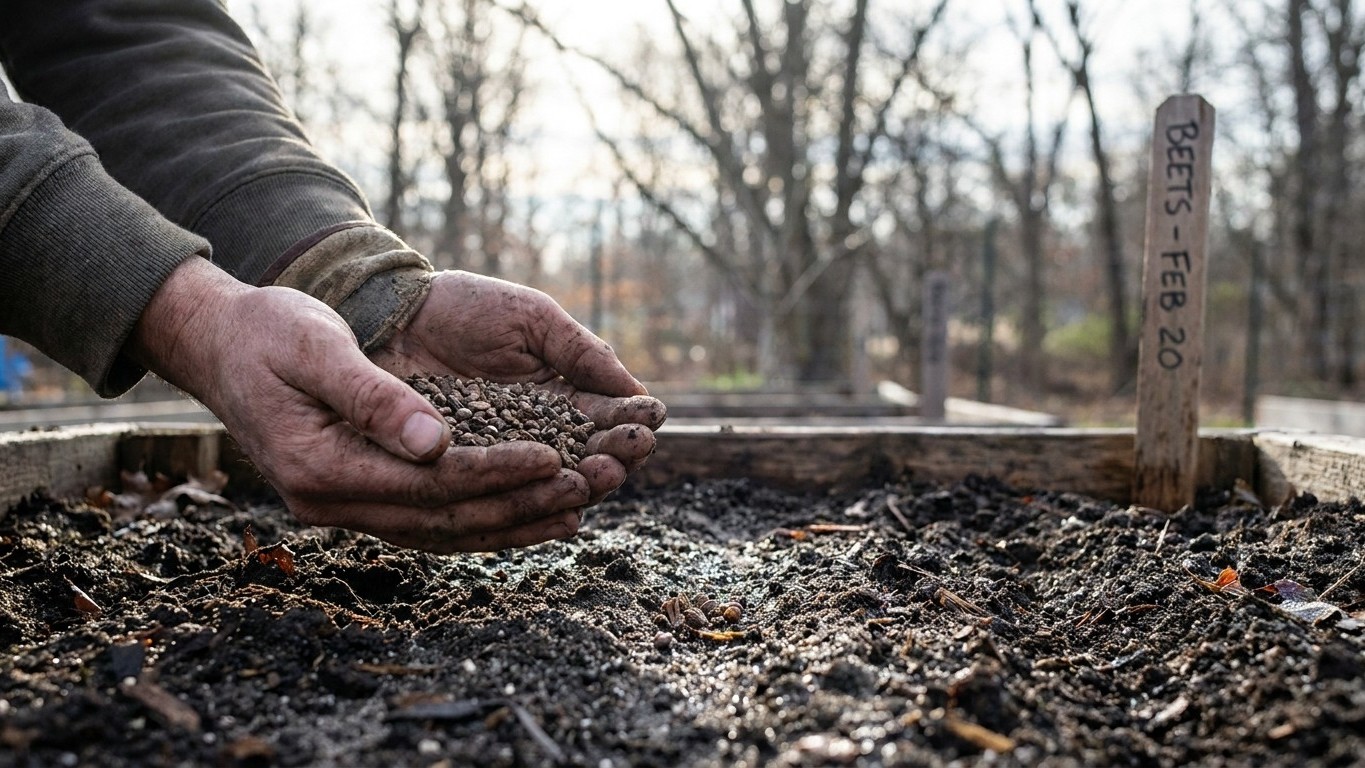

Sow beet seed directly in the ground two to three weeks before your county’s last spring frost. For the Kansas reference weather station used in the federal Climate Normals, that frost falls somewhere between April 4 and April 18, which puts direct seeding in a window running roughly from mid-March to the first days of April, depending on where in the state you garden and how that spring is shaping up.
The short answer
Kansas’s official state soil, the Harney series, gives a useful starting point for what a beet root is working with underground. It’s a Mollisol, the deep, dark prairie soil that built the Corn Belt, and its surface horizon runs about 9 percent sand, 24 percent clay and 67 percent silt, with organic matter around 2.0 percent and a surface pH near 6.7, close to neutral. It’s classified as well drained. That texture reads as loam to silt loam rather than the sandy ground beets actually prefer.
Utah State University Extension is specific on what beets want: deep, sandy, well-drained soil rich in organic matter, amended with no more than 1 inch of composted organic matter per 100 square feet. A soil that’s two-thirds silt by weight doesn’t shed water the way sand does, and it can seal over into a crust after a hard rain, which matters a lot for a seed that has to push a shoot through the surface. The near-neutral pH is good news, beets aren’t fussy about acidity in that range, but the fine texture means a Kansas gardener working ground like the Harney series should think about loosening the bed deeply and working in that thin layer of compost rather than assuming beets will simply thrive as-is.
On heat, the guidance is equally specific: air above 85 F combined with water stress is what turns a beet root woody. This page doesn’t have a published count of how many days a given Kansas location spends above 90 F in a typical year, so no number is offered here, but anyone who has spent a July in the state knows stretches well above that 85 F line are routine, not rare. That’s a strong argument for getting beets in the ground early enough that the root has already sized up before the hottest weeks arrive, rather than trying to rush a planting in once summer heat has set in.
None of this describes any one garden exactly. Kansas spans hundreds of mapped soil series, and a backyard bed, especially one near a creek bottom, on a hillside, or on ground a builder graded and filled, can differ completely from the Harney profile. Treat these numbers as a regional tendency, not a report on your dirt, and run a soil test before you decide how much to amend.
The six weeks that decide it here
Sowing two to three weeks ahead of that April 4 to April 18 frost window means the first six weeks of a beet’s life, the stretch when water stress does its damage, land somewhere between mid-March and mid-May across the state. That’s a specific slice of the Kansas calendar, and it’s worth knowing what that slice usually looks like.
Kansas spring is known for swinging hard rather than settling into a steady pattern. Weeks of dry, windy weather can be followed by heavy rain systems, sometimes within the same month, and the transition from late-winter cold to summer heat can happen faster here than in places with a longer, gentler spring. That variability is exactly the condition Utah State University Extension flags as risky: water stress in the first six weeks after seeding is what pushes beets into premature flowering, a failure called bolting that ruins the root for eating even if the plant otherwise looks healthy.
The practical takeaway isn’t to fear the season, it’s to watch it. A dry stretch of even a week or two during that six-week window, especially one paired with the wind Kansas is famous for, can dry out a shallow seedbed fast. A wet stretch right after sowing can crust the silty surface described above and slow emergence. Either extreme during those first six weeks is a bigger threat to a beet crop here than the eventual summer heat is, because bolting locks in a bad outcome early, while woodiness from heat is a later-season problem that shows up if the crop is left in the ground too long.
Keeping the bed evenly moist, not soaked, not dry, through that early window matters more in a state where spring swings between extremes than it would somewhere with a milder, more predictable spring.
What goes wrong here
- Surface crusting on silty ground. With a surface texture near 67 percent silt in soils like the Harney series, a hard spring rain right after sowing can seal the top inch and trap seedlings underneath. Keep the seedbed loose at planting, rake lightly after a heavy rain, and consider a thin, light mulch to break the force of raindrops without smothering emerging shoots.
- Dry spells during the first six weeks causing bolting. A Kansas spring that turns dry and windy for even a week or two during that early window can trigger premature flowering, per Utah State University Extension. Check soil moisture by hand two or three times a week during that stretch and water consistently rather than waiting for visible wilting.
- Sowing too late and running into summer heat. If seeding slips past the early spring window, the root is still small when air temperatures push past 85 F, and heat combined with any water stress at that point makes the root woody rather than tender. Aim for the two-to-three-week-before-frost window and don’t treat late spring as a backup start date for this crop.
- Compaction from the clay fraction restricting root growth. At roughly 24 percent clay, ground like the Harney series can compact below the surface even though the top looks loose and dark. Beet roots need to push straight down through loosened soil, so work the bed to a full spade’s depth before sowing rather than just scratching the surface, and stick to the 1-inch-per-100-square-feet compost guideline instead of over-amending, which can make a silty bed hold even more water than it should.
Common questions
Can I sow a fall crop of beets in Kansas?
This page doesn’t carry a published first-fall-frost date for Kansas, so no fall sowing window is given here. If you want to try a second crop, count backward from your county’s typical first fall frost and use the same 60 to 80 day maturity window described below, then check your own county’s data rather than relying on a statewide estimate.
How long does it take beets to mature from seed in Kansas?
Utah State University Extension puts beet maturity at 60 to 80 days, counted from the day the seed goes into the ground, not from a transplant date, since beets are grown by direct seeding rather than started indoors and moved outside.
Should I add compost to Kansas garden soil before sowing beets?
A modest amount helps on ground like the Harney series, which runs fairly heavy in silt and clay. Utah State University Extension recommends no more than 1 inch of composted organic matter per 100 square feet, worked into a deeply loosened bed rather than layered on top.
Do different beet varieties handle Kansas conditions differently?
Utah State University Extension names several beet varieties in its guidance but doesn’t attach a season, color, or specific use to any one of them. Rather than assuming one variety is better suited to Kansas heat or soil, treat variety choice as a separate decision from timing, and rely on your own trial results or a local extension office for variety-specific advice.