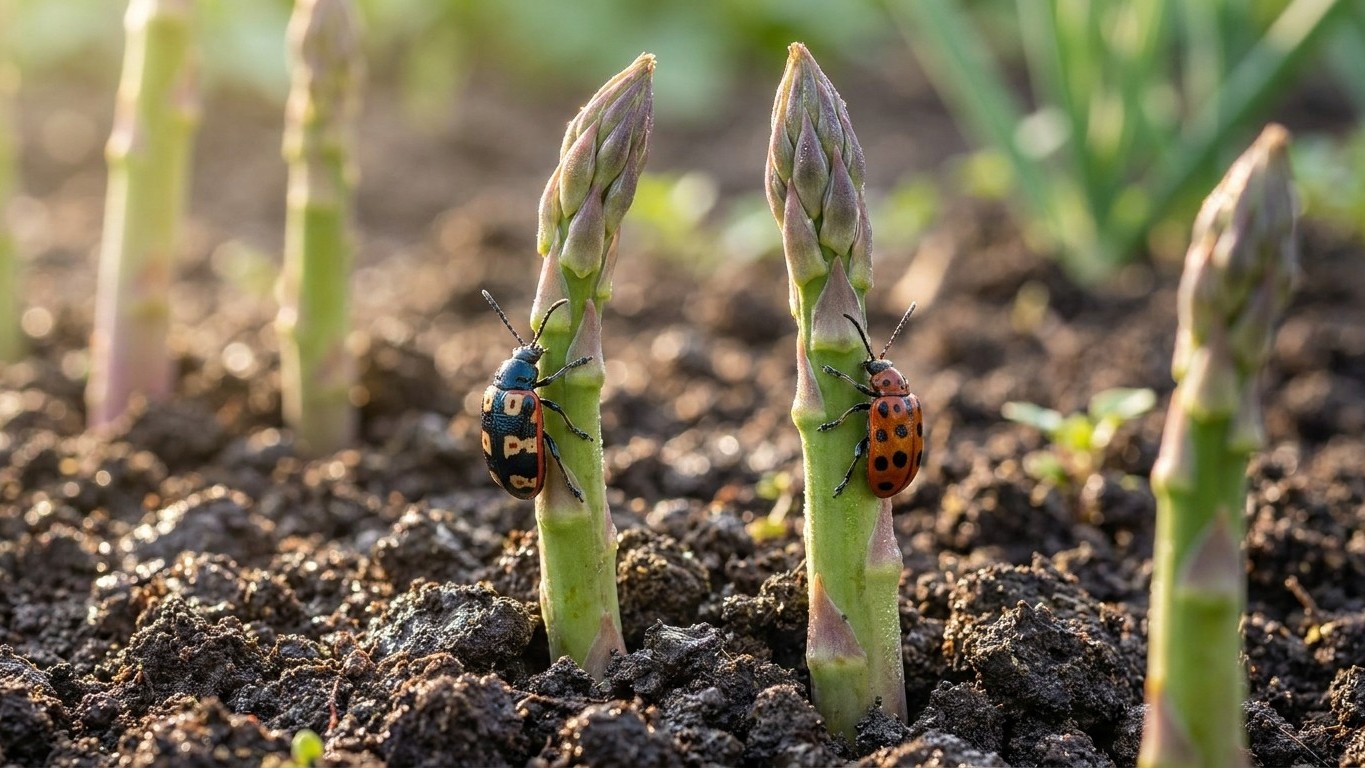

Stop cutting when most of the spears coming up are thinner than a pencil. That signal beats any date on the calendar, and it applies every year the bed produces. A new bed gives you nothing to cut until its third year, though. Spears you do cut lose quality quickly once they leave the plant. They keep best at 32°F to 35.6°F in very humid air, and above 50°F they toughen within hours.
How do you know when to stop cutting asparagus in Kansas?
Each spring the crown spends energy stored in its roots to push up spears, and the first ones of the season are the fattest. As that reserve drains, the spears slim down. When most spears are thinner than a pencil, the crown needs to grow ferns to refill its roots, and the cutting season is over. Go by the spears themselves, because spring warmth shifts the end date from one year to the next.
The start of the season moves too. At the reference airport station, NOAA NCEI 1991-2020 normals put the last 32°F freeze between April 4 and April 18. A suburban or rural plot typically sees its last spring frost one to two weeks later, and more than that at elevation. Your county extension office can tell you the dates for your own ground.
How many weeks can you cut each year?
Crowns go into 8-inch furrows in early spring. Utah State University Extension is clear that the bed is not harvested until year 3, and then it produces for 10 to 15 years. Cutting early costs you later, because the roots need those first seasons to build up. After that, the window opens a little wider each year:
- Years 1 and 2: no cutting at all
- Year 4: a longer harvest
- Year 5 and after: a full harvest
Those weeks are ceilings. If most spears thin out before the time is up, stop early. In the planting year, backfill the furrow gradually so the trench fills in as the crowns establish.
Does the variety change when you stop?
Several varieties are available, and they differ in sex. Beyond that, nothing in the listing separates them on flavor or yield, so none of them earns a promise of better spears. The pencil rule applies to all four.
| Variety | Sex |
|---|---|
| Jersey Giant | All-male |
| Jersey Knight | All-male |
| UC 157 F1 | Male and female |
| Purple Passion | Male and female |
What does the bed need after the last cut?
Water and time. Once you stop, the ferns carry the crown through summer. The reference station averages about 13.2 inches of rain across June, July and August, out of 34.3 inches over the year. July is the driest of the three at 3.98 inches, with June at 4.93 and August at 4.3. Those are what the region can usually expect, and a rain gauge on your own plot settles the real number. Days at or above 90°F pull water out of the ground quickly, and a single summer thunderstorm mostly runs off, so a wet-looking month can still leave the bed dry.
Soil decides how much of that rain stays. Kansas’s state soil, the Harney series, is a deep, dark prairie Mollisol with 9 percent sand, 24 percent clay and 67 percent silt. It is well drained, with a surface pH of about 6.7 and organic matter near 2.0 percent. That is the soil that represents the state, though, and your garden may be nothing like it. River bottoms, hill country and ground a builder has scraped or filled all behave differently. A bed stays put for up to 15 years, so confirm the drainage before planting. Most soils work if they drain well, and a soil test will give you your own numbers. If water stands, build the bed up or pick another spot. Our guide on whether Kansas soil will hold an asparagus bed for fifteen years goes deeper, and what eats asparagus in Kansas, and when covers who else shows up for the ferns. For the full path from crown to harvest, see Growing Asparagus in Kansas.
Keeping it, and for how long
A cut spear is still alive. It keeps losing water, and the cut end loses it faster than anywhere else. Cold slows that loss, and so does humid air.
What temperature and humidity keep asparagus best?
The UC Davis Postharvest Technology Center gives the optimum as 0°C to 2°C, which is 32°F to 35.6°F, with relative humidity of 95 to 100 percent. Its fact sheet says high humidity is essential to prevent desiccation. Hold the spears in that range and they stay crisp the longest.
The window is narrow, and both edges bite. Spear toughening occurs rapidly above 10°C (50°F), which a warm counter or a hot car will reach quickly. At the cold end, freezing injury is likely at -0.6°C (30.9°F) or lower. Frozen spears take on a water-soaked look and turn extremely soft once they thaw. A fridge that runs a degree or two too cold can ruin a bunch as surely as a warm kitchen can.
How long does cut asparagus last?
Any number of days you see quoted is a ceiling, reached only when the spears sit in that cold, near-saturated air from the moment they are cut. Every hour spent above 50°F eats into the time you have left. A bunch that rode home in a warm car, then sat on the counter while you unpacked groceries, will not last as long as the same bunch put straight into the cold.
So the practical rule is to cool the spears right away and eat them soon. Spears from your own bed have an advantage, since they go from ground to fridge in minutes. Don’t wait to bring in a morning’s cutting.
Where in the house that actually is
Most domestic fridges run warmer than that 32°F to 35.6°F window, and the door runs warmer still. No shelf will give you the full optimum, so the goal is to get as close as you can without freezing the spears.
Which shelf in the fridge is best for asparagus?
The lowest shelf toward the back is usually the coldest spot, so that is the best place to start. Keep the spears away from the door, which swings through warm air every time it opens. Also keep them off the back wall if your fridge blows cold air from there, because that air can drop below 30.9°F and freeze them. A crisper drawer can work if it holds moisture, but a bare bunch on an open shelf sits in far drier air than the 95 to 100 percent the spears need.
How do you keep asparagus humid in a home fridge?
High humidity in practice means giving the cut ends water and keeping the air around the spears damp. Stand the spears upright with the cut ends in water, and skipping this step costs you the crispness you worked to keep. Any of these setups will do:
- An upright jar with water in the bottom, with a loose bag over the tips
- A damp paper towel wrapped around the cut ends, then the whole bunch in a bag
- A loosely closed produce bag inside the crisper drawer
Change the water if it clouds, and trim a sliver from the ends if they dry out.
Common questions
Can I cut a few spears in the first two years?
No. Utah State University Extension says the bed is not harvested until year 3. The first two seasons belong to the roots. Cutting early weakens the crown you are counting on for 10 to 15 years.
How thin is too thin to keep cutting?
When most spears are thinner than a pencil, stop. A few thin ones early in the season are normal. When thin spears dominate the bed, the crown is running low and needs its ferns.
What happens if my fridge is too cold or too warm for asparagus?
Above 50°F, spears toughen rapidly. At -0.6°C (30.9°F) or lower, freezing injury is likely, leaving them water-soaked and extremely soft. The target is 32°F to 35.6°F with 95 to 100 percent humidity, so aim for the coldest shelf that stays above freezing.
Will asparagus grow in my soil for 15 years?
It depends on drainage. The Harney series drains well, but it represents the state, and your ground may differ. Test your soil, watch for standing water after a hard rain, and call your county extension office if you are unsure.