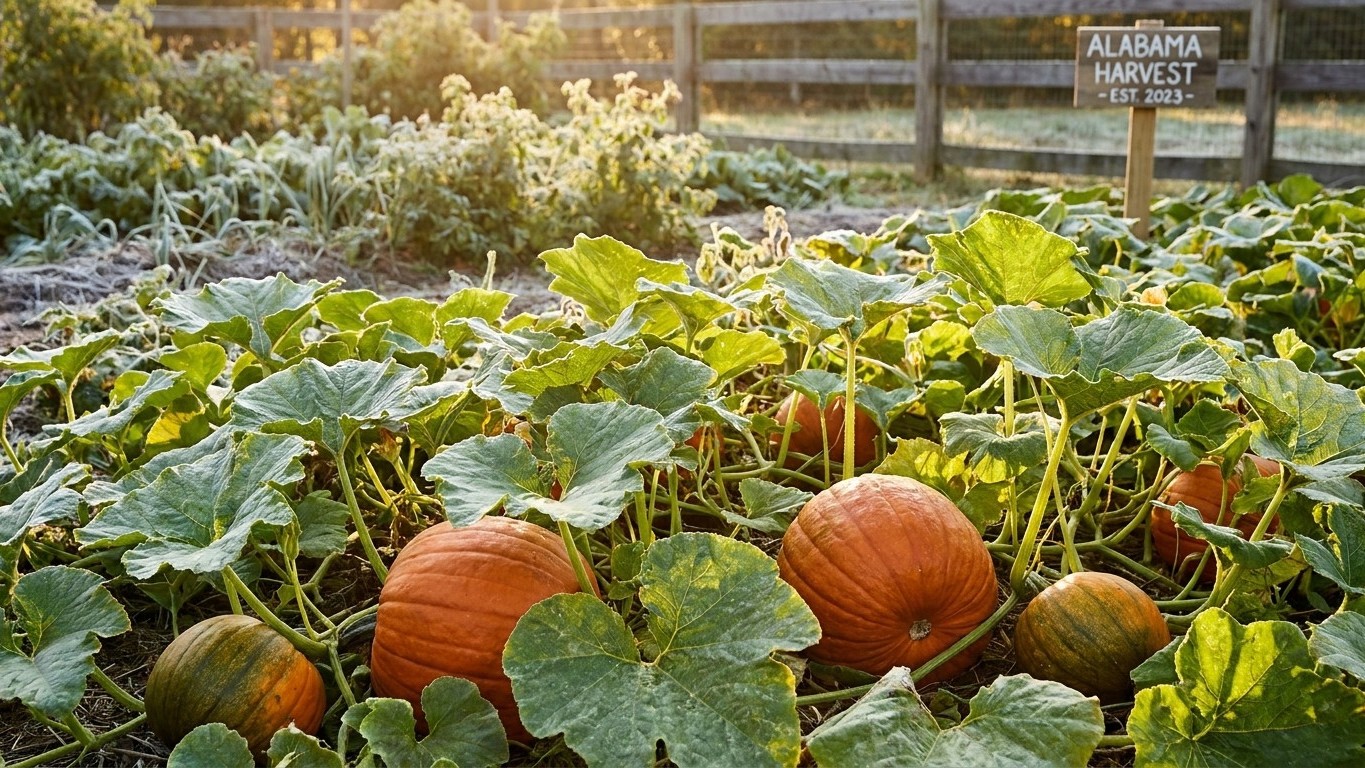

Yes, in most seasons, but the margin in Kansas is tighter than most gardeners assume. Kansas pumpkins need 45 to 55 days between the day a flower opens and full color, and that clock has to close out before the state’s first fall frost, which lands anywhere from October 23 to November 2. The real question isn’t whether pumpkins can ripen here. It’s whether your vine flowers early enough to give that clock the days it actually needs.
The short answer
Start with the finish line: NOAA NCEI’s 1991-2020 Climate Normals put the reference station’s first fall freeze somewhere between October 23 and November 2, based on the 30 to 70 percent probability band for a 32°F freeze. Everything that happens in a Kansas pumpkin patch works backward from that window, not forward from the calendar page marked “spring.”
Utah State University Extension, the only source behind the maturation numbers here, is specific about where the clock starts: 45 to 55 days from the moment a female flower opens and the fruit sets, not from the day seed goes into the ground. Subtract that span from the frost window and you get the true deadline, a flowering deadline, not a planting deadline.
Run the math against the earliest edge of frost, October 23, paired with the longer 55-day maturation some varieties need, and the last safe flower has to open around the very end of August. Run it against the latest edge of frost, November 2, paired with a variety that finishes in 45 days, and a flower opening as late as the third week of September can still make it. So the honest answer is a window, not a date: somewhere between late August and mid-September is when the vine’s last productive flowers need to open for the fruit to reach orange, hardened skin instead of green flesh caught by frost.
Which end of that window applies to a given yard depends on two variables. First, how far the garden sits from the reference weather station used for these normals, since suburban and rural gardens across Kansas typically see the first fall frost arrive earlier than the station figures suggest, sometimes by one to two weeks, and more at elevation. Second, whether the variety on hand runs closer to the 45-day end or the 55-day end of the maturation range. Gardeners outside the immediate station area should treat mid-September, not late September, as the safer cutoff for the last flower to open.
None of this addresses when to plant seed, and that’s the calculation gardeners most often collapse into one number when it’s really two. A pumpkin vine spends weeks producing leaves and male flowers before the first productive female flower even opens, so the sowing date and the flowering deadline sit weeks apart on the calendar, and treating them as the same date is where most Kansas pumpkin patches lose their harvest.
When to sow here
Kansas’s last spring frost, from the same NOAA NCEI normals, falls between April 4 and April 18 at the reference station. That date tells you when the air stops freezing. It tells you almost nothing about when to put pumpkin seed in the ground, because seed germinating in cold, wet soil rots before it sprouts, and pumpkin seed specifically wants the soil itself at 65°F, a threshold that arrives on its own timeline well after the air has warmed.
- Let the frost window close first. April 4 to April 18 marks the earliest the air is reliably frost-free at the reference station. Gardens outside city limits should lean toward the later end of that window, since rural spots tend to run one to two weeks colder in spring than the airport station these normals come from.
- Then wait again, longer, for the soil. Soil temperature lags air temperature by weeks rather than days. In practice, that means the ground in much of Kansas doesn’t hold a steady 65°F until well into May, often three to five weeks after the last frost window has already passed, because bare soil needs sustained warmth through a full day-night cycle, not just a warm afternoon, before it reaches that mark.
- Use a soil thermometer instead of the calendar. Pushed two to three inches deep and checked in the morning, before the day’s heat skews the reading, a simple thermometer is the only reliable way to confirm 65°F has arrived, since bare soil, mulched soil, and raised beds all warm at different rates even in the same yard.
- Add row covers to buy back time. A row cover trapping daytime heat over the bed can push effective soil warming forward by about two weeks. That matters directly against the flowering deadline calculated above: two weeks of earlier sowing means two more weeks of vine growth before the plant has to start flowering to hit its window.
- Count forward from flowering, not from sowing, once seed is in. Expect several weeks of vegetative growth, leaves, vines, and male flowers, before the first female flowers open. It’s that flowering date, not the sowing date, that starts the 45-to-55-day clock toward a ripe, harvestable pumpkin.
Gardeners who sow the day the last frost date passes, without checking the soil, most often lose seed to rot rather than to cold air. The two-to-three-week wait after the frost window closes isn’t excess caution, it’s the gap between seed that germinates and seed that sits in the ground doing nothing.
What goes wrong here
Kansas’s season length produces a handful of specific, repeatable failures, each one traceable to the arithmetic above rather than to bad luck or disease alone.
- A late flower that never colors. When the vine’s first strong flush of female flowers doesn’t open until late September, the fruit is still green when frost arrives, because it never receives its full 45 to 55 days. The remedy is matching variety to a Kansas planting date that already runs late: shorter-season options such as Small Sugar, Baby Pam, Jack Be Little, or New England Pie generally ask for less time on the vine than larger types such as Big Max, Connecticut Field, or Cinderella, though the exact days for any specific seed lot should always be checked against the packet rather than assumed.
- A fruit caught mid-ripening by frost. A pumpkin that’s colored but still soft-skinned when the first fall frost hits, October 23 to November 2 at the reference station, earlier in many rural counties, is a fruit that started on schedule but ran out of days. The remedy is covering individual fruit with a blanket or tarp on forecast frost nights near the end of that window, buying a few extra days for the rind to finish hardening before harvesting with the stem attached.
- A vine that dies back before the skin hardens. Heat stress, disease, or an early light frost can kill the leaves while the fruit underneath is still soft-skinned, cutting off the plant’s ability to finish curing the rind even when the calendar days are technically there. Once the vine collapses, the fix shifts from the garden to indoors: move the fruit somewhere it won’t freeze and let it finish hardening off the vine, since Utah State University Extension’s guidance covers keeping harvested pumpkins out of freezing temperatures but publishes no specific storage temperature or keeping time beyond that instruction.
- Insect damage that hastens vine collapse. Squash bugs and cucumber beetles both speed up the vine dieback described above by damaging leaves and stems before the fruit is ready, and both pests already have dedicated identification and control pages for Kansas gardens on this site, worth checking directly rather than guessing at the cause of a wilting vine.
Common questions
Will my pumpkin still ripen if it’s green when frost hits?
Once a hard freeze damages the fruit’s cell walls, ripening stops for good, and no method reliably turns a frozen green pumpkin orange afterward. A fruit that’s mostly pale green with some blush of color can sometimes continue coloring off the vine in a warm, dry spot, though the sourced guidance behind this page only specifies keeping fruit somewhere it won’t freeze, without giving a timeline for how long that finishing process might take.
Does the first fall frost date mean my pumpkins are guaranteed dead that day?
The October 23 to November 2 window from NOAA NCEI marks when a 32°F freeze becomes likely at the reference station, not a fixed kill date for every garden in the state. Rural and higher-elevation gardens in Kansas often see that first freeze arrive earlier than the station figures suggest, sometimes by one to two weeks, so treat the early end of the window as the safer planning target rather than the late end.
Can I speed up ripening once the fruit has already set?
Reducing water slightly in the final weeks and trimming excess leaves so more sunlight reaches the fruit are common garden practices, but neither is quantified in the sourced guidance behind this page, so treat them as supplementary steps rather than a substitute for getting the flowering date right in the first place.
What’s the latest I can sow pumpkin seed in Kansas and still expect ripe fruit?
Work backward from the flowering deadline rather than the frost date itself. Since several weeks of vine growth pass between sowing and the first productive flowers, and those flowers then need 45 to 55 more days, sowing much past early June leaves little margin against a first fall frost that can arrive as early as October 23 in some counties.