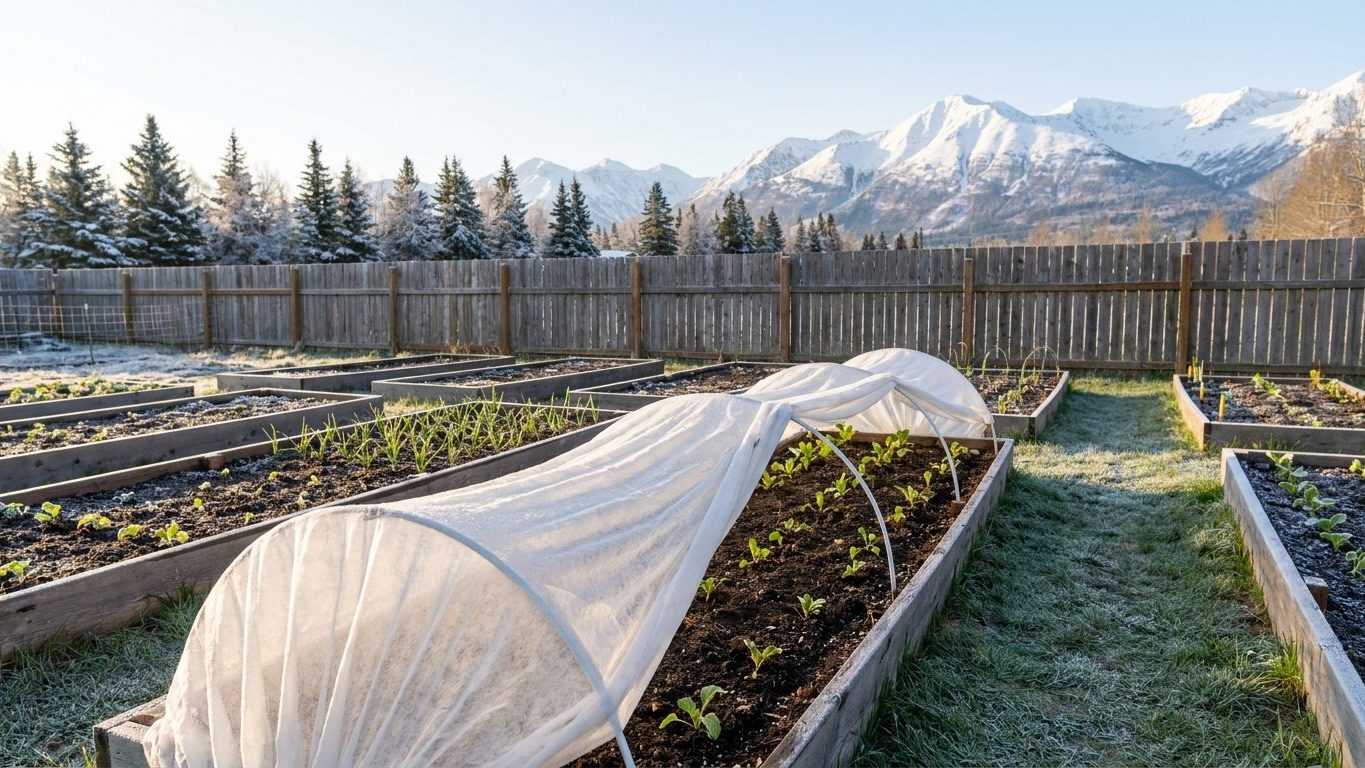

Cover your Kansas garden on any night the forecast low heads toward 32°F. Start watching for those nights in early April and keep watching until the last one passes, then pick the watch up again in late October. The dates below come from Wichita’s climate records, so treat them as a starting line. Gardens get hurt on the nights that fall outside the average, and most of this page is about those. For the wider picture, see Extending the Growing Season in Kansas.
The short answer for Kansas
Cover tender plants whenever a low at or near 32°F is forecast, in both seasons. At the Wichita reference station, the last spring frost falls between April 4 and April 18, and the first fall frost between October 23 and November 2. Those are figures from NOAA’s 1991-2020 Climate Normals for one airport, not a state-wide guarantee.
What the dates measure matters more than the dates. They mark the band where the probability of a 32°F freeze runs between 30 and 70 percent. In spring the odds of another freeze shrink as you move across that window. In fall the odds of a first freeze grow. Neither end is a gate that frost respects. A freeze after April 18 is less likely, not impossible.
| Season | Wichita reference window | What it is a probability of |
|---|---|---|
| Last spring frost | April 4 to April 18 | A 32°F freeze (30-70% band) |
| First fall frost | October 23 to November 2 | A 32°F freeze (30-70% band) |
One caution comes with the table. The numbers are from an airport station. Suburban and rural gardens typically see the last spring frost later and the first fall frost earlier, often by one to two weeks, and more at elevation. If you garden outside the city, shift your watch accordingly.
Spring: a gamble, not a gate
Tomatoes, peppers, squash, cucumbers and beans do not tolerate a freeze. If you set them out inside the April window, plan on covering them at least once. Lettuce, spinach, kale, peas and onions shrug off light frost, so they rarely need covers except on the sharpest nights.
Fall: cover to buy time
Fall covering is about stretching a harvest by a few weeks. A cover thrown over peppers and tomatoes on the first cold night can carry them through a short snap, and cool-season greens can keep growing well past the first freeze. Match the cover to the crop. The guide to which season extenders work in Kansas covers the materials.
What will not work here
Kansas has a long season, so the usual short-season logic fails. This is not a place where you need a heated tunnel to ripen a tomato. With a first fall frost not arriving until October 23 to November 2 at the reference station, the problem is bridging a few bad nights at each end, not manufacturing weeks of warmth. Heavy, expensive structures aimed at a Maine-style problem are overkill for most gardens here.
Covers also cannot carry tender crops through winter. The mean daily minimum of the coldest month at Wichita is 22.5°F. A lightweight fabric adds only a few degrees of protection, so it will save a tomato plant from a 31°F night and do nothing against that January average. Anyone hoping a sheet of fabric will keep peppers alive into December is working against the numbers.
Covering by calendar fails too. Putting fabric on every night from April 4 onward wastes effort and invites trouble, because a cover left on through a sunny, windy afternoon can cook seedlings or blow off the row. Plastic is the worst offender. Trapped under it on a warm spring day, plants can overheat quickly, so vent or pull it back by midmorning.
Planting on the earliest date in the window fails often enough to avoid. April 4 is the point where the odds of another 32°F freeze are still at the high end of that 30-70% band, which is close to a coin flip with a thumb on the scale. Gardeners who set out tomatoes then are betting on a mild April. The ones who wait until the later end, or past it, spend less time with a blanket in hand.
Finally, trusting the airport’s dates for your own yard fails. A garden in a low spot, a rural lot or higher ground can run one to two weeks off the reference figures, which is the whole span of the April window. Use the dates as an outline and let the forecast and your own yard fill in the details.
What changes across Kansas
Kansas is not one garden. The USDA Plant Hardiness Zone Map (2023, based on 1991-2020 normals) places the state in zones 5b to 7a, so there is no single answer, only a spread. That is a wide range of winter cold. A reader in the colder part of the state is working with a different plant palette than one in the warmer part.
The zone system measures one thing, the average annual extreme minimum temperature. It tells you whether a perennial survives winter, not when the last frost lands. Two gardens in the same zone can differ by a week or two on frost dates. Check the USDA map for your own zone rather than assuming one from a neighbor or from this page.
Latitude adds a second variable. The 37.65 degrees north in these figures belongs to Wichita, not the whole state. Counties in the north sit well beyond that line and should expect a later last spring frost and an earlier first fall frost than the reference figures. Shift your watch period to match. In practice that means beginning to cover earlier in the fall and holding off on tender transplants in spring.
The same logic applies to elevation. Ground that climbs toward the west tends to run colder at night, and the caution on these figures says as much: more than the one-to-two-week shift at higher elevation. A reader in the north or at altitude should lean toward the conservative end of every window on this page, and treat the reference dates as the best case.
Where to check this for your own county
Your state extension service is the next stop. In Kansas that is K-State Research and Extension, part of the land-grant extension network. It works through local offices, and those offices know what your county does, which no statewide page can.
Look for two things. The first is a local planting calendar, which gives dates for your area rather than for the Wichita airport. The second is the list of varieties trialled in your county, which tells you what has been grown and measured in conditions close to yours. Both beat any general advice, including this page.
A county recommendation outranks a state one, and this page is the state one. It rests on a single reference station and a handful of numbers. It does not have county-level frost dates, so it does not offer any. If the extension calendar for your county disagrees with a date here, go with the county.
Checking this against your own garden
Your own observations outrank every date above. Three are worth watching, and none needs an instrument.
- Soil warmth by feel. Push your hand a few inches into the bed in the morning. Soil that still feels cold and damp is not ready for tender transplants, whatever the calendar says. Beds that warm sooner than others show you where your early spots are.
- The first male flowers. On squash and cucumbers the male blooms usually open before the female ones. When they appear, the plants have found enough warmth to flower, and you learn how your garden is running compared with the reference dates.
- The first true leaves. The first leaves on a seedling are seed leaves. The true leaves that follow show that the plant is growing, not just surviving. If they come slowly in one spot, that spot is cooler than you thought.
Over a season or two, these signs add up to a map of your own microclimate: the warm bed by the south wall, the cold corner at the bottom of the slope. A garden that has been watched for two springs is worth more than any airport average.
Common questions
Should I cover for a light frost?
Yes, for tender crops. A light freeze at 32°F will blacken the leaves of tomatoes, peppers and squash. Hardy crops like kale, spinach and peas can usually go uncovered.
Is the last frost date a safe planting date?
No. The April 4 to April 18 window is a probability band for a 32°F freeze at the Wichita reference station, not a promise. Rural and suburban gardens typically see the last frost one to two weeks later, so plan to have covers ready.
Can I leave covers on all day?
Not plastic. Sun and trapped heat can overheat plants within hours. Fabric is more forgiving, but vent or remove any cover on warm afternoons.
Will covers keep plants alive through a Kansas winter?
Tender crops, no. The coldest month’s mean daily minimum at Wichita is 22.5°F, far more than a cover can offset. Covers are for bridging short cold snaps in spring and fall.