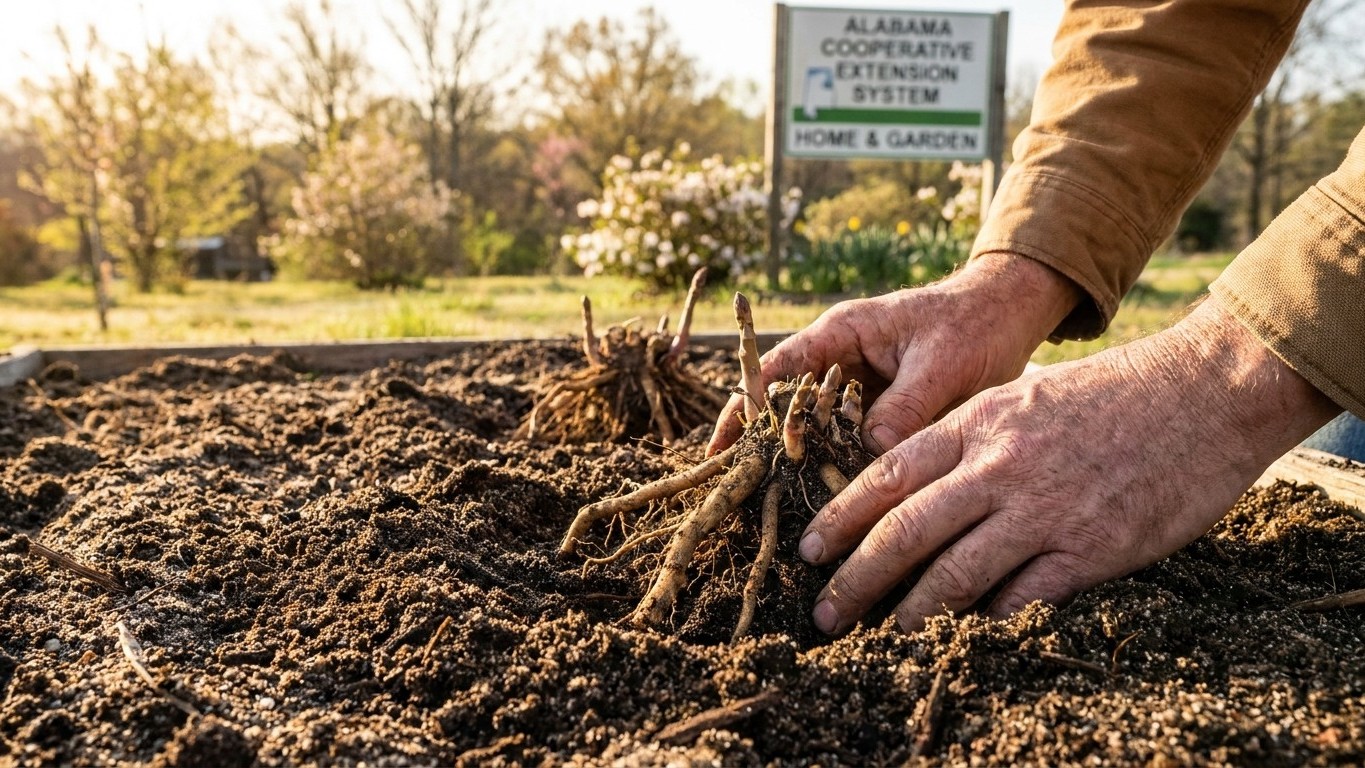

Kentucky gardeners get one shot at siting an Asparagus Bed, and the answer to when starts with where. Crowns go into the ground in early spring, timed loosely to the region’s last frost window, but that date only matters if the ground underneath is a soil the plant can live in for a decade or more. Get the site wrong and the calendar won’t save you.
The short answer
An asparagus bed isn’t a crop you replant each spring, it’s closer to a fruit tree in commitment: once the crowns settle in, they’ll keep sending up spears for 10 to 15 years, and Utah State University Extension’s guidance narrows the site requirement down to a single test. Most soils will work, provided they drain. That’s it. No pH range, no clay percentage target, no organic-matter figure to hit, just drainage.
Kentucky’s designated state soil, the Crider series, gives a useful baseline for what the region’s ground tends to do. Mapped across many counties, Crider runs loam to silt: about 5 percent sand, 19 percent clay, and 76 percent silt, with organic matter near 3.0 percent in the surface layer and a surface pH around 6.2, slightly acid. USDA’s own records describe the series as well drained. Where a garden happens to sit on ground close to this profile, that heavy-silt composition paired with a well-drained rating suggests asparagus can go straight into native soil without special engineering.
The catch is that Crider represents Kentucky’s soil, not any one backyard. A state this size holds hundreds of mapped soil series, and ground a builder graded flat for a subdivision, or a low spot where a creek used to run, can behave nothing like the surface horizon USDA measured. A silty loam that drains beautifully on a ridge can sit wet for days in a low corner of the same county. Standing water an hour after a hard rain, or a shovel that comes up sticky and gray six inches down, are the practical signs that a given spot won’t do for a 10-to-15-year bed.
Where that’s the case, the fix isn’t to abandon asparagus, it’s to build the drainage instead of hoping for it: a raised bed or mounded row lets excess water move off before it pools around the crowns, which rot fast in saturated ground. A basic soil test, run before crowns touch the ground, settles the pH question this guidance stays silent on, and confirms whether a given plot needs anything added.
On variety, the choices published by Utah State University Extension come down to one trait: sex. Jersey Giant and Jersey Knight are bred all-male, so they don’t spend energy on seed production. UC 157 F1 and Purple Passion are male-and-female mixes. No flavor comparison, no yield number, and no reason to prefer one over another shows up in that guidance, so treat the choice as a matter of what a given nursery carries rather than a rule to chase.
Will the summer here water it for you?
An asparagus bed asks for 1 to 2 inches of water every other week through its first two growing seasons, then eases off to 1 to 2 inches every three weeks once it’s established. Kentucky’s summer, measured over the 1991-2020 period at the state’s reference climate station, delivers about 12.0 inches across June, July, and August combined, June at 4.27 inches, July at 4.05, and August the driest at 3.71. Here’s how that stacks up against what the plant is asking for.
- Year one and two, June and July: the every-other-week target works out to roughly 2 to 4 inches a month. June’s average of 4.27 inches and July’s 4.05 land right at the upper end of that range, so on paper the sky is doing most of the work during the plant’s most water-sensitive stretch.
- Year one and two, August: the driest summer month averages 3.71 inches, still within the 2-to-4-inch band but closer to the low end. A dry August, below normal, is the point in the establishment years where supplemental watering is most likely needed.
- Established beds, year three onward: the 1-to-2-inch-every-three-weeks target translates to roughly 1.3 to 2.7 inches a month, comfortably under what any summer month here averages. An established bed is far less likely to need help from a hose.
- The distribution problem: these are monthly averages, not a guarantee of even delivery. A summer’s worth of rain here often arrives as a handful of thunderstorms that dump an inch or two at once and run off a silt-heavy surface rather than soaking in, leaving long dry stretches between. A monthly total that looks sufficient on a climate table can still leave a bed thirsty for two weeks straight.
- The practical fix: since these figures are 30-year normals for one reference station and not a forecast for any single yard, a rain gauge on the actual plot is what tells a gardener whether a given week met the 1-to-2-inch mark or fell short.
When to put the crowns in
Early spring is the target, and 1991-2020 climate normals put the region’s last spring freeze, the point where temperatures drop to 32°F, somewhere between March 24 and April 4. That’s a mean, not a guarantee, so it marks roughly where the window opens rather than a fixed date to circle. The same normals note that the reference station sits in an urban setting and tends to run later in spring, and earlier in fall, than the rural ground around it, so a rural garden should tighten that window rather than stretch it further into April.
Once the ground can be worked and the hardest freezes have mostly passed, dig furrows about 8 inches deep and set the crowns in. The planting method isn’t to fill that furrow all at once: cover the crowns with a couple inches of soil to start, then keep adding roughly two more inches every other month across the growing season as the spears push upward, rather than burying them under the full 8 inches on day one.
Starting from seed instead of crowns is the alternative route, though it costs a season: seedlings need to reach a size worth transplanting before they can go into the garden, which pushes the first real harvest out further than starting with crowns does. Either way, the plant enforces its own patience regardless of when it goes into the ground. No harvest happens in year one or two. Year three brings the first cutting, and it’s a short one, about 4 weeks. Year four stretches it to roughly 6 weeks, and year five to about 8. After that, the signal to stop each season isn’t a date on a calendar, it’s a look at the spears themselves: once most of them come up thinner than a pencil, cutting stops and the bed is left alone to grow ferns and rebuild the crown for the year ahead.
Common questions
Can asparagus grow in clay-heavy soil in Kentucky? It depends on drainage, not clay content alone. A clay-rich soil that still lets water pass through within a day or so can work, since the only published requirement is that the site drains. A clay soil that holds standing water for days is the kind of ground that calls for a raised bed instead.
How do I know if my garden drains well enough? Dig a hole about a foot deep, fill it with water, and watch how long it takes to disappear. Standing water hours later, or a shovel that comes up sticky and gray well below the surface, both point to a spot better handled with a mounded or raised bed than a straight furrow.
Does the last-frost date apply the same way across the whole state? No. The March 24 to April 4 window comes from one reference station, and that station’s own data notes it runs later in spring than the rural county around it. Gardeners outside town should expect their actual safe planting window to open a bit earlier.
How many years until I get a real harvest? Three, at minimum. Year one and two get no cutting at all while the crown builds strength. Year three allows about 4 weeks of harvest, year four about 6, and year five about 8, with the stopping point each year decided by spear thickness rather than a fixed week count.