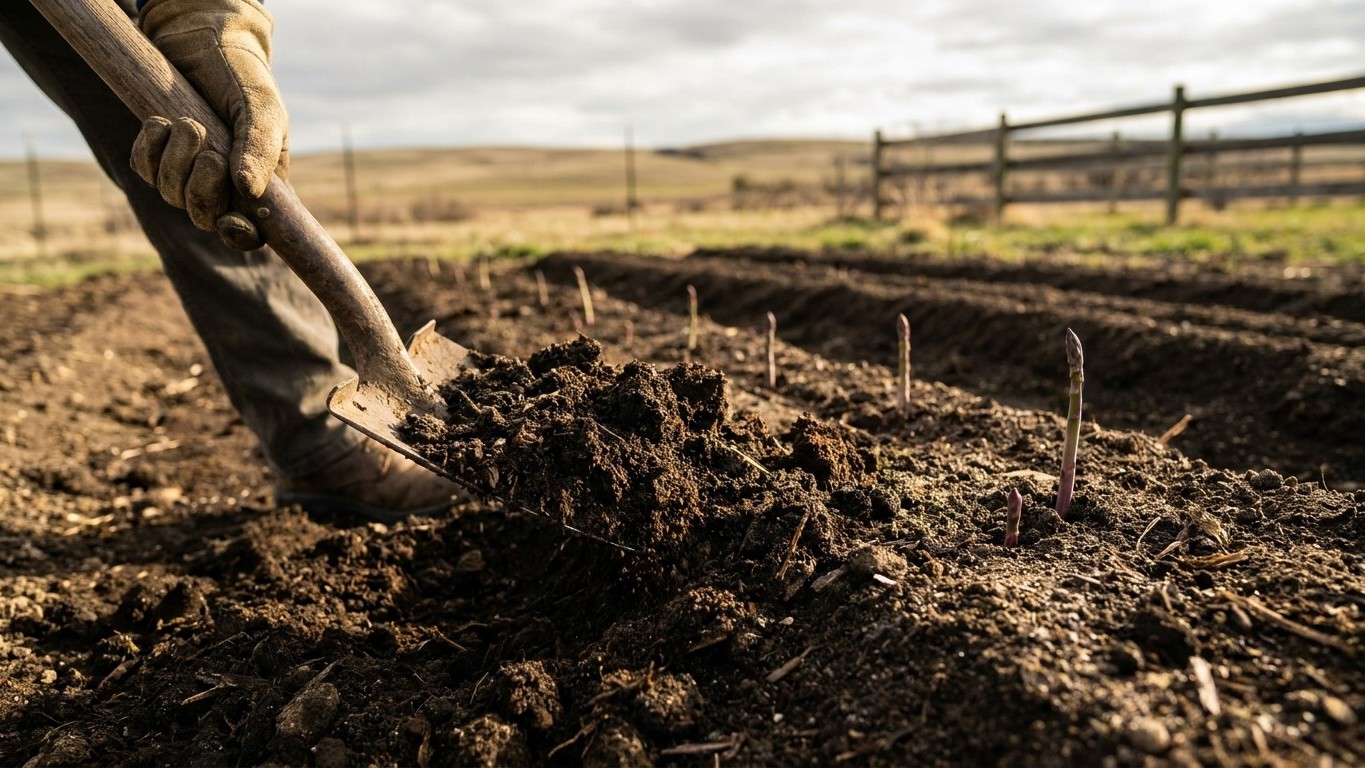

An asparagus bed you plant this spring could still be feeding you fifteen years from now, and in most of Kentucky the ground underneath it will cooperate. The state’s own soil, well drained by nature, gives the crop what it asks for, but the real question, Will Kentucky Soil Hold an Asparagus Bed for Fifteen Years?, depends on more than the state average. The catch is that “the state’s soil” and “your backyard” are not always the same thing.
The short answer
Kentucky’s official state soil, the Crider series, is a forest-derived Alfisol found across a wide stretch of the state, and it happens to answer the one question asparagus actually cares about. Utah State University Extension is blunt on this point: asparagus tolerates most soil types, provided the soil is well drained. Crider is recorded as well drained, and USDA soil survey data describes its surface layer as a silt-heavy loam: 76 percent silt, 19 percent clay, and just 5 percent sand, with organic matter around 3.0 percent and a surface pH near 6.2, slightly acid. That combination, mostly silt with a modest clay fraction, tends to hold moisture without turning into the kind of dense, standing-water clay that rots a perennial crown.
That’s the encouraging part. The part worth sitting with is that Crider is a representative series mapped across broad areas of the state, not a measurement of the dirt behind any one house. A garden built on river bottomland, on fill a builder brought in, or on a compacted subdivision lot can behave nothing like the mapped surface horizon these numbers describe. Organic matter, texture, and drainage all shift with the specific parcel, and no state-level figure substitutes for looking at your own ground.
What “well drained” looks like in practice
The test is simple and costs nothing: dig a hole about a foot deep, fill it with water, and watch how fast it disappears. Water still standing after several hours is a soil telling you something the Crider numbers can’t. Since an asparagus bed is a ten-to-fifteen-year commitment, a heavy or slow-draining spot isn’t the kind of annual nuisance you fix with an inch of compost each spring, it’s a decision baked into the ground for a decade and a half, which is why knowing When to Plant Asparagus Crowns in Kentucky matters as much as knowing where.
If that’s what the hole shows, the fix is structural, not seasonal. Build the bed up, a raised bed or a mounded row lifts the crowns above a wet subsoil rather than fighting it. Work in coarse organic matter before planting, not after, since disturbing an established asparagus row to improve drainage later damages the very roots you’re trying to protect. A soil test, run before the crowns go in, is the only way to know whether the ground under your feet resembles the state’s mapped soil or diverges from it entirely.
Will the summer here water it for you?
Kentucky summers aren’t dry by national standards, but they don’t hand asparagus what it needs on a reliable schedule either. NOAA’s 1991-2020 climate normals put June, July, and August rainfall at roughly 12.0 inches combined, out of about 48.3 inches for the year, with August running driest at 3.71 inches against June’s 4.27 and July’s 4.05. Spread evenly, that’s close to an inch a week each summer month. Asparagus doesn’t want it spread evenly, and it doesn’t want the same amount at every stage.
- Years one and two: the bed needs 1 to 2 inches of water every other week. A single normal week in June or July can nearly cover that on its own, but Kentucky rain rarely lands on a two-week schedule, it tends to arrive in a thunderstorm and then stop. That means the gardener should track actual rainfall with a gauge, not assume the monthly average is landing on the calendar dates that matter.
- August’s shortfall: at 3.71 inches, August is the month most likely to leave a gap. If two consecutive weeks pass without close to an inch of rain, that’s the trigger to run a hose rather than wait.
- Established beds, year three on: the interval stretches to every three weeks. By then the root system is deep enough that Kentucky’s summer rainfall, uneven as it is, usually closes most of the gap on its own, with supplemental watering reserved for genuine dry stretches rather than a routine chore.
- Reading the ground, not just the sky: a silt-heavy soil like Crider holds moisture longer than sand does, which works in the crop’s favor between rain events, but it also means a downpour can look like it solved the problem when the water hasn’t actually reached root depth. A rain gauge paired with the same finger-in-the-soil check used for drainage tells the real story better than the monthly normal does.
When to put the crowns in
Crowns go into the ground in early spring, and in Kentucky that window sits around the state’s last spring frost, which NOAA’s 1991-2020 normals place between March 24 and April 4 at the reference station used for these figures. That’s a mean date built from three decades of data, not a promise for any single year, and it’s worth saying plainly that this station reading runs later in spring than surrounding rural areas tend to, so a garden outside the immediate area may see its own frost-free window open earlier.
Utah State University Extension describes the planting method directly: crowns go into furrows about 8 inches deep, set in early spring. The furrow isn’t filled in one motion. It’s backfilled gradually across the season, about two inches every other month, which lets the emerging spears keep pace with the soil level rather than getting buried too deep too fast. That gradual fill also happens to suit Kentucky’s soil profile, since a silt-heavy surface like Crider settles and drains differently than a sandy one, and backfilling in stages avoids compacting a still-loose furrow all at once.
Crowns are the faster route to a harvest, but seed is the alternative the same source describes, at the cost of an extra year before the plant is established enough to treat the same way. Either way, the harvest clock doesn’t start early: no spears come off the bed in year one or two regardless of planting method, and the first cutting doesn’t happen until year three, starting at four weeks of harvest, then six, then eight in the years after. The rule for when to stop cutting each season isn’t a date on a calendar, it’s a look at the spears themselves: once most of what’s coming up is thinner than a pencil, harvest ends for the year and the plant is left to grow into ferns that feed the crown for next season.
On variety, the published record from Utah State University Extension is narrow by design: it names Jersey Giant and Jersey Knight as all-male varieties, and UC 157 F1 and Purple Passion as male-and-female types. No flavor comparison, yield figure, or reason to prefer one over another appears in that source, so none is claimed here. Winter chilling requirements and ideal soil pH for the crop also go unmentioned in that reference, and Kentucky’s hardiness zone isn’t a substitute for a chilling figure that simply isn’t published.
Checking this against your own county
Everything above describes a state, and a state is not a garden. The Crider soil series covers wide ground but not all of it, the frost dates come from one reference station, and rainfall normals are averages built over three decades. The gardener with the most useful answer for a specific address is the local extension office, which can run or interpret a soil test, confirm frost timing for the actual county, and speak to conditions the state-level numbers can’t reach. The University of Kentucky Cooperative Extension Service, reachable at extension.ca.uky.edu, is the named starting point for that county-level check.
Common questions
Can asparagus grow in Kentucky’s clay soil?
It depends on how heavy the clay actually is and how well it drains, which is a property of the specific lot, not the state. Kentucky’s representative soil, Crider, is a silt-and-clay loam that drains well despite its texture, but a garden on denser, slower-draining clay should raise the bed or amend it before planting rather than after, since disturbing an established row later damages the crowns.
How long before an asparagus bed produces in Kentucky?
No harvest happens in the first two years regardless of location. Cutting begins in year three, starting at four weeks of harvest and extending to six, then eight weeks in subsequent years, according to Utah State University Extension. Once most emerging spears run thinner than a pencil, harvest stops for the season.
What’s the best time to plant asparagus crowns in Kentucky?
Early spring, timed around the state’s mean last frost window of March 24 to April 4 per NOAA’s 1991-2020 normals. That’s an average, not a guarantee for any given year, and a station reading that runs later than some surrounding rural areas, so local timing can shift earlier or later depending on the specific site.
Does Kentucky get enough rain for asparagus without irrigation?
Summer rainfall averages about 12.0 inches across June, July, and August, close to an inch a week, but it arrives unevenly rather than on the every-other-week schedule young asparagus needs. August, the driest month at 3.71 inches, is the most likely point to require supplemental watering, especially in the first two years before the root system deepens.