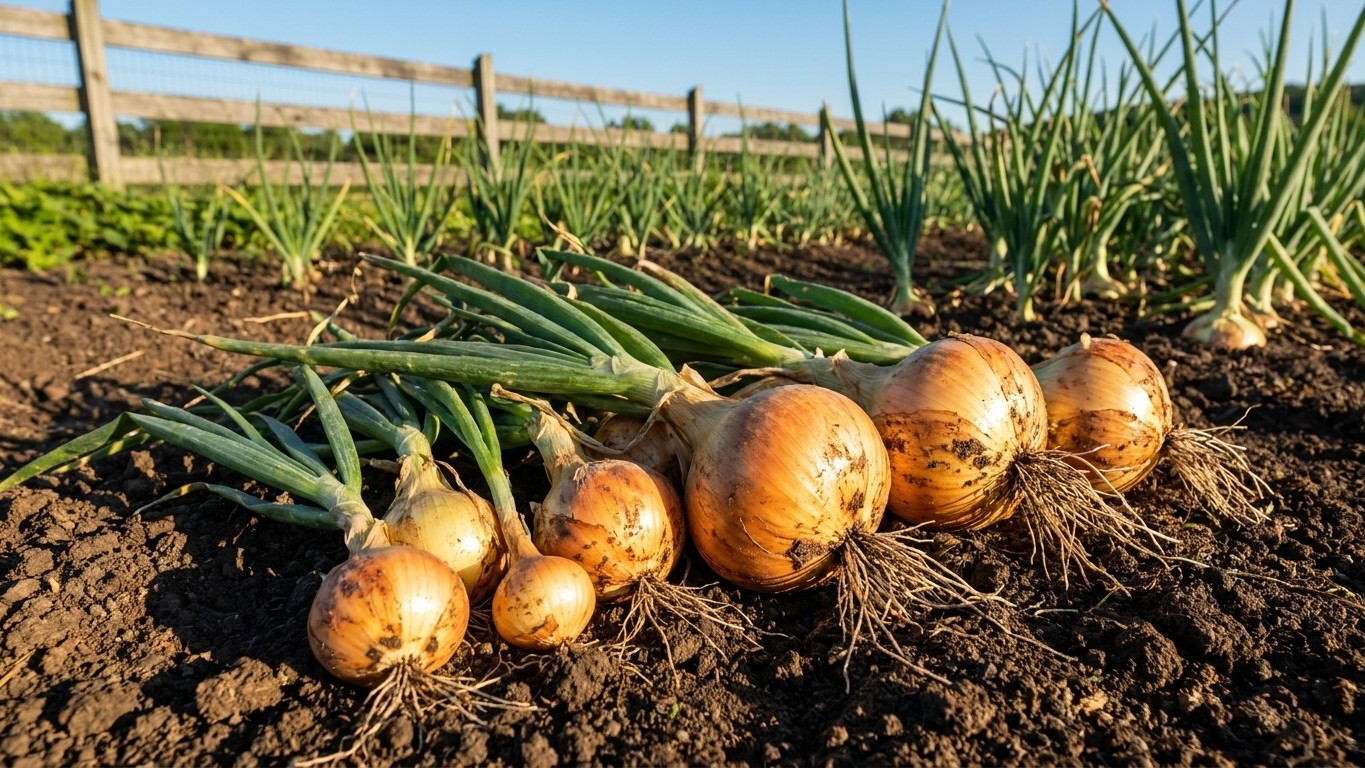

Lift onions when the tops fall over and the necks go soft, then cure them until the necks are tight and the skins turn papery. The plant sets the date, not the calendar. A bulb pulled green and stored wet rots, and one cured properly can sit in a pantry for months. Kentucky’s day length also decides how long a given onion will keep. The sections below start with that.
The short answer for Kentucky
Louisville, the reference city for the figures on this page, sits at 38.18 degrees north and gets 14 h 39 of daylight on the longest day of the year. That number, not summer heat, is what tells an onion to stop making leaves and start swelling a bulb. Clemson Cooperative Extension puts the trigger for short-day onions at about 12 hours. Kentucky passes that mark in spring, well before the solstice, so short-day plants begin bulbing early and keep going as the days lengthen.
What you see above ground tells you the rest. Once bulbing is underway, the leaves have done their work. The plant stops feeding the tops and the necks soften, so the green leaves flop over one after another. For most Kentucky plantings that happens in early to midsummer, though a fall-planted bed and a spring-planted bed will not finish on the same day. When most of the tops are down and yellowing, loosen the soil with a garden fork and lift the bulbs on a dry day.
Lifting without bruising
Do not yank. A bulb that is nicked or bruised at lifting is the first one to rot in the box. Slide the fork a few inches out from the row, lever the soil up, and pull by hand. Leave the tops attached. Lay the bulbs in a single layer in the shade, since direct summer sun can scald the exposed skin.
Curing is the part that decides storage
Curing means drying the outer skins and sealing the neck, where rot gets in. Spread the bulbs in a single layer somewhere warm, dry and breezy, such as a covered porch, a garage with the door open, or a barn loft. Keep them out of rain. No timer applies here. Bulbs are ready when the neck is tight and no longer squeezes shut with moisture inside, and the skins crackle when you rub them. Then trim the tops and roots and move them to storage. Clemson gives the ideal storage conditions as “between 45 °F and 55 °F, and 50 to 60 percent humidity” (Clemson Cooperative Extension, Home & Garden Information Center). Dry, which matters for where you put them.
What will not work here
Most failed onion harvests in Kentucky come from a handful of mistakes, and none of them is a matter of “doing it a little better next year.” Each one produces a specific bad result.
Planting late is the one that surprises people. It does not push the harvest later, it shrinks it. Day length triggers bulbing on a fixed schedule, and whatever size the plant has reached on that day is the size the bulb will be. A transplant that went in late, with only a few leaves, will bulb right on time at the size of a golf ball or smaller. The calendar does not wait for it.
- Long-day types that need the top of the 14 to 16 hour range. Louisville reaches only 14 h 39 on its longest day, so a variety that waits for 15 or 16 hours never gets its signal. It makes leaves all season, forms no real bulb, then rots in the ground.
- Lifting with green, upright tops. The neck is still thick and full of moisture, so the bulb will not seal and will rot in storage within weeks.
- Storing straight from the ground. Uncured bulbs go in the box wet at the neck, and one bad bulb spoils the layer around it.
- Curing in a damp spot. A shaded corner that stays humid after rain will not dry the skins. Mold shows up before the necks close.
- Washing the bulbs. Rinsing adds moisture right where you are trying to remove it. Brush off dry soil by hand.
- Counting on sweet onions to last the winter. The University of Missouri Extension (G6355) puts it plainly: “As a rule, ‘sweet’ onions do not store as well as the more pungent types.”
Rot and damage often start before harvest, so scarred or chewed bulbs go in the eat-first pile. What Eats Onion in Kentucky, and When covers what to look for in the bed.
What changes across Kentucky
The figures above belong to Louisville, 38.18 degrees north. Kentucky is not one latitude. It runs from the Tennessee line in the south to the Ohio River in the north, and from the Mississippi bluffs in the west to the Appalachian ridges in the east. Far southern and far northern counties will not match Louisville exactly. The gap is small compared with the difference between Kentucky and, say, Minnesota, but it is enough to shift planting and lifting by a week or two at the edges.
| Where you garden | Latitude | Longest day | What it changes |
|---|---|---|---|
| Louisville (reference city) | 38.18 degrees north | 14 h 39 | Short-day types bulb early, past the 12-hour trigger well before the solstice |
| South of Louisville | Lower than 38.18, not published here | Slightly less than 14 h 39 | Bulbing starts a little sooner and the bulbs stay a little smaller, so lean sweet and eat early |
| North of Louisville | Higher than 38.18, not published here | Slightly more than 14 h 39 | More daylight to work with, so a longer growing window and slightly better keeping |
I have left the other latitudes blank on purpose. Only the Louisville figure is verified for this page, and putting a number in a cell without a source would mislead more than it helps. If you garden near the Ohio River or near the Tennessee line, look up your own coordinates and compare them to 38.18. For the broader picture of growing onions across the state, start with Onions in Kentucky.
Sweet now, or onions that last
Every garden makes this trade, whether the gardener chooses it or not. The bite of an onion comes from volatile sulfur compounds, and those same compounds protect the bulb while it sits in storage. A sweet variety has fewer of them. It tastes better raw and is gentler on the eyes, but it will not last the winter. This is chemistry, not luck, and no storage trick changes it.
Day length lines up with it. Short-day types run sweeter and keep less. Long-day types are sharper and last longer. A southern garden therefore gives you onions to eat soon, and a northern one gives onions that feed you into March. Kentucky sits in the middle and leans toward sweet. That is a good thing if you like onions on burgers in July, and a poor one if you are counting on stored onions in the new year.
So what does your pantry look like in March? If you grew mostly sweet types, it is nearly empty: the last of them went soft or sprouted by late fall or early winter, and anything left over is a bulb with a soft spot you cut around. If you grew a pungent type and cured it well, you still have firm bulbs in a cool, dry spot. The best approach for most Kentucky gardens is to plant both on purpose. Eat the sweet ones first, store the sharp ones, and check The Best Onion Varieties for Kentucky before you choose which is which.
Checking this against your own garden
The Louisville numbers are a good anchor, not a rule for every bed from Paducah to Pikeville. Several checks take only a few minutes and are worth doing this week, before next season’s plans harden:
- Look up the latitude of your own address and compare it with 38.18 degrees north. If it differs by a degree or more, expect your timing to shift.
- Find your local frost dates. They are not published on this page, and your county extension office can give you the ones that apply to your area.
- Write down the date your tops fell this year, and the planting date. Next year, those two entries will tell you more than any chart.
- Put a thermometer and a hygrometer where you plan to store the crop. You are aiming for 45 to 55 °F and 50 to 60 percent humidity.
- Call your county extension office and ask which onion types do well in your soil and how they have performed locally.
County extension agents see what grows in your county every year, and no state-wide figure replaces that.
Common questions
What if the tops have not fallen but I need the bed?
You can pull the bulbs and eat them fresh. Just do not put them in storage. Bulbs lifted with green, upright tops have thick, wet necks that will not seal, so treat them as the first ones for the kitchen.
Should I wash onions before curing?
No. Washing adds moisture where you want dryness. Let the soil dry on the skin and brush it off by hand after the curing period.
How do I know curing is finished?
The neck is tight and does not squeeze, and the outer skins are dry and papery enough to rustle. The bulbs tell you, not the calendar. If the neck still feels moist, give it more time in a warm, dry, airy spot.
Can I store onions in the same cellar as carrots?
Not well. Onions want 50 to 60 percent humidity, and carrots and other roots want it damp. A single cellar cannot hold both at their best, so keep the onions in the driest, coolest part of the house.