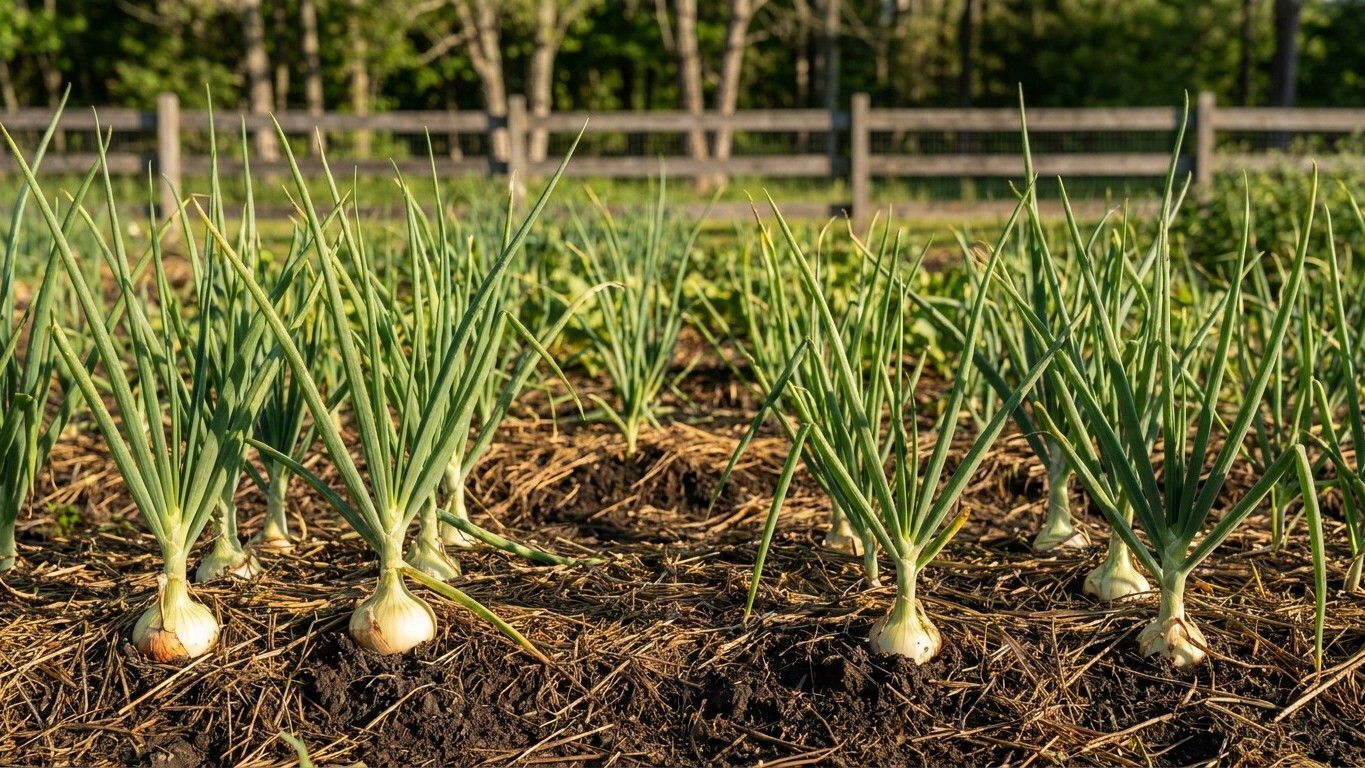

Kentucky’s official pest tracking for gardens and landscapes doesn’t include a single insect that treats onion as a preferred meal. That’s not an oversight, it’s chemistry: the same sulfur compounds that make a pungent onion sting your eyes also make its leaves and bulb unappealing to most chewing insects. What does show up in an onion bed usually traces back to a handful of wandering generalists, or to something that isn’t a bug at all.
Which pests attack onion in Kentucky
University of Kentucky Extension Entomology documents ten pests active in the state’s home landscapes and gardens: Azalea lace bug, Bagworm, Brown marmorated stink bug, Eastern tent caterpillar (Malacosoma americanum), Fall webworm, Japanese beetle, Spotted cucumber beetle, Squash bug, Squash vine borer, and Striped cucumber beetle.
- Azalea lace bug
- Bagworm
- Brown marmorated stink bug
- Eastern tent caterpillar
- Fall webworm
- Japanese beetle
- Spotted cucumber beetle
- Squash bug
- Squash vine borer
- Striped cucumber beetle
Run that list against an onion row and most of it falls away on the first pass. Azalea lace bug lives on the underside of azalea leaves and has no reason to cross into a vegetable bed. Bagworm builds its case on juniper, arborvitae, and other conifers, never on a bulb crop. Eastern tent caterpillar strips wild cherry and apple branches in a tree canopy, not anything growing at ground level. Fall webworm does the same on hardwood branches later in the season. Squash bug, squash vine borer, striped cucumber beetle, and spotted cucumber beetle are all tied to cucurbits, squash, cucumber, melon, and their vine tissue, which shares nothing chemically with an allium.
That leaves two generalists with wide enough appetites to theoretically wander onto onion foliage: Japanese beetle and brown marmorated stink bug. Neither is documented as targeting onion specifically, and both have plenty of preferred hosts nearby to occupy them first. Read crop by crop, zero of the ten pests on this state’s entomology list are onion specialists, which is the closest thing to good news a vegetable grower gets in this state.
When each one shows up, and what it does first
Because nothing on the list specializes in onion, there’s no dedicated pest calendar for the crop the way there is for squash or cucumber. What exists instead is a growth calendar: onion bulbing is triggered by day length, not by heat, and at the reference latitude of 38.18 degrees north the longest day of the year holds 14 hours and 39 minutes of daylight. Long-day varieties wait for something close to that stretch of light before they stop pushing leaves and start swelling a bulb. Short-day types trigger much earlier, around 12 hours, and finish sooner. That shift in the plant, from leaf-building to bulb-building, matters more for pest timing than any date on a wall calendar.
During the leafy stage, right after transplanting, an onion patch is mostly uninteresting to insects looking for something to eat. If Japanese beetles turn up at all, it’s during their peak adult activity in the heart of summer, and they’re drawn first to roses, grapes, and other broad-leaved favorites growing nearby. When they do stray onto onion, the sign is a lacy, skeletonized patch on a leaf blade, veins left standing while the tissue between them is chewed away, usually in small clusters near the edge of the bed closest to whatever plant actually attracted them.
Brown marmorated stink bug follows a looser pattern. It overwinters as an adult, becomes active again once the weather warms, and spends the growing season moving between hosts, favoring fruiting vegetables and fruit trees over anything in the onion family. If it feeds on an onion leaf at all, the mark is a small discolored puncture where the stylet pierced the tissue, not the broad chewed sections a beetle leaves behind. Neither insect shows a preference for the bulbing stage over the leafy stage; if they appear, it’s opportunistic, tied to their own life cycle rather than to anything the onion is doing.
Telling the damage apart from everything else
Most of what looks like a pest problem in a Kentucky onion bed isn’t one. The state’s own environmental swings, wet springs followed by dry stretches, do more visible damage to onion foliage than any insect on the documented list.
| Symptom | Likely cause | What sets it apart |
|---|---|---|
| Ragged, torn holes scattered across leaves | Mechanical or hail damage | Edges are torn unevenly, no feeding trail, appears suddenly after a storm |
| Papery yellow or tan tips on older leaves | Nutrient stress or inconsistent watering | Starts at the tip and moves down evenly, no chewed tissue |
| Lacy, netlike patches with veins left intact | A generalist feeder straying from a neighboring plant | Insects often visible feeding in small clusters at the time |
| Watery lesions or soft rot at the bulb neck | Fungal or bacterial disease | Has an odor, spreads underground, no leaf chewing involved |
| Bent, split, or misshapen bulbs | Irregular watering during bulb swell | Happens with no leaf damage above ground at all |
None of that table is a diagnosis you should make alone in the garden. If a symptom doesn’t clearly match one of these patterns, or if it’s spreading fast, the safest next move is a sample to your county Extension office rather than a guess. Onion disease and onion stress can look enough alike that even an experienced gardener misreads one for the other.
What actually works here, and what is a waste of time
Given that none of the ten documented pests specializes in onion, the highest-return effort isn’t insect control at all. It’s water consistency during bulb swell and keeping weeds down so nothing else is competing for root space. If a generalist feeder like Japanese beetle is heavy elsewhere in the yard, a floating row cover over young onion transplants keeps stray beetles off the leaves without touching a pesticide, and it costs nothing in effectiveness because onions don’t rely on pollinators to form a bulb.
Timing that cover matters more than the material itself. Pull the row cover before the plants shift into bulbing, since blocking light at that stage works against the exact day-length signal the plant needs to start swelling a bulb. Leaving it on too long can delay or shrink the harvest more than any beetle would have.
What’s a waste of time: spraying broad-spectrum insecticide on onion “just in case.” There’s no documented pest here for it to target, so the main effect is killing off the predatory insects and pollinators working the rest of the garden. Companion planting claims about onion repelling other pests are common in gardening chatter, but they aren’t backed by anything in the state’s entomology documentation, and building a planting plan around an unproven claim usually just wastes bed space.
Where to check this for your own county
A state-level list from University of Kentucky Extension Entomology tells you what’s been documented across Kentucky as a whole, not what’s active in a specific backyard. Pest pressure shifts county to county and even yard to yard, depending on nearby host plants, soil moisture, and what got planted the year before. A garden next to a stand of wild cherry trees will see more Eastern tent caterpillar activity nearby than one surrounded by lawn, even though neither one has anything to do with the onions themselves.
The most useful next step for anything unclear in an onion bed is the county office of the Cooperative Extension Service, not a search engine guess. Bring or photograph the actual damage, the leaf, the bulb, the insect if one’s visible, and let the office match it against what’s active locally that season. That’s also where a grower finds out what’s currently labeled for use on onion in Kentucky, since this isn’t the place to prescribe a treatment. The documentation behind this page tells you what’s been seen statewide; your own onion bed still gets the final word.