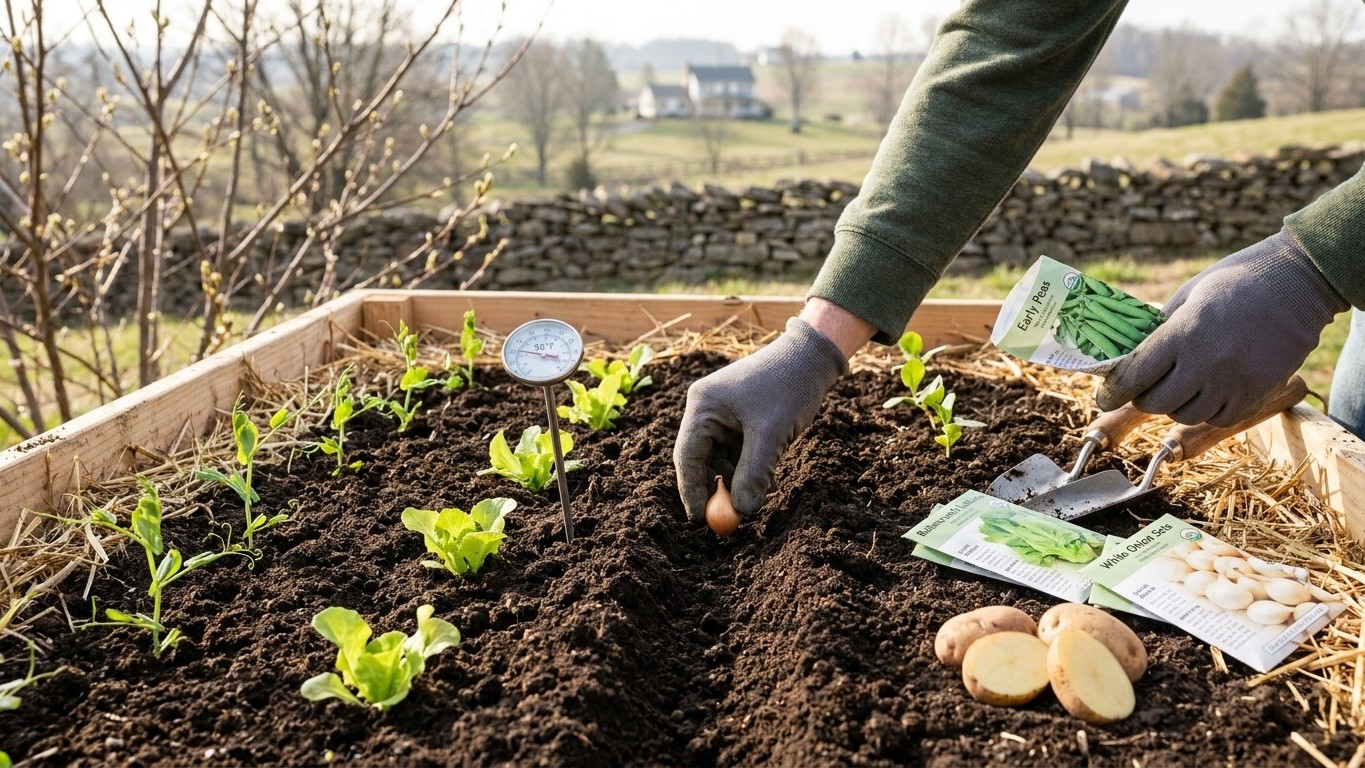

Kentucky’s April sits right on top of the state’s average last frost, which falls between March 24 and April 4 at the Louisville reporting station. That means cool-season crops go into the ground with confidence from the first of the month, while tomatoes, peppers, and other tender transplants wait until the back half of April or later, once soil has warmed and the frost risk has genuinely passed rather than just felt like it has.
What goes in the ground in April

The calendar says spring, but the soil decides the real start date. Cool-season vegetables germinate and grow fine in soil that’s still on the chilly side, while warm-season crops simply sit and rot if the ground hasn’t caught up to the air temperature. That’s the mechanism worth remembering all month: a 70-degree afternoon means nothing if the top four inches of soil are still in the 50s.
With Louisville’s average last frost landing between March 24 and April 4, most of the state can treat early April as the tail end of frost risk rather than the middle of it. That opens the door for a long list of hardy and semi-hardy crops direct-sown or transplanted outdoors right away:
- Peas, both shelling and snap types, direct-sown as soon as soil can be worked
- Lettuce, spinach, and other salad greens, direct-sown or transplanted
- Onion sets and shallots, plus any garlic not already in from fall
- Potatoes, seed pieces cut and cured before planting
- Carrots, beets, radishes, and turnips, direct-sown
- Cabbage, broccoli, and kale transplants, hardened off first
- Asparagus crowns and strawberry plants, both best started early in the month
Tender crops are the gamble. Tomatoes, peppers, squash, cucumbers, and beans want both the frost date behind them and soil consistently in the 60s. In practice that usually pushes transplanting toward the last week of April at the earliest, and often into May for anyone north of Louisville or at higher elevation. A grower who jumps the gun and sets out tomatoes in the second week of April is betting against a documented freeze pattern, not just bad luck.
What to start under cover
Seed starting works backward from a target transplant date, not forward from today’s weather. For tomatoes and peppers, most gardeners count 6 to 8 weeks before the planting-out date. If the plan is to set tomatoes outside in the last week of April, seeds needed to go into trays roughly in early March. If that window was missed, buying started transplants from a local nursery closes the gap without losing the season.
Cucurbits move faster and resent root disturbance, so squash, cucumbers, and melons are usually started only 3 to 4 weeks ahead of transplanting. Sown now, in April, they’re ready to go into warmed soil in mid-to-late May, right when both the calendar and the thermometer agree it’s safe.
Two failure modes show up every spring. Starting too early leaves plants rootbound and leggy on the windowsill, stretching for light and stalling out the moment they hit the garden. Starting too late means the transplant is still a seedling when the safe planting window opens, and the harvest slides weeks behind schedule. Splitting the difference by starting a second, smaller batch two weeks after the first is a simple hedge against both a late cold snap and a stretch of gray weather that slows germination.
Under cover isn’t only about trays on a windowsill. Cold frames and low tunnels extend the outdoor list this month too, letting spinach, lettuce, and brassica transplants go into the ground a week or two ahead of the open-air date, with the cover coming off gradually rather than all at once.
What is ready to pick
April harvests are modest but real. Asparagus beds that have been established for a few seasons typically start sending up spears this month, and the rule for cutting is simple: harvest while spears are still tight and firm, before the tips begin to feather open. Rhubarb stalks thicken enough to pull once they’ve reached a usable length, though the leaves stay in the compost pile, never the kitchen.
Anything sown under cover in late winter, spinach, lettuce, mustard greens, is often ready for a first cutting now, and cutting outer leaves rather than pulling whole plants stretches the harvest by weeks. Green onions started from sets earlier in spring are usually pencil-thick and ready by mid-month.
The other harvest happening in April is really an inventory check. Stored potatoes, winter squash, and onions from the previous season should get a hands-on look now: soft spots, sprouting eyes, or a squash that’s gone slightly spongy at the stem end all mean use it now, not later. This is also the point where any stored garlic or onions that have started sprouting are worth using in the kitchen before they’re worth nothing at all. It’s a small task, but it’s the difference between eating what was grown and throwing half of it away in May.
The jobs that matter this month
April rewards the gardener who gets ahead of the plants rather than behind them. Soil preparation tops the list: working compost or aged manure into beds now, while the ground is workable but before the first transplants go in, builds the fertility that April-planted crops will draw on for the next two months.
Mulching comes right behind it. A layer of straw or shredded leaves around cool-season transplants now holds moisture as temperatures climb and suppresses the first flush of weeds before they get a foothold. Staking and trellising belong in the same early window, since peas, and later tomatoes, sprawl fast once they take off, and it’s far easier to set a support before the plant needs it than to wrestle a cage over a foot of tangled vine.
Watering rhythm matters more in April than it gets credit for. Spring rain can lull a gardener into skipping a watering check, but a dry week on newly transplanted brassicas or strawberries stresses them at exactly the point they need steady moisture to establish roots. Succession sowing of radishes, lettuce, and spinach every couple of weeks through the month keeps a harvest coming instead of one big flush followed by a gap.
Pest scouting starts in earnest now too. Flea beetles show up on brassica transplants almost as soon as they’re in the ground, and aphids find the first tender new growth within days. Catching either in the first week, with row cover or an early treatment, is far cheaper than fighting an established infestation in May. Anyone with fruit trees or cane berries should also finish dormant pruning before buds fully break open, since pruning cuts made after leaf-out slow the plant and invite disease. Seed orders for succession plantings later in the season should go in now too, before popular varieties sell out.
What not to do in April
The most common mistake is trusting the air instead of the soil. A run of 75-degree afternoons in early April feels like permission to set out tomatoes, but the soil four inches down is often still 15 to 20 degrees cooler than the air, and a warm-season transplant dropped into cold soil simply stalls, sometimes for weeks, sometimes permanently. Checking soil temperature with a simple probe thermometer before transplanting takes two minutes and prevents a wasted six weeks of seed-starting effort.
The second mistake is uncovering too early after a mild stretch. Row covers, cold frames, and mulch layers put on to protect cool-season crops earlier in spring often come off the first warm weekend, right before a late cold snap moves through. Given that the last frost at the Louisville station averages as late as April 4, and rural Jefferson County typically runs colder still, pulling protection in the first week of the month is premature almost everywhere in the state.
The third mistake is nitrogen timing. Heavy nitrogen feeding right at transplant pushes fast, soft, leafy growth before roots have had a chance to establish, leaving young plants more vulnerable to both cold snaps and pest pressure. A modest starter feed at planting, followed by a real feeding once plants show new growth, builds a sturdier plant than one big dose up front.
Checking this against your own county
A statewide April is a starting point, not an instruction. Kentucky spans USDA Hardiness Zones 6a to 7a, and elevation, valley cold pockets, and simple north-south distance across the state shift real planting windows by two weeks or more in either direction. The frost dates cited here come from the Louisville station, and the National Weather Service has noted that this urban station reads later in spring and earlier in fall than the rural parts of surrounding Jefferson County, so rural gardens should plan on a tighter frost-free window than these numbers suggest, not a looser one.
The most reliable next step is the University of Kentucky Cooperative Extension Service, which publishes county-level planting guidance built for these local differences: extension.ca.uky.edu.
Common questions
Can I plant tomatoes in Kentucky in April?
Only late in the month, and only after soil has warmed past the mid-60s. Louisville’s average last frost falls between March 24 and April 4, but cooler and higher-elevation areas run later, so most gardeners are safer waiting until the last week of April or into May for tender transplants like tomatoes and peppers.
Is it safe to plant grass seed in April in Kentucky?
Cool-season lawns typically do better with fall seeding, since spring seedlings have to compete with summer heat and weed pressure right after germination. If spring seeding is the only option, early April, once soil is workable, is a better window than waiting into the warmer, drier part of the month.
When is the last frost date in Kentucky?
At the Louisville station, the 1991-2020 average last spring frost falls between March 24 and April 4. That figure runs later than much of rural Jefferson County and other parts of the state, so local extension guidance is worth checking before planting tender crops.
What vegetables can I direct sow in April in Kentucky?
Peas, lettuce, spinach, carrots, beets, radishes, turnips, onion sets, and potatoes all direct-sow well in April soil. Warm-season crops like beans, squash, and cucumbers should wait until soil temperatures are reliably warmer, typically later in the month or into May.