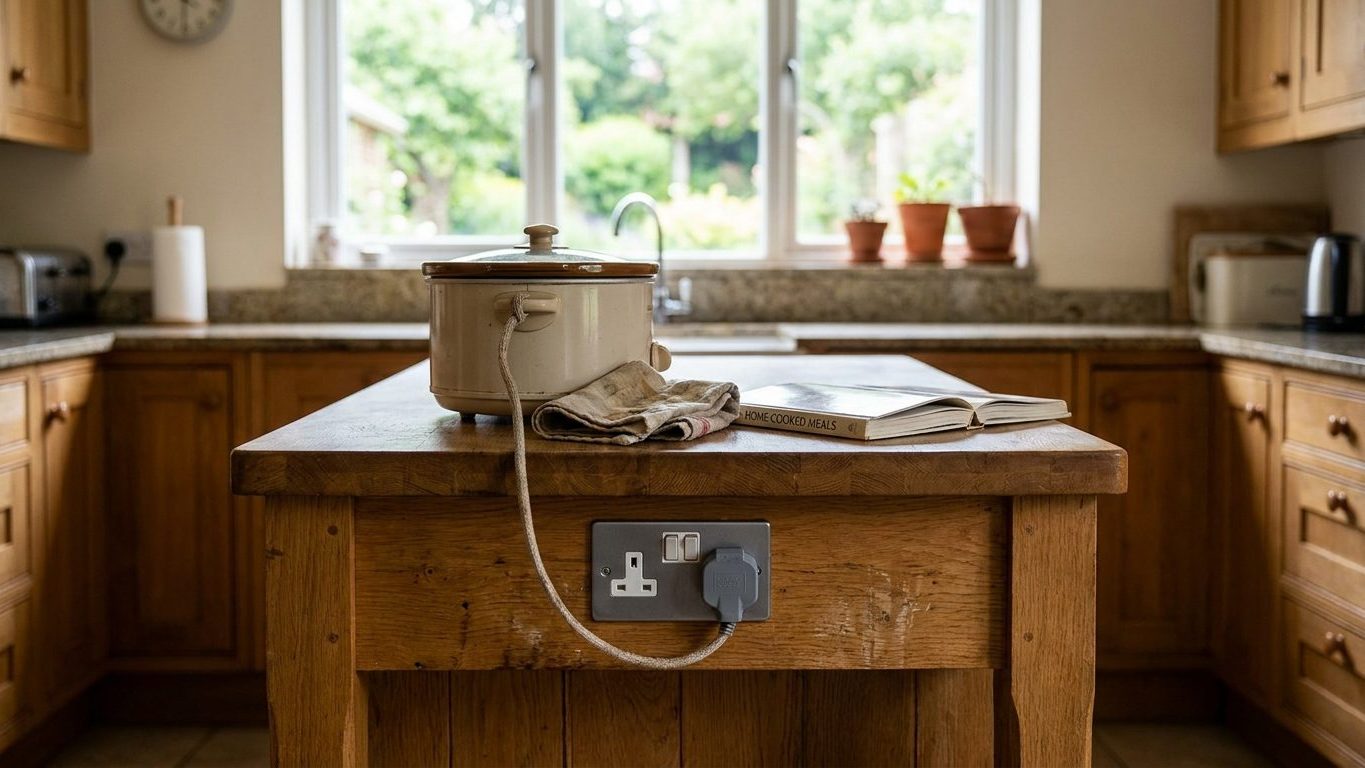

Twelve inches by twenty-four inches is the number that decides everything here. Any kitchen island or peninsula countertop that size or larger needs at least one receptacle outlet, and a second one kicks in once the countertop grows past a certain point beyond that. Measure the usable countertop surface on your island now, not the cabinet footprint underneath it, and do that math before you call an electrician, because that surface number is what decides how many outlets the wiring plan has to include.
The size that triggers the requirement

A countertop of 12 inches by 24 inches or larger on a kitchen island or peninsula requires at least one receptacle outlet. That comes from the 2020 National Electrical Code, section 210.52(C)(2), and it’s a code requirement, not a suggestion from a kitchen designer or a showroom. An electrical inspector checks for it against the permit drawings, and the rough-in inspection does not pass without it.
The 12-by-24-inch figure measures the countertop surface itself, the flat prep and serving area, not the cabinets, the overhang, or the stools tucked underneath. Twelve inches by twenty-four inches works out to 288 square inches, or 2 square feet, which is a smaller island than most people picture when they hear the word “island.” A narrow bar-height counter that size already clears the threshold.
Once the countertop passes that starting size, the same NEC section adds a receptacle for every additional 9 square feet, or fraction of it, of countertop area. A 24-by-60-inch island, for example, works out to about 10 square feet, which is over the 9-square-foot mark and calls for a second receptacle even though the island looks like a single continuous run of counter. Nobody counts square footage by eye reliably, which is exactly why the code counts it in numbers instead of leaving it to judgment.
None of this depends on how many islands or peninsulas the kitchen has. Each qualifying countertop is measured on its own, so a kitchen with an island and a separate peninsula can end up needing receptacles at both, calculated separately against the same 12-by-24-inch and 9-square-foot figures.
Why the rule counts area and not islands
The 2020 NEC ties the receptacle requirement to countertop area rather than to the island as a single unit because the point of the rule is reach, not decoration. A cook standing anywhere along a long countertop should be able to plug in a mixer or a griddle without running a cord across a stovetop or a sink to get to the nearest outlet. Area is the only measurement that scales with how much counter a cord actually has to cross.
That’s also why the 9-square-foot increment exists instead of a flat one-outlet-per-island rule. A small island and a 15-foot island both start at the same 12-by-24-inch trigger, but only the long one keeps adding receptacles as it grows. The code is describing a maximum distance a cord should have to travel, expressed as area instead of as feet, because countertops vary in shape as much as in length.
What this means for odd-shaped islands
An L-shaped or curved island still gets measured as total countertop area, not as a run of linear feet. That matters because a compact, deep island can clear the 9-square-foot mark faster than a long, narrow one does, even if the narrow one looks bigger standing in the kitchen. Total square footage, not visual size, is what a licensed electrician or an inspector is actually calculating.
This is also where island layout starts to overlap with how the kitchen is actually used. A receptacle placed for code compliance still has to sit somewhere a cook can reach without crossing the main path between the sink, the stove, and the refrigerator, which is worth checking against The Kitchen Work Triangle: 4 to 9 Feet Per Leg before the electrician sets the boxes. Code compliance and a workable layout are two different checks, and passing one does not guarantee the other.
Where the receptacle may and may not go
Receptacles serving an island or peninsula countertop may no longer be installed face-up in the countertop surface itself. That’s from the 2020 NEC, section 210.52(C)(3), and it’s a change from earlier code cycles that did allow pop-up or flip-lid outlets set flush into the counter. Under the current edition, the receptacle has to be mounted elsewhere, such as on the side of the island cabinet, on a riser, or on a permitted appliance-type box, rather than facing straight up where spills and countertop clutter sit directly on top of it.
Every receptacle serving a kitchen countertop, island included, also needs GFCI protection. That comes from the 2020 NEC, section 210.8(A)(6), and it applies regardless of where on the island the receptacle is mounted. This is one requirement that doesn’t get looser near a sink or stricter far from one. Any countertop receptacle in the kitchen is on the list.
None of this becomes law on its own. The National Electrical Code is a model code, and it only governs a given kitchen once the local jurisdiction has adopted that edition, sometimes with amendments that add to or soften specific sections. Two counties in the same state can be working from different NEC editions at the same time, depending on when each one last adopted an update. The FACTS available here don’t include a local exception to the face-up or GFCI rules, so if your jurisdiction has one, it comes from the local building or electrical department, not from this page.
Checking an existing island against the current edition

Checking an island against these rules starts with a tape measure, not a guess. Measure the countertop surface only, edge to edge, and leave out any part of the counter that sits over an appliance garage, a wine fridge, or open shelving where nobody would set down a mixer. The most common measuring mistake is including overhang that hangs past the cabinet face on the seating side, since that overhang is still usable counter and still counts toward the total.
A quick way to see where the count lands
| Countertop area | Receptacles the count implies |
|---|---|
| Under 12 by 24 inches (under 2 sq ft) | None required by this rule |
| 12 by 24 inches up to 9 sq ft | 1 |
| Over 9 sq ft, up to 18 sq ft | 2 |
| Over 18 sq ft, up to 27 sq ft | 3 |
That table is arithmetic built from the 12-by-24-inch starting point and the 9-square-foot increment in the 2020 NEC, not a separate rule. Once you have a square footage figure, you can see roughly where your island falls, though the exact count for an oddly shaped counter is something a licensed electrician should confirm.
If the island also carries a dishwasher, the same measuring habit matters there too, since appliance clearance gets missed in the same way outlet count does. That’s covered separately in Where a Dishwasher Can Go, and the Air Gap Nobody Fits, and it’s worth checking at the same time you’re out there with the tape measure.
Whatever the count comes out to, this page can’t tell you whether your specific island passes. Only a local inspector or a licensed electrician working from your actual countertop and your jurisdiction’s adopted code edition can say that.
The island wired before the rule changed
An island wired under an older code cycle isn’t automatically illegal just because a newer edition changed the rules. Most jurisdictions don’t require existing wiring to be ripped out and redone every time a new NEC edition is adopted. The trigger is usually new work, not the calendar. Add a permit for a kitchen remodel, a new circuit, or an addition, and the inspector reviewing that permit will typically expect the affected work to meet the current adopted edition, which is where an older face-up outlet or a missing GFCI often gets flagged.
The practical risk shows up at three points. During a sale, a home inspector may note a face-up countertop receptacle or a missing GFCI as a safety item, even without a permit involved. During a remodel, the inspector will not sign off on the permit if the island’s outlets don’t meet the current code once the project touches that circuit. And day to day, a countertop receptacle without GFCI protection near a sink is a real shock hazard, whatever edition it was installed under.
If you’re not sure where your island’s wiring stands, the next call is to the local building or electrical department, or to a licensed electrician who can open the box and check. That’s a more reliable answer than counting outlets from across the kitchen.
Common questions
Does a small kitchen peninsula need an outlet too, or just full islands?
The same 12-by-24-inch threshold in the 2020 NEC, section 210.52(C)(2), applies to peninsulas as well as islands. Size and countertop area decide it, not what you call the feature.
Can I put a pop-up or flip-lid outlet in my island countertop instead of a side-mounted one?
Not under the current edition. The 2020 NEC, section 210.52(C)(3), no longer permits receptacles installed face-up in the countertop surface, which rules out flush pop-up units for new installations covered by that edition.
Does the GFCI requirement apply even if the outlet is on the far side of the island from the sink?
Yes. The 2020 NEC, section 210.8(A)(6), requires GFCI protection for every receptacle serving a kitchen countertop, regardless of its distance from the sink or the cooktop.
My island is an odd shape with a curved end. How do I count the square footage accurately?
Measure the actual usable countertop surface, including any curved or angled sections, rather than approximating with a rectangle. For a shape complicated enough that you’re not confident in the number, a licensed electrician or your local building department can confirm the count against the countertop as built.