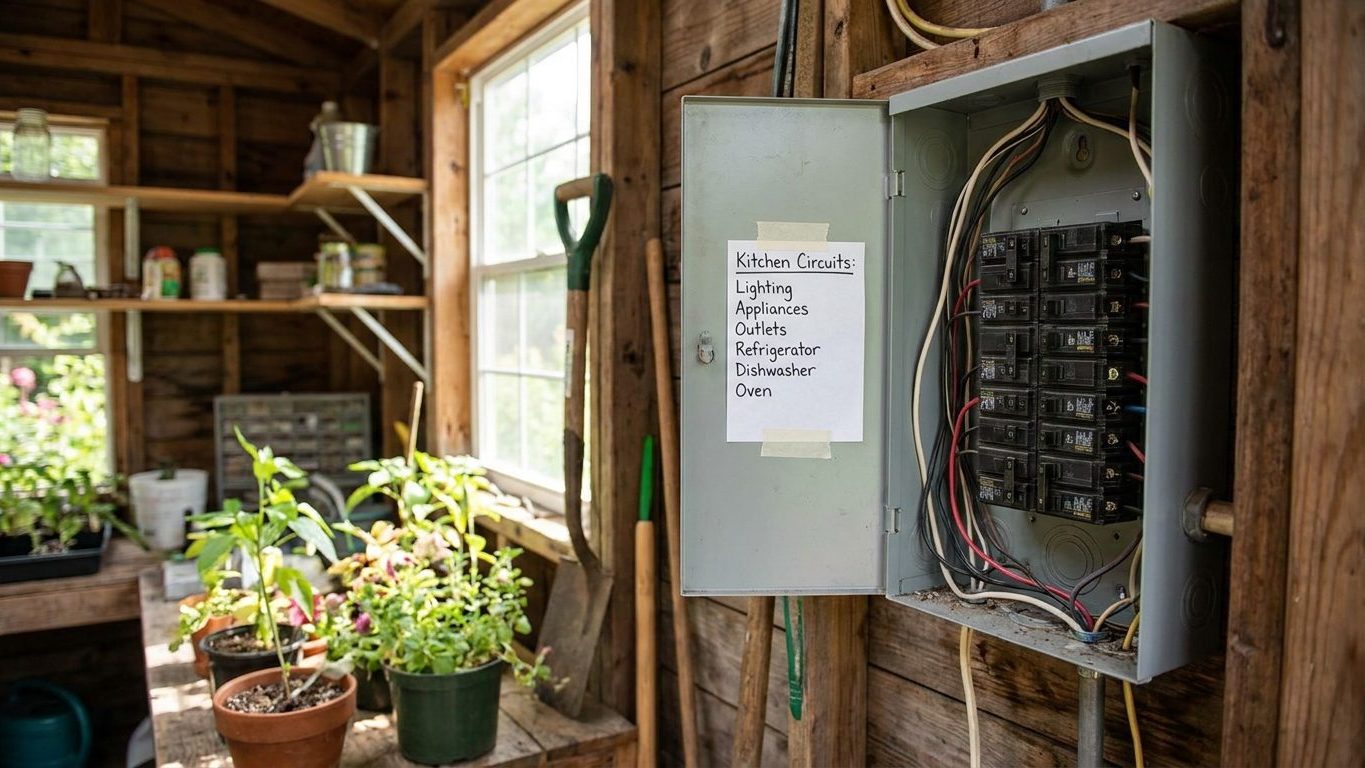

Stand at your kitchen‘s breaker panel and try to count how many switches actually belong to that room, and you’ll likely come up short unless you know what to look for. A kitchen needs a minimum of two 20-amp small-appliance circuits for the countertop outlets alone, and then one more circuit for every major built-in it holds: a dishwasher, a disposal, a wall oven, a cooktop. Check your panel labels against the appliances actually installed before you assume one circuit is doing double duty.
The circuits a kitchen is required to have

The 2020 National Electrical Code, section 210.11(C)(1), requires at least two 20-amp small-appliance branch circuits to feed the countertop receptacles in a kitchen. That is a code requirement enforced at inspection wherever a jurisdiction has adopted the 2020 NEC, not a preference from whoever designed the cabinets. The count covers only the outlets a coffee maker, toaster or stand mixer plugs into along the counter. Those same countertop receptacles also carry a separate GFCI protection requirement, which is a different rule from how many circuits feed them and is covered in Which Kitchen Outlets Need GFCI Protection?
What else the kitchen adds beyond that floor
Two small-appliance circuits are the starting point, not the total. The same code, in section 422.10, requires a dishwasher, a disposal, a wall oven and a cooktop to each take a dedicated circuit sized to that specific appliance’s rating. A kitchen with all four of those built-ins is already carrying six circuits before anyone counts the lighting.
Lighting is its own line. Section 210.52(B)(2) of the 2020 NEC keeps kitchen lighting off the small-appliance circuits entirely, so the ceiling fixture and any under-cabinet lights need a circuit that has nothing to do with the counter plugs. A refrigerator is treated more loosely: section 210.52(B)(1) allows it to sit on its own individual circuit, though the code does not force that separation the way it forces the others.
Add up the mandatory pieces and a kitchen with a dishwasher, a disposal, a wall oven, a cooktop and a dedicated refrigerator circuit is running on eight or more branch circuits before anything else on that panel gets counted. A galley kitchen with no built-in oven or disposal might get by on the two small-appliance circuits and a lighting circuit and nothing more. The number the title asks for is not fixed. It is the sum of what the code requires for the counter and the lighting, plus one circuit for every dedicated appliance the kitchen actually holds.
Why two circuits, and why they serve nothing else
The reason the 2020 National Electrical Code sets a floor of two 20-amp small-appliance circuits instead of one comes down to how many high-draw countertop appliances a modern kitchen tends to run at once. A coffee maker, a toaster, an air fryer and a stand mixer pulling current from a single circuit trips the breaker fast, and splitting the countertop load across two separate circuits means one overloaded run does not take down every outlet in the room.
The second half of that rule, that those circuits serve no other room, exists for the same reason. If a small-appliance circuit also fed a receptacle in the dining room or a hallway, whatever ran there would compete for the same 20 amps as the kitchen counter. The built-in headroom the code is trying to guarantee for countertop appliances would disappear the moment someone plugged in something unrelated down the hall.
The same logic explains why kitchen lighting is barred from those circuits under section 210.52(B)(2). A tripped breaker from an overloaded toaster and coffee maker combination is an inconvenience if it only kills the counter outlets. It becomes a hazard if it also kills the only light source in the room, especially at night or while something is cooking on the stove.
The refrigerator’s allowance for its own circuit, under section 210.52(B)(1), follows the same reasoning from a different angle. A refrigerator runs continuously and cannot afford to lose power because a toaster on the same circuit tripped a breaker. Giving it an individual circuit means a spike from a countertop appliance never touches the compressor keeping food cold, which is also why the refrigerator does not blink or reset when something else in the kitchen faults.
Splitting the load also buys room for the kitchen to grow. Add a second coffee station or a countertop induction burner years after the original wiring went in, and having two independent 20-amp circuits already serving the counter means an electrician has a real chance of tying the new load onto whichever circuit has spare capacity, rather than opening a wall to run an entirely new line.
The appliances that each take a circuit of their own
The 2020 National Electrical Code, section 422.10, requires a dishwasher, a disposal, a wall oven and a cooktop to each run on its own dedicated circuit, sized to that specific appliance’s electrical rating rather than to a single number every kitchen shares. The rating comes from the appliance’s nameplate, not from a rule of thumb, so the circuit size for a given cooktop is whatever that model’s manufacturer specifies. If that cooktop sits on an island, the wiring to it is a separate question from the clearance required around the island itself, covered in How Much Clearance Around a Kitchen Island?
Whether that code language even applies to the kitchen in front of you depends on adoption. The 2020 NEC is a model code, and it only carries legal weight where a state, county or city has formally adopted it, often with local amendments that tighten or loosen specific sections. A kitchen inspected under an older edition, or under a version amended locally, may see this requirement worded differently or numbered under a different section entirely.
Appliance manufacturers sometimes go further than the code requires. A wall oven’s installation manual might call for a circuit larger than the bare code minimum for that appliance class, and where that happens, the manufacturer’s instruction is what an electrician wires to and what an inspector checks against. This page does not have a documented exception beyond what the 2020 NEC lists here, so if a kitchen’s permit history looks unusual, the local building or planning department is the place to ask, not a guess based on a similar kitchen down the street.
Add a wall oven or a second cooktop during a remodel and that new appliance carries the same requirement retroactively. It needs its own circuit run to the panel, not a tap off whatever line already happens to be nearby. That is the point most likely to trip up a DIY renovation, since an existing circuit at the wall may look like it has enough capacity on paper while still failing to meet section 422.10’s requirement that the appliance get a circuit of its own.
Reading a panel to work out what your kitchen has

Start at the breaker panel, not at the outlets themselves. Most panels have a directory on the inside of the door, and each circuit should have a label describing what it feeds. Cross-reference that label against the kitchen itself rather than trusting the handwriting. Labels get out of date the moment someone reroutes an outlet during a remodel and nobody updates the sticker.
What to check outlet by outlet
- Flip one breaker off and check every countertop outlet, not just the nearest one, since a single small-appliance circuit can serve receptacles on both sides of the room
- Note whether the refrigerator keeps running when other kitchen breakers trip, which is the sign it has its own circuit under section 210.52(B)(1)
- Check the dishwasher, disposal, wall oven and cooktop separately, one appliance at a time, since section 422.10 expects each on its own line
- Confirm the kitchen light switches independently of the counter outlets, since lighting is barred from the small-appliance circuits under section 210.52(B)(2)
The most common measuring error is testing with an appliance already running instead of testing it off, then on. A dead outlet during a running dishwasher cycle tells you the circuit tripped, not which circuit it was on. Test each breaker with the appliance off first, then switch it on to confirm the connection, rather than pulling the plug on something already mid-cycle and guessing backward.
Write down what you find as you go, on paper or with a photo of the panel door, since the point of this exercise is a record to hand an electrician later, not a one-time mental note. A kitchen wired over several decades by different contractors often has circuits that don’t match the tidy structure the code describes. Sometimes a small-appliance circuit was extended to a nearby breakfast nook, or a wall oven and cooktop end up sharing a line that was only ever sized for one.
The breaker that trips every time the kettle runs
A breaker that trips whenever the kettle, the toaster and the microwave run at the same time is usually a load problem, not a faulty breaker. If a kitchen was wired with only one small-appliance circuit instead of the two 20-amp circuits the 2020 NEC requires under section 210.11(C)(1), every countertop appliance is fighting for the same capacity, and the breaker is doing exactly what it was designed to do.
At inspection, a kitchen missing that second small-appliance circuit, or missing a dedicated circuit for the dishwasher or disposal required by section 422.10, fails and stays failed until an electrician runs the missing line. In an older kitchen that was never inspected under the 2020 NEC, the same shortfall does not show up until it is already causing daily friction, tripping at the same three appliances every morning.
Ten years on, the risk shifts from inconvenience to something worth actually watching. Repeated tripping means a circuit is being asked to do more than it was built for on a regular basis, and while the breaker itself does not wear out from routine trips, whatever is plugged in gets interrupted mid-cycle, which is its own kind of aggravation for anything with a timer or a memory chip.
If this is happening in a kitchen being planned for renovation rather than just lived with, the next call is to a licensed electrician who can trace the existing circuits, not a guess based on how many outlets there are. A local building or planning department can confirm which code edition and amendments apply before a permit is pulled, and a kitchen designer working on the layout should know the existing circuit count before final appliance choices lock in what each one will draw.
Common questions
Does a microwave need its own circuit?
The facts covered here don’t list a microwave among the appliances the 2020 NEC names for a dedicated circuit, that group is the dishwasher, disposal, wall oven and cooktop under section 422.10. A countertop microwave typically runs off the small-appliance circuits along with everything else on the counter, but a built-in microwave’s installation manual may call for its own line. Check that manual and the local building department if the model in question is a built-in.
Is the refrigerator required to have its own circuit?
No. Section 210.52(B)(1) of the 2020 NEC allows a refrigerator to sit on an individual circuit, but it does not force that separation. Plenty of kitchens run the refrigerator off a shared circuit without violating that section, the individual-circuit option exists mainly so a tripped breaker elsewhere in the kitchen doesn’t take food safety down with it.
Can the two small-appliance circuits also feed an outlet in the dining room?
No. Section 210.11(C)(1) is specific that those two circuits serve the kitchen’s countertop receptacles and nothing else in the house. An outlet in an adjoining dining area needs to come from a different circuit, even if it is only a few feet from the kitchen counter.
What if my older kitchen only has one small-appliance circuit right now?
That’s common in houses wired before the two-circuit requirement was in place, and it isn’t automatically something to panic over, older wiring is typically evaluated against the code edition in force when it was installed, not retroactively against the current one. If you’re renovating or adding appliances, that’s the moment a licensed electrician and the local building department can tell you whether bringing the kitchen up to the current requirement applies to the scope of work you’re doing.