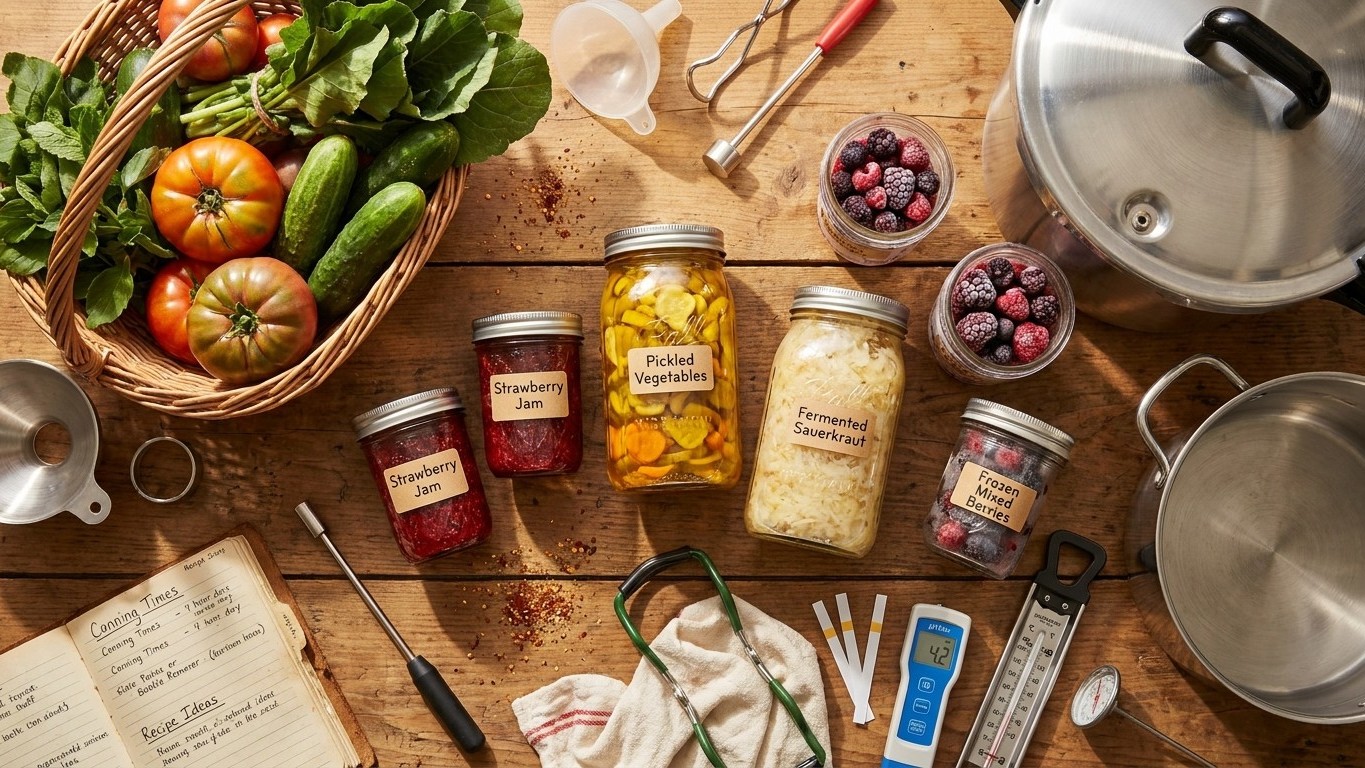

Every jar of home-preserved food comes down to one number: 4.6. That’s the pH threshold that decides whether a food is safe to process in a simple boiling-water bath or whether it demands a pressure canner reaching much higher temperatures. Miss that distinction and the consequences aren’t a ruined batch of pickles. They’re a genuine health risk. This guide walks through Home Canning: What It Is, and What It Cannot Do Safely, what each preservation method actually does—including approaches like Drying Food at Home: Removing the Water, Not the Risk, Fermenting: Letting the Food Make Its Own Acid, and Freezing the Harvest: What It Preserves, and What It Does Not—and how to pick the right one for what’s sitting on your counter.
Preserving the Harvest

Ask any food scientist why some canning recipes take twenty minutes in a pot of boiling water while others require a specialized pressure vessel, and the answer traces back to acidity. The National Center for Home Food Preservation at the University of Georgia draws the line at pH 4.6. Foods with a pH above that number are classified as low-acid. Foods at or below it are acid foods. That single measurement determines everything downstream: which equipment you need, how hot the food must get, and how long it has to stay there.
Low-acid foods include red meats, seafood, poultry, milk, and just about every fresh vegetable you’d pull out of a garden, with one notable exception. Acid foods are the ones most people associate with home canning: fruits, pickles, sauerkraut, jams, jellies, marmalades, and fruit butters. The natural acidity in these foods creates an environment hostile to the organism that matters most in this whole discussion.
That organism is Clostridium botulinum, and it needs three conditions at once to produce its toxin: a moist, low-acid food, a temperature sitting somewhere between 40 and 120 degrees Fahrenheit, and an oxygen level below 2 percent. A sealed jar of unprocessed vegetables checks every one of those boxes. It’s dark, moist, oxygen-poor, and sitting at room temperature. That’s exactly the environment the bacteria wants.
Here’s the detail that makes this more than a technical footnote: botulinum toxin has no taste and no smell. A contaminated jar can look, smell, and taste completely normal. There’s no sensory test that protects you here, no “sniff it first” rule that works. The only real safeguard is processing the food at a temperature and for a duration proven to destroy the bacteria or its spores, based on that food’s specific acidity, jar size, and altitude.
Low-acid foods require a pressure canner because they need water temperatures of 240 to 250 degrees Fahrenheit, only achievable under pressure. Acid foods can be safely processed in a boiling-water canner, which tops out at 212 degrees Fahrenheit at sea level. That gap between 212 and 240-250 degrees isn’t a small technical detail. It’s the difference between a method that kills the organisms that cause spoilage and one that specifically targets the spores of Clostridium botulinum.
One complication worth flagging: some tomato varieties, along with figs, are now known to sit slightly above that 4.6 line even though they’re traditionally treated as acid foods. That’s why tested recipes for canning tomatoes and figs call for added acid, typically bottled lemon juice or citric acid, before processing. Skipping that step means treating a borderline low-acid food as if it were safely acidic.
The four methods, and what each one does
Four techniques cover almost everything a home preserver will ever do with a harvest, and each one works by attacking a different vulnerability in the microorganisms that cause spoilage. Knowing what’s actually happening inside the jar, bag, or crock makes it much easier to choose correctly.
Canning
Canning uses heat to destroy microorganisms and enzymes, then relies on a vacuum seal to keep new contamination out. The two canning methods, boiling-water and pressure, aren’t interchangeable; they exist because low-acid and acid foods need fundamentally different temperatures to reach safety, as covered above. Once a jar seals properly, the food inside is shelf-stable at room temperature for a long stretch, which is the main appeal of canning over the other three methods.
Freezing
Freezing doesn’t kill microorganisms the way heat does. It slows them down, along with the enzyme activity that causes food to break down, discolor, and lose flavor over time. That’s why many vegetables get blanched, a brief dip in boiling water, before freezing: blanching stops enzymes cold before ice crystals even form. Freezing preserves texture and nutrients better than most other methods, but it depends entirely on continuous freezer storage. A power outage or a forgotten door changes the safety picture fast.
Drying
Drying works by removing the water that bacteria, yeasts, and molds need to survive. Strip enough moisture out of a fruit, vegetable, or herb, and you create an environment where spoilage organisms simply can’t establish themselves. Dried foods are lightweight, shelf-stable without refrigeration, and take up a fraction of the storage space canned or frozen goods need. The tradeoff is that drying changes texture substantially and requires either a dedicated dehydrator or careful oven management to get consistent results.
Fermenting
Fermenting flips the usual approach to food safety on its head: instead of eliminating microorganisms, it encourages a specific, beneficial one to take over. Lactic acid bacteria consume sugars in the food and produce lactic acid as a byproduct, which drops the pH low enough to make the environment inhospitable to the harmful organisms that cause spoilage. Sauerkraut and fermented pickles are the classic examples. The process transforms both the flavor and the acidity of the food, and that self-generated acid is often what later makes boiling-water canning safe for a food that started out low-acid.
Choosing between them
The right method isn’t really a preference question. It’s dictated by what the food is, what equipment is already in the kitchen, how much storage space is available, and how long the food needs to last. Run through these scenarios before committing a harvest to any one method:
- Choose pressure canning when the food is low-acid, meaning meat, poultry, seafood, or most fresh vegetables, and you want it shelf-stable without refrigeration.
- Choose boiling-water canning when the food is naturally acidic (or has been acidified per a tested recipe), such as fruit, jam, or pickles, and shelf storage matters more than preserving raw texture.
- Choose freezing when you have reliable freezer space, want to preserve texture and nutrients as closely as possible to fresh, and don’t need decades of shelf life.
- Choose drying when storage space is limited, you don’t own canning or freezing equipment, and the food (herbs, fruit leather, jerky, dried vegetables) tolerates a chewier or more concentrated texture.
- Choose fermenting when you want the flavor and probiotic qualities fermentation produces, and you’re prepared to either eat the ferment refrigerated or can it afterward using a tested acid-food recipe.
Elevation factors into this decision too, though it’s a wrinkle specific to canning. Water boils at a lower temperature as altitude increases, and a lower boiling temperature kills fewer organisms. The USDA’s Complete Guide to Home Canning addresses this directly: canners at higher elevations need either a longer processing time or higher pressure to compensate for that lower boiling point. Someone canning tomatoes at 500 feet and someone canning the same recipe at 5,000 feet are not using the same process, even if the jars look identical.
Storage space often ends up being the deciding factor in practice. A pantry shelf holds far more jars than a chest freezer holds bags, but a freezer preserves flavor and nutrients that heat processing inevitably diminishes. There’s no universally “best” method here, just tradeoffs that shift depending on the food and the kitchen.
Where the exact times come from
This page won’t list a single processing time, pressure setting, or headspace measurement, and that’s intentional. Those numbers vary by food, jar size, altitude, and recipe, and getting even one of them wrong on a low-acid food can create the exact conditions Clostridium botulinum needs to produce its toxin. Because that toxin has no taste and no smell, there’s no way to catch a mistake by inspecting or tasting the finished product.
The only reliable source for tested, food-specific processing instructions is the National Center for Home Food Preservation, along with the USDA’s Complete Guide to Home Canning. Both are built on lab-tested research rather than tradition or guesswork, which is exactly what a decision this unforgiving requires.
Common questions
Can I tell if a canned food is contaminated by smelling or tasting it?
No. Botulinum toxin has no taste and no smell, and a contaminated jar can look completely normal. Safety depends on following a tested process, not on inspecting the finished jar.
Why do tomatoes sometimes need added acid before canning?
Some tomato varieties have pH values slightly above 4.6, putting them right at the edge of the low-acid range. Tested recipes call for added acid, like bottled lemon juice, to reliably bring the pH down into safe territory before canning.
Is freezing safer than canning?
Freezing isn’t safer or riskier in the same sense; it works differently. It slows microbial growth and enzyme activity rather than destroying it, so safety depends on maintaining a continuously cold freezer rather than on reaching a specific processing temperature.
Does fermenting make a food safe to can afterward?
Fermentation can lower a food’s pH enough to shift it from low-acid to acid, but that only holds true when the process follows a tested recipe. The finished ferment’s acidity should be confirmed using guidance from the National Center for Home Food Preservation before it’s treated as a boiling-water-safe food.